Loading summary…
AI-assisted study material. Check important details against the original book. Chapter details have not been independently verified. How this material is made
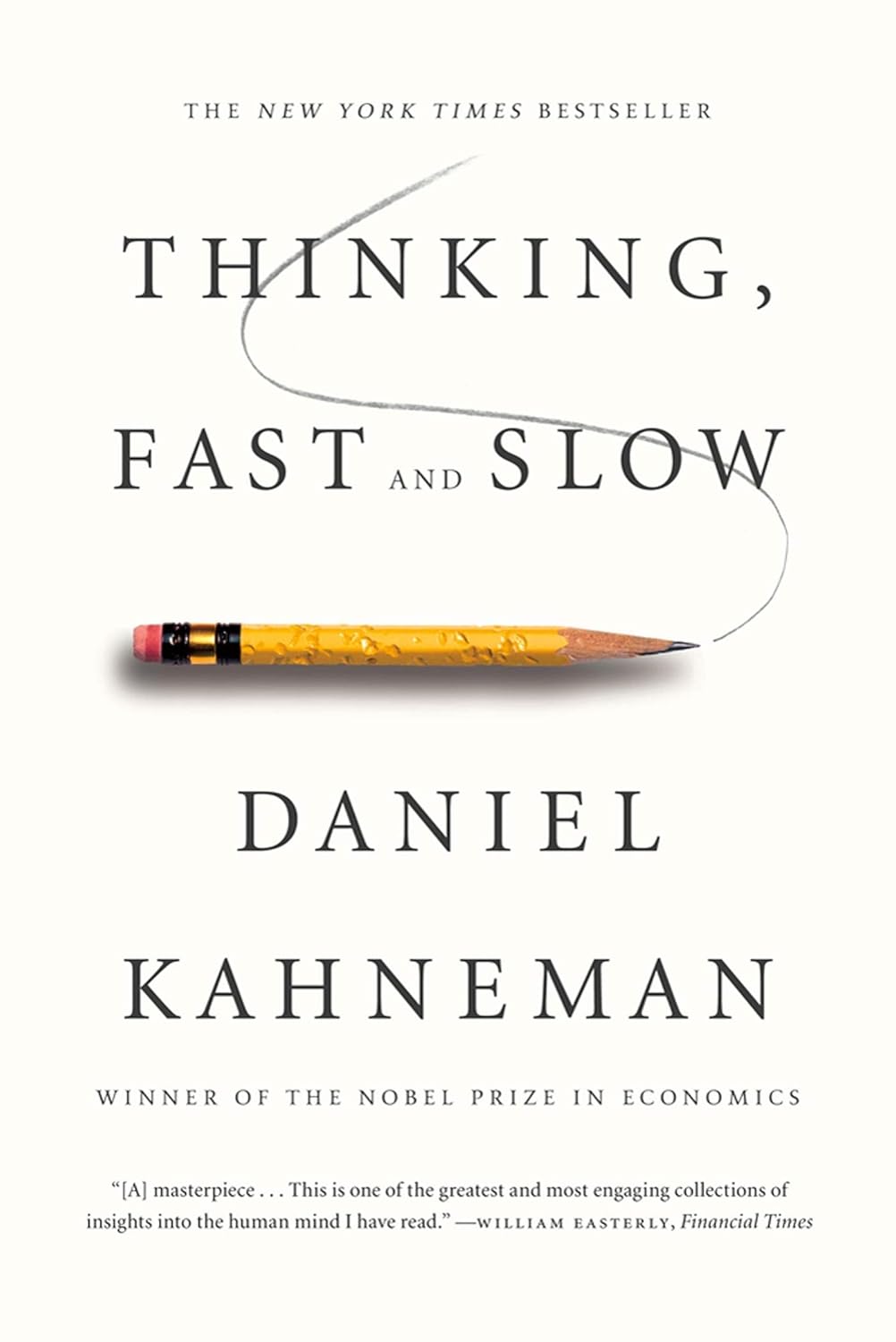
Thinking, Fast and Slow
by Daniel Kahneman
34 chapters•Concise summaries and key takeaways
Chapter 1 of 34
3% Complete
The Two Systems
Summary:
System 1 operates automatically and quickly with little or no effort and no sense of voluntary control, while System 2 allocates attention to effortful mental activities and is associated with subjective experiences of agency and choice. Their interaction produces most of our thoughts and decisions: System 1 generates impressions and feelings that System 2 can endorse, modify, or override.
Key points:
- System 1 = fast, automatic, intuitive; System 2 = slow, deliberate, effortful.
- System 1 continuously generates suggestions (impressions, intuitions, impulses) that System 2 may monitor.
- System 2 has limited capacity and is often lazy, accepting System 1’s outputs unless a reason to intervene appears.
- Many errors arise when System 1’s shortcuts are applied inappropriately and System 2 fails to correct them.
Themes & relevance:
Understanding the two-system model explains why people reliably make predictable errors and how bias and intuition shape judgment in everyday life and policy. It provides a framework for improving decisions by recognizing when to engage deliberate thinking.
Takeaway / How to use:
Be mindful of when a quick intuition might need deliberate, System 2 scrutiny.
Try one idea, then return to it.
Choose one useful idea, save a practical action, and give yourself a reason to revisit it.
Keep this book
Save it to your library and return to this review after signing in.
Save one action
Write down an idea you want to use in your work or daily life.
Come back to review
Sync your notes and review dates, then find due books on your dashboard.
14-day trial • No credit card required • Sign in with Google
Review this book
Recall prompts, personal cards, saved actions, and downloadable study notes.
Review this book
Recall prompts, personal cards, saved actions, and downloadable study notes.
Loading your saved reviews…
Share this summary
Generate a branded share card or copy a link.
Share this summary
Generate a branded share card or copy a link.
Share this reading moment
Turn your current progress into a branded share page that points people back to the summary.
Share your progress
Thinking, Fast and Slow
by Daniel Kahneman
Chapter 1 of 34. 3% of the way through this summary.
Progress
1/34
Complete
3%
Visible progress makes it easier to keep the habit alive.
ReadSprint
Share with the ReadSprint source so others can read the context.
Loading your reading streak…
Related books and topics
Authors, topics, and study links connected to this book.
Related books and topics
Authors, topics, and study links connected to this book.
Topic relationship graph
This graph keeps Thinking, Fast and Slow attached to psychology, focus, and psychology.
Current book
Thinking, Fast and Slow
topic
Psychology summaries
Browse more books in the same category and keep the reading path tight.
topic
Focus topic page
See how Thinking, Fast and Slow connects to other focus books and learning paths.
topic
Psychology topic page
See how Thinking, Fast and Slow connects to other psychology books and learning paths.
author
Daniel Kahneman
Explore Daniel Kahneman's books, related authors, and connected reading paths.
book
Man's Search for Meaning
Connects through focus and psychology themes and a similar learning intent.
book
Quiet: The Power of Introverts in a World That Can't Stop Talking
Connects through psychology themes and a similar learning intent.
learning
Best books for focus
Strengthen the attention and concentration side of this reading path.
learning
Active recall for reading
Turn high-attention books into repeatable review prompts and recall loops.
Related books
The closest book-to-book matches based on topic overlap, author proximity, and learning intent.
Related book
Man's Search for Meaning
by Viktor E. Frankl
Connects through focus and psychology themes and a similar learning intent.
Related book
Quiet: The Power of Introverts in a World That Can't Stop Talking
by Susan Cain
Connects through psychology themes and a similar learning intent.
Related book
The Psychology Of Money
by Morgan Housel
Connects through psychology themes and a similar learning intent.
Related book
The Body Keeps the Score
by Bessel van der Kolk, M.D.
Connects through psychology themes and a similar learning intent.
Similar themes
Books that reinforce the same core ideas from a different angle so the topic gets deeper, not noisier.
Theme match
Man's Search for Meaning
by Viktor E. Frankl
Shares strong focus and psychology themes, so the ideas reinforce each other instead of drifting apart.
Theme match
Quiet: The Power of Introverts in a World That Can't Stop Talking
by Susan Cain
Shares strong psychology themes, so the ideas reinforce each other instead of drifting apart.
Theme match
The Psychology Of Money
by Morgan Housel
Shares strong psychology themes, so the ideas reinforce each other instead of drifting apart.
Theme match
The Body Keeps the Score
by Bessel van der Kolk, M.D.
Shares strong psychology themes, so the ideas reinforce each other instead of drifting apart.
Recommended next reads
A practical next step if you want to keep momentum after finishing this book.
Next read
The Optimism Bias
by Tali Sharot
A good next read when you want to keep building the psychology angle from Thinking, Fast and Slow.
Next read
The Social Paradox
by William von Hippel
A good next read when you want to keep building the psychology angle from Thinking, Fast and Slow.
Next read
Blink: The Power of Thinking Without Thinking
by Malcolm Gladwell
A good next read when you want to keep building the psychology angle from Thinking, Fast and Slow.
Next read
Deep Thinking: Where Machine Intelligence Ends and Human Creativity Begins
by Garry Kasparov
A good next read when you want to keep building the psychology angle from Thinking, Fast and Slow.
Books readers also liked
Modeled from shared topics, category overlap, and nearby reading paths to surface the closest adjacent titles.
Adjacent pick
Deep Work for Distracted People: Simple Methods to Stay Focused, Think Clearly, and Finish What Matters
by MD Saly
Modeled as a nearby pick for readers following the same focus path.
Adjacent pick
The Art of Strategy: A Game Theorist's Guide to Success in Business and Life
by Avinash K. Dixit and Barry J. Nalebuff
Modeled as a nearby pick for readers following the same psychology path.
Adjacent pick
A Billion Wicked Thoughts: What the Internet Tells Us About Sexual Relationships
by Ogi Ogas and Sai Gaddam
Modeled as a nearby pick for readers following the same psychology path.
Adjacent pick
Gut Feelings: Healing the Shame-Fueled Relationship Between What You Eat and How You Feel
by Dr. Will Cole
Modeled as a nearby pick for readers following the same psychology path.
Author relationship system
Move from this author into connected writers, nearby themes, and any other books already in the ReadSprint library.
Author
Daniel Kahneman
Explore Daniel Kahneman's books, related authors, and connected reading paths.
Related author
Viktor E. Frankl
Connected through focus and psychology ideas and adjacent books.
Related author
Susan Cain
Connected through focus and psychology ideas and adjacent books.
Related author
Morgan Housel
Connected through psychology ideas and adjacent books.
Related author
Bessel van der Kolk, M.D.
Connected through psychology ideas and adjacent books.
Related author
Tali Sharot
Connected through psychology ideas and adjacent books.
Related author
William von Hippel
Connected through psychology ideas and adjacent books.
Similar themes and topic pages
Use topic hubs and category pages to keep reading depth aligned with what this book is actually about.
Category
Psychology summaries
Browse more books in the same category and keep the reading path tight.
Topic
Focus topic page
See how Thinking, Fast and Slow connects to other focus books and learning paths.
Topic
Psychology topic page
See how Thinking, Fast and Slow connects to other psychology books and learning paths.
Recommended learning pages
These pages extend the educational angle with retention, recall, and adjacent reading systems.
Best books for focus
Strengthen the attention and concentration side of this reading path.
Active recall for reading
Turn high-attention books into repeatable review prompts and recall loops.
How to remember books better
Useful when behavior, memory, and retention matter as much as selection.
How to learn faster from books
Build a tighter reading and review system for high-value nonfiction.
Reading retention hub
Explore the systems that make book ideas stick after the first read.
Learning and recall hub
Go deeper into quizzes, recall, and faster nonfiction learning workflows.
Nonfiction learning system
A full system for turning summaries, quizzes, and notes into durable knowledge.
Internal study links
Every core page for this book is one click away, which keeps the reading flow crawlable and easy to revisit.
Overview
Book overview
Use the book hub to move between summary, takeaways, quiz, and next reads.
Highlights
Summary highlights
Review memorable summary highlights that pull the argument back into focus.
Review
Takeaways
Compress the book into the practical ideas most worth keeping.
Quiz
Quiz and questions
Test yourself with retrieval prompts instead of passively rereading.
Chapters
Chapter summaries
Jump to the exact part of the book you want to revisit.
Concepts
Key concepts
Study the mental models carrying the book instead of only the chapter order.