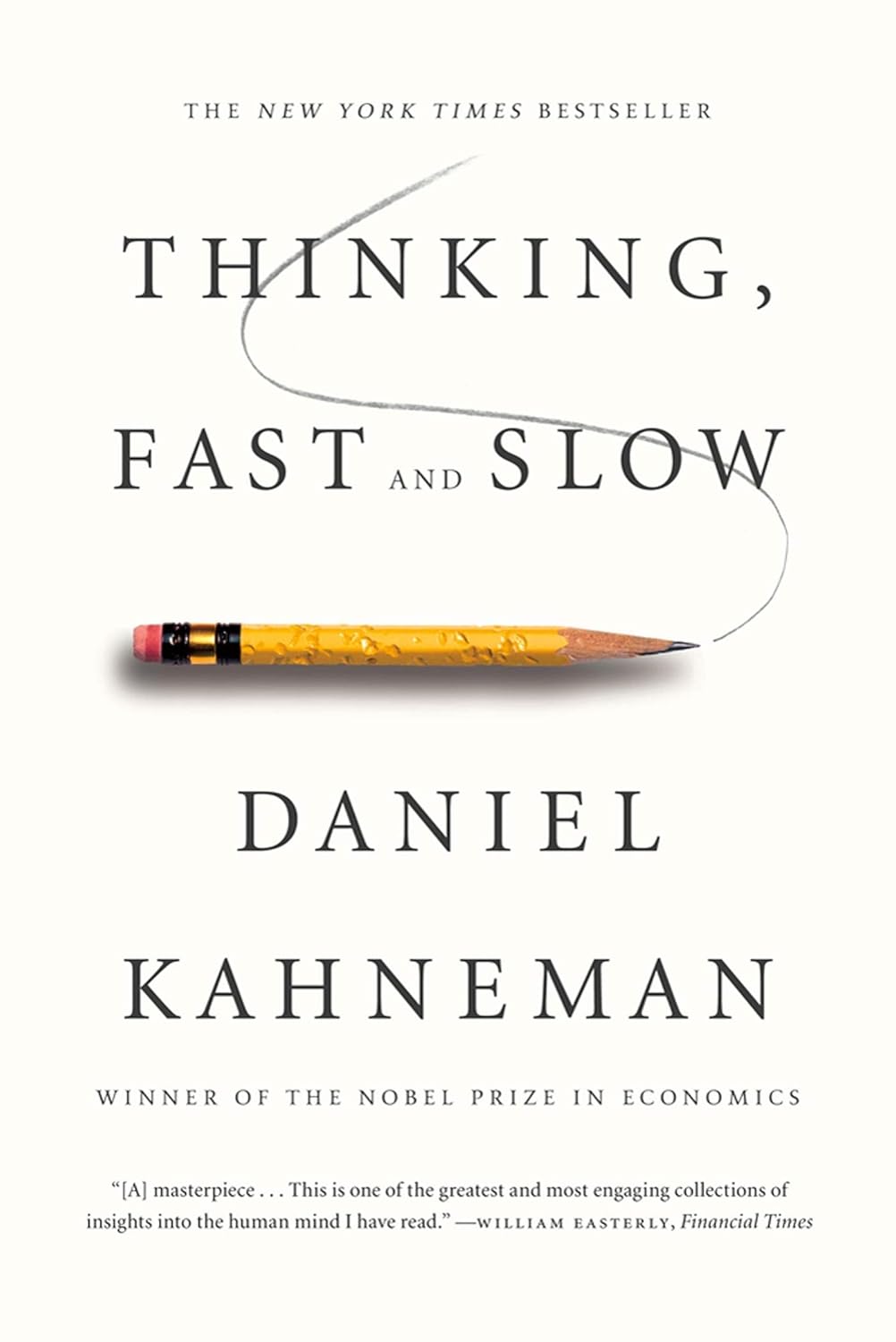
The Two Systems
Summary:
System 1 operates automatically and quickly with little or no effort and no sense of voluntary control, while System 2 allocates attention to effortful mental activities and is associated with subjective experiences of agency and choice. Their interaction produces most of our thoughts and decisions: System 1 generates impressions and feelings that System 2 can endorse, modify, or override.
Key points:
- System 1 = fast, automatic, intuitive; System 2 = slow, deliberate, effortful.
- System 1 continuously generates suggestions (impressions, intuitions, impulses) that System 2 may monitor.
- System 2 has limited capacity and is often lazy, accepting System 1’s outputs unless a reason to intervene appears.
- Many errors arise when System 1’s shortcuts are applied inappropriately and System 2 fails to correct them.
Themes & relevance:
Understanding the two-system model explains why people reliably make predictable errors and how bias and intuition shape judgment in everyday life and policy. It provides a framework for improving decisions by recognizing when to engage deliberate thinking.
Takeaway / How to use:
Be mindful of when a quick intuition might need deliberate, System 2 scrutiny.
Key points
- System 1 = fast, automatic, intuitive; System 2 = slow, deliberate, effortful.
- System 1 continuously generates suggestions (impressions, intuitions, impulses) that System 2 may monitor.
- System 2 has limited capacity and is often lazy, accepting System 1’s outputs unless a reason to intervene appears.
- Many errors arise when System 1’s shortcuts are applied inappropriately and System 2 fails to correct them.
Attention and Effort
Summary:
Mental effort and focused attention are limited and costly, and tasks requiring concentration slow down thinking and reduce the capacity for other operations. System 2 controls attention and exerts cognitive effort, producing a subjective sense of strain when performing demanding tasks.
Key points:
- Attention is a limited resource; demanding tasks consume cognitive capacity and reduce performance on concurrent tasks.
- Effortful tasks feel tiring and demand endorsement by System 2, making them unpleasant and often avoided.
- Performing mental work involves trade-offs: accuracy and depth require time and energy.
- Self-control and executive functions depend on this limited attentional capacity and can be depleted by prolonged use (discussed as 'ego depletion' in related work).
Themes & relevance:
Recognizing the costs of effort explains why people rely on heuristics and why designs that reduce unnecessary cognitive load improve performance and decision quality. It also informs task design, education, and policy interventions.
Takeaway / How to use:
Allocate focused attention deliberately and reduce distractions when accuracy matters.
Key points
- Attention is a limited resource; demanding tasks consume cognitive capacity and reduce performance on concurrent tasks.
- Effortful tasks feel tiring and demand endorsement by System 2, making them unpleasant and often avoided.
- Performing mental work involves trade-offs: accuracy and depth require time and energy.
- Self-control and executive functions depend on this limited attentional capacity and can be depleted by prolonged use (discussed as 'ego depletion' in related work).
The Lazy Controller
Summary:
System 2 is often reluctant to engage and tends to conserve effort, leading to a default reliance on System 1’s intuitive responses. This laziness explains why errors persist: System 2 will not correct mistaken intuitions unless sufficiently motivated or prompted.
Key points:
- System 2’s reluctance causes people to accept intuitive answers even when they are incorrect.
- Cognitive load, time pressure, and distractions increase reliance on mental shortcuts.
- The tendency to avoid effort leads to systematic biases and reinforces initial impressions and beliefs.
- Motivation, incentives, and prompt cues can mobilize System 2 to override intuitive errors.
Themes & relevance:
The lazy-controller idea highlights the behavioral roots of bias and overconfidence and suggests practical levers (incentives, structure, nudges) to encourage deliberation where needed.
Takeaway / How to use:
Design prompts and incentives to trigger System 2 when decisions are important.
Key points
- System 2’s reluctance causes people to accept intuitive answers even when they are incorrect.
- Cognitive load, time pressure, and distractions increase reliance on mental shortcuts.
- The tendency to avoid effort leads to systematic biases and reinforces initial impressions and beliefs.
- Motivation, incentives, and prompt cues can mobilize System 2 to override intuitive errors.
The Associative Machine
Summary:
System 1 is an associative machine that links ideas, memories, and impressions into coherent patterns, producing a narrative that feels natural and fluent. These associations create automatic inferences, primes, and emotional responses that guide behavior without conscious awareness.
Key points:
- System 1 works by activating related ideas through associative memory and spreading activation.
- Priming effects show how subtle cues can influence thought, preferences, and actions.
- Coherence-seeking results in constructed stories that may omit uncertainty and conflicting evidence.
- Associative responses are rapid and often shape beliefs and judgments before System 2 intervenes.
Themes & relevance:
The associative nature of thought explains susceptibility to framing, priming, and narrative bias, with implications for marketing, communication, and legal or organizational decision contexts.
Takeaway / How to use:
Be aware of how context and priming shape your impressions and adjust the environment to reduce unwanted influence.
Key points
- System 1 works by activating related ideas through associative memory and spreading activation.
- Priming effects show how subtle cues can influence thought, preferences, and actions.
- Coherence-seeking results in constructed stories that may omit uncertainty and conflicting evidence.
- Associative responses are rapid and often shape beliefs and judgments before System 2 intervenes.
Cognitive Ease
Summary:
Cognitive ease—how fluent and effortless information feels—influences belief, judgment, and willingness to accept statements as true. Familiar, clear, and simple information produces positive feelings and reduces skepticism, while cognitive strain triggers more careful scrutiny.
Key points:
- Familiarity, clear fonts, repetition, and priming increase cognitive ease and perceived truthfulness.
- Cognitive strain signals difficulty and prompts System 2 to engage, improving skepticism and analytic thinking.
- Mood and ease affect risk assessment, confidence, and persuasion.
- Designers and communicators can exploit ease to increase acceptance; conversely, inducing mild strain can reduce error.
Themes & relevance:
Cognitive ease links subjective feeling to epistemic judgments and shows practical ways to shape perception, for better or worse, in education, media, and policy.
Takeaway / How to use:
Introduce mild cognitive strain (e.g., pose a question requiring thought) to reduce acceptance of intuitive falsehoods.
Key points
- Familiarity, clear fonts, repetition, and priming increase cognitive ease and perceived truthfulness.
- Cognitive strain signals difficulty and prompts System 2 to engage, improving skepticism and analytic thinking.
- Mood and ease affect risk assessment, confidence, and persuasion.
- Designers and communicators can exploit ease to increase acceptance; conversely, inducing mild strain can reduce error.
Norms, Surprises, and Causes
Summary:
System 1 constantly evaluates events against norms and expectations; surprising events trigger searches for causes and prompt causal explanations. Our minds prefer simple, coherent causal stories, often overlooking statistical or base-rate information.
Key points:
- Expectations and norms form a baseline; deviations produce surprise and rapid causal inference.
- People favor simple, plausible causal stories even when chance or complex explanations are more accurate.
- The preference for causal narratives drives hindsight bias and overinterpretation of random events.
- Statistical thinking and base rates are often neglected in favor of vivid causal accounts.
Themes & relevance:
This chapter clarifies why people over-attribute meaning and causality in noisy environments and underscores the need for statistical reasoning in domains like medicine, law, and finance.
Takeaway / How to use:
When surprised, explicitly consider statistical explanations and base rates before leaping to causal stories.
Key points
- Expectations and norms form a baseline; deviations produce surprise and rapid causal inference.
- People favor simple, plausible causal stories even when chance or complex explanations are more accurate.
- The preference for causal narratives drives hindsight bias and overinterpretation of random events.
- Statistical thinking and base rates are often neglected in favor of vivid causal accounts.
A Machine for Jumping to Conclusions
Summary:
System 1 rapidly forms coherent impressions from limited evidence (WYSIATI: What You See Is All There Is), leading to quick judgments that often ignore missing information and alternative hypotheses. These jumps create overconfidence in judgments derived from incomplete data.
Key points:
- WYSIATI: people form opinions based on the information available, neglecting what is absent.
- Coherence and fluency make a story more believable regardless of its completeness.
- Rapid coherence-seeking produces overconfidence and underestimation of uncertainty.
- Correcting these errors requires deliberately considering missing information and opposing scenarios.
Themes & relevance:
The tendency to jump to conclusions explains many cognitive biases and errors in forecasting, diagnosis, and everyday reasoning, stressing the importance of seeking disconfirming evidence.
Takeaway / How to use:
Actively search for missing data and disconfirming evidence before finalizing judgments.
Key points
- WYSIATI: people form opinions based on the information available, neglecting what is absent.
- Coherence and fluency make a story more believable regardless of its completeness.
- Rapid coherence-seeking produces overconfidence and underestimation of uncertainty.
- Correcting these errors requires deliberately considering missing information and opposing scenarios.
How Judgments Happen
Summary:
Judgments arise from intuitive impressions produced by System 1 and are often shaped by attribute substitution—when a difficult question is replaced by an easier one without conscious awareness. System 2 usually endorses these impressions unless it intervenes.
Key points:
- People substitute simpler intuitive answers for complex questions (attribute substitution), e.g., answering “How happy are you?” by recalling recent events.
- Heuristics like availability and representativeness are forms of substitution that lead to systematic errors.
- Confidence in judgments often reflects the ease with which a coherent story can be constructed, not the actual accuracy.
- Deliberate, analytical checks help detect when substitution has occurred.
Themes & relevance:
This chapter connects heuristics to specific mental processes and shows practical routes to reduce error by recognizing substitution and prompting analytical thinking.
Takeaway / How to use:
Pause and reframe hard questions to avoid substituting an easier, misleading one.
Key points
- People substitute simpler intuitive answers for complex questions (attribute substitution), e.g., answering “How happy are you?” by recalling recent events.
- Heuristics like availability and representativeness are forms of substitution that lead to systematic errors.
- Confidence in judgments often reflects the ease with which a coherent story can be constructed, not the actual accuracy.
- Deliberate, analytical checks help detect when substitution has occurred.
Answering an Easier Question
Summary:
When faced with a difficult question, System 1 often substitutes an easier one and answers that instead, producing a quick intuitive response that feels appropriate. This attribute substitution explains many biases where judgments are driven by immediate impressions rather than careful analysis.
Key points:
- Attribute substitution: a hard target question is replaced by an easier, related question answered by System 1.
- Intuitive answers come from impressions, feelings, and readily available attributes rather than analytical reasoning.
- System 2 is lazy and often accepts System 1's substitute answers without thorough checking.
- This process produces systematic errors when the substituted question diverges from the original.
Themes & relevance:
This chapter highlights how fast intuitive processes shape judgments and lead to predictable biases in everyday decisions. Recognizing substitution helps explain errors in polling, evaluation, and personal judgments.
Takeaway / How to use:
When a quick intuition arises for a complex question, pause and ask the original, harder question explicitly.
Key points
- Attribute substitution: a hard target question is replaced by an easier, related question answered by System 1.
- Intuitive answers come from impressions, feelings, and readily available attributes rather than analytical reasoning.
- System 2 is lazy and often accepts System 1's substitute answers without thorough checking.
- This process produces systematic errors when the substituted question diverges from the original.
The Law of Small Numbers
Summary:
People expect small samples to resemble the population, leading to overinterpretation of random variation and spurious patterns. This misperception fuels mistaken beliefs about luck, skill, and trends from limited data.
Key points:
- Small samples have high variability; extreme outcomes are common and not evidence of stable effects.
- Observers extrapolate from small samples, producing erroneous conclusions about patterns or skill.
- Regression to the mean explains why extreme performances tend to be followed by more average results.
- Misread small-sample evidence affects fields from medicine to sports and business.
Themes & relevance:
The chapter underscores the importance of statistical thinking and skepticism about conclusions drawn from limited data. Appreciating sample size reduces errors in forecasting and evaluation.
Takeaway / How to use:
Insist on adequate sample sizes and expect regression to the mean before inferring causes from short-run results.
Key points
- Small samples have high variability; extreme outcomes are common and not evidence of stable effects.
- Observers extrapolate from small samples, producing erroneous conclusions about patterns or skill.
- Regression to the mean explains why extreme performances tend to be followed by more average results.
- Misread small-sample evidence affects fields from medicine to sports and business.
Anchors
Summary:
Numerical estimates are strongly influenced by an initial anchor, even when that anchor is arbitrary, because people insufficiently adjust from the anchor. Anchoring operates through intuitive activation and biased adjustment by System 2.
Key points:
- Arbitrary anchors (e.g., random numbers) systematically shift subsequent estimates.
- Adjustment is typically insufficient: people start from the anchor and fail to move far enough toward an unbiased estimate.
- Anchoring effects arise from both associative activation in System 1 and effort-limited adjustments by System 2.
- Anchoring plays a powerful role in negotiations, pricing, and judicial decisions.
Themes & relevance:
Anchoring shows how incidental information can distort judgment across domains, emphasizing the need to control initial reference points. Awareness of anchors helps reduce manipulation and improve estimates.
Takeaway / How to use:
Avoid exposure to irrelevant anchors and deliberately consider a wide range of alternative values before committing to an estimate.
Key points
- Arbitrary anchors (e.g., random numbers) systematically shift subsequent estimates.
- Adjustment is typically insufficient: people start from the anchor and fail to move far enough toward an unbiased estimate.
- Anchoring effects arise from both associative activation in System 1 and effort-limited adjustments by System 2.
- Anchoring plays a powerful role in negotiations, pricing, and judicial decisions.
The Science of Availability
Summary:
The availability heuristic leads people to judge the frequency or probability of events by the ease with which examples come to mind. Factors like vividness, recency, and retrievability bias these judgments away from objective statistics.
Key points:
- Ease of recall or mental availability is used as a proxy for probability or frequency.
- Salient, dramatic, or recent events are overestimated; invisible or complex events are underestimated.
- Media coverage and vivid anecdotes amplify availability and distort public perception.
- Availability interacts with other heuristics, producing compound biases in risk assessment.
Themes & relevance:
This chapter connects cognitive processes to how people form beliefs about what is common or dangerous, highlighting limits of intuition for probabilistic reality. Correcting for availability improves judgment in policy and personal decisions.
Takeaway / How to use:
When assessing frequency or risk, check objective data rather than relying on how easily examples come to mind.
Key points
- Ease of recall or mental availability is used as a proxy for probability or frequency.
- Salient, dramatic, or recent events are overestimated; invisible or complex events are underestimated.
- Media coverage and vivid anecdotes amplify availability and distort public perception.
- Availability interacts with other heuristics, producing compound biases in risk assessment.
Availability, Emotion, and Risk
Summary:
Emotional reactions amplify availability: feelings caused by vivid or frightening events make risks seem larger and more probable. The affective response often drives judgments of risk more than statistical reasoning.
Key points:
- The affect heuristic links emotional impressions (good/bad) to judgments of benefits and risks.
- Media and anecdote-driven salience inflate fears of rare but dramatic risks (e.g., terrorism, plane crashes).
- Emotional availability leads to distorted policy and personal decisions, favoring actions that reduce dread rather than expected harm.
- Risk perception is shaped more by what evokes strong feelings than by objective probabilities.
Themes & relevance:
The chapter shows how emotion and availability together skew risk assessment, with major implications for public policy, health behavior, and communication. Understanding this helps design better risk communication and decisions.
Takeaway / How to use:
Separate emotional reactions from probabilistic evidence when evaluating risks and prioritize actions based on expected outcomes.
Key points
- The affect heuristic links emotional impressions (good/bad) to judgments of benefits and risks.
- Media and anecdote-driven salience inflate fears of rare but dramatic risks (e.g., terrorism, plane crashes).
- Emotional availability leads to distorted policy and personal decisions, favoring actions that reduce dread rather than expected harm.
- Risk perception is shaped more by what evokes strong feelings than by objective probabilities.
The Illusion of Understanding
Summary:
People create coherent narratives to explain events, leading to an illusion of understanding that overlooks randomness and complexity. Hindsight and storytelling make past events seem more predictable and inevitable than they were.
Key points:
- Narrative fallacy: simple, coherent stories are preferred even if they omit uncertainty and noise.
- Hindsight bias increases confidence in explanations and reduces recognition of unpredictability.
- The tendency to build stories leads to overconfidence about causes and future events.
- Coherence and causality are often constructed retrospectively from limited information.
Themes & relevance:
This chapter emphasizes the human preference for stories over statistical ambiguity, which undermines accurate understanding and planning. Recognizing narrative-driven illusions helps maintain humility about explanations.
Takeaway / How to use:
Introduce alternative scenarios and actively look for missing evidence before accepting a neat explanation.
Key points
- Narrative fallacy: simple, coherent stories are preferred even if they omit uncertainty and noise.
- Hindsight bias increases confidence in explanations and reduces recognition of unpredictability.
- The tendency to build stories leads to overconfidence about causes and future events.
- Coherence and causality are often constructed retrospectively from limited information.
The Illusion of Validity
Summary:
Confidence in judgment often persists despite evidence of low predictive validity; people mistake coherent, consistent impressions for accurate prediction. Overconfidence grows when feedback is misleading or environments are noisy.
Key points:
- Subjective confidence is a poor indicator of actual predictive accuracy.
- Coherent patterns and plausible stories create the feeling of validity without supporting data.
- Experts often overestimate their predictive power, especially in environments with weak signals and high noise.
- Simple statistical rules often outperform expert intuition in predictive tasks.
Themes & relevance:
The chapter warns against trusting appearances of skill and coherence as proof of valid judgment, underscoring the value of objective validation and cautious interpretation of confidence. It has strong implications for hiring, forecasting, and assessment.
Takeaway / How to use:
Test judgments against out-of-sample performance and prefer validated rules over unaudited intuition.
Key points
- Subjective confidence is a poor indicator of actual predictive accuracy.
- Coherent patterns and plausible stories create the feeling of validity without supporting data.
- Experts often overestimate their predictive power, especially in environments with weak signals and high noise.
- Simple statistical rules often outperform expert intuition in predictive tasks.
Intuitions vs. Formulas
Summary:
Statistical formulas and algorithms generally outperform human experts for prediction because they apply consistent, unbiased rules to available information. Expert intuition can excel only in environments that are regular and provide immediate, informative feedback.
Key points:
- Algorithms produce more reliable, consistent predictions than unaided human judgment.
- Human intuition succeeds when the environment is stable, regular, and feedback is swift and clear.
- Combining algorithmic rules with expert oversight often yields the best practical outcomes.
- Resistance to formulas is psychological; adopting simple rules improves decisions even when experts distrust them.
Themes & relevance:
This chapter promotes systematic decision methods over faith in unaudited intuition, relevant to medicine, finance, and management. Embracing formulas reduces error and improves predictability.
Takeaway / How to use:
Use simple predictive algorithms for routine judgments and reserve intuition for domains with proven immediate feedback.
Key points
- Algorithms produce more reliable, consistent predictions than unaided human judgment.
- Human intuition succeeds when the environment is stable, regular, and feedback is swift and clear.
- Combining algorithmic rules with expert oversight often yields the best practical outcomes.
- Resistance to formulas is psychological; adopting simple rules improves decisions even when experts distrust them.
Expert Intuition: When Can We Trust It?
Summary:
Expert intuition can be reliable in environments that are highly regular and where experts receive immediate, accurate feedback so they can learn patterns. In noisy or unpredictable domains, intuitive judgments often fail and produce overconfidence.
Key points:
- Intuition is pattern recognition learned through prolonged practice with consistent feedback.
- Two conditions for trustworthy expertise: an environment with regularities and rapid, unambiguous feedback.
- In environments lacking these conditions (finance, clinical diagnosis without feedback) intuition misleads.
- Experts often show overconfidence and can’t explain decisions beyond giving rationalizations.
- Algorithms and rules often outperform human intuition in noisy settings.
Themes & relevance:
Distinguishing when to rely on intuition versus rules or algorithms is essential for better decision making in business, medicine, and public policy. Recognizing limits of expertise reduces costly errors and overconfidence.
Takeaway / How to use:
Use rules, statistical models, or outside checks in unpredictable domains and reserve intuitive judgment for stable, feedback-rich environments.
Key points
- Intuition is pattern recognition learned through prolonged practice with consistent feedback.
- Two conditions for trustworthy expertise: an environment with regularities and rapid, unambiguous feedback.
- In environments lacking these conditions (finance, clinical diagnosis without feedback) intuition misleads.
- Experts often show overconfidence and can’t explain decisions beyond giving rationalizations.
- Algorithms and rules often outperform human intuition in noisy settings.
The Outside View
Summary:
The outside view improves forecasting by grounding predictions in the statistical distribution of similar cases (the reference class) rather than idiosyncratic details of the case at hand. Relying on the outside view counters the planning fallacy and overoptimistic inside-view narratives.
Key points:
- Inside view: focus on the specific case, leading to unique-story forecasts and optimism.
- Outside view: identify a relevant reference class and use its base rate to predict likely outcomes.
- Reference class forecasting reduces bias from unrepresentative anecdotes and wishful thinking.
- Combining inside and outside views yields better calibrated predictions than either alone.
- Institutionalizing outside-view checks (e.g., pre-mortems) improves planning and accountability.
Themes & relevance:
Applying base-rate information counters systematic optimism and underestimation of costs and timelines in projects, improving forecasts across domains. The outside view is a practical tool for managers, forecasters, and planners.
Takeaway / How to use:
Before committing to a plan, compare it to the outcomes of similar past projects to adjust your forecast.
Key points
- Inside view: focus on the specific case, leading to unique-story forecasts and optimism.
- Outside view: identify a relevant reference class and use its base rate to predict likely outcomes.
- Reference class forecasting reduces bias from unrepresentative anecdotes and wishful thinking.
- Combining inside and outside views yields better calibrated predictions than either alone.
- Institutionalizing outside-view checks (e.g., pre-mortems) improves planning and accountability.
The Engine of Capitalism
Summary:
Optimism and overconfidence drive entrepreneurship and investment, producing innovation and economic growth despite many failures. The same optimism that fuels the engine of capitalism also causes systematic forecasting errors and costly mistakes.
Key points:
- Overoptimism and overconfidence lead entrepreneurs to start risky projects that statisticians might predict to fail.
- The planning fallacy and neglect of base rates cause underestimation of time, costs, and failure rates.
- Although many ventures fail, the small fraction of substantial successes can justify broad risk-taking at the aggregate level.
- Incentives, competition, and a tolerance for failure shape the economic benefits of optimistic risk taking.
- Policy and funding decisions can be improved by applying the outside view and better accountability.
Themes & relevance:
Understanding the psychological roots of entrepreneurial risk explains both the vitality and inefficiencies of market economies and suggests ways to balance encouragement of innovation with realistic appraisal.
Takeaway / How to use:
Recognize optimism’s role in creation but apply outside-view checks before allocating resources to new ventures.
Key points
- Overoptimism and overconfidence lead entrepreneurs to start risky projects that statisticians might predict to fail.
- The planning fallacy and neglect of base rates cause underestimation of time, costs, and failure rates.
- Although many ventures fail, the small fraction of substantial successes can justify broad risk-taking at the aggregate level.
- Incentives, competition, and a tolerance for failure shape the economic benefits of optimistic risk taking.
- Policy and funding decisions can be improved by applying the outside view and better accountability.
Prospect Theory
Summary:
Prospect Theory describes how people evaluate gains and losses relative to a reference point, showing that they are loss-averse and exhibit diminishing sensitivity to outcomes. It replaces expected utility with a value function that is concave for gains, convex for losses, and steeper for losses than gains, combined with nonlinear probability weighting.
Key points:
- Preferences are reference-dependent: outcomes are framed as gains or losses relative to a reference point.
- Value function: concave for gains (risk aversion), convex for losses (risk seeking), and steeper for losses (loss aversion).
- People overweight small probabilities and underweight moderate-to-large probabilities via a probability-weighting function.
- Prospect Theory accounts for systematic deviations from expected-utility theory in choices under risk.
- The theory has broad predictive power for economic and behavioral phenomena like insurance, gambling, and investment behavior.
Themes & relevance:
Prospect Theory provides a descriptive foundation for understanding real-world risk preferences and framing effects, reshaping models in economics, finance, and public policy.
Takeaway / How to use:
Frame choices by considering reference points and probability weighting to predict or influence decision behavior.
Key points
- Preferences are reference-dependent: outcomes are framed as gains or losses relative to a reference point.
- Value function: concave for gains (risk aversion), convex for losses (risk seeking), and steeper for losses (loss aversion).
- People overweight small probabilities and underweight moderate-to-large probabilities via a probability-weighting function.
- Prospect Theory accounts for systematic deviations from expected-utility theory in choices under risk.
- The theory has broad predictive power for economic and behavioral phenomena like insurance, gambling, and investment behavior.
The Endowment Effect
Summary:
The endowment effect describes people’s tendency to value items more once they own them, typically demanding more to give them up than they would pay to acquire them. This bias is closely tied to loss aversion and reference dependence from Prospect Theory.
Key points:
- Ownership creates a new reference point; giving up an owned item is perceived as a loss and felt more strongly than an equivalent gain.
- Experimental evidence (e.g., mug studies) shows large gaps between willingness to accept and willingness to pay for identical objects.
- The effect influences market behavior, bargaining, and consumer choice, reducing trade and efficiency.
- Endowment effects can be mitigated by reframing ownership or implementing policies that reduce attachment (e.g., trial periods).
Themes & relevance:
Recognizing the endowment effect helps explain resistance to market exchange, negotiation impasses, and valuation anomalies in consumer behavior.
Takeaway / How to use:
When negotiating or setting prices, account for ownership-induced valuation differences and use neutral reference frames when possible.
Key points
- Ownership creates a new reference point; giving up an owned item is perceived as a loss and felt more strongly than an equivalent gain.
- Experimental evidence (e.g., mug studies) shows large gaps between willingness to accept and willingness to pay for identical objects.
- The effect influences market behavior, bargaining, and consumer choice, reducing trade and efficiency.
- Endowment effects can be mitigated by reframing ownership or implementing policies that reduce attachment (e.g., trial periods).
Bad Events
Summary:
Bad events (losses, negative outcomes) typically have a larger psychological impact than equivalent good events, shaping choices and attention. This asymmetry leads to heightened avoidance of losses, stronger memory for negative outcomes, and disproportionate behavioral responses.
Key points:
- Losses loom larger than gains: people are more motivated to avoid negative outcomes than to pursue equal-sized gains.
- Negative events attract more attention, are remembered more vividly, and influence future risk-taking and policy preferences.
- The disproportionate impact of bad events can cause excessive risk aversion, insurance purchase, or avoidance behaviors.
- Emotion-driven overreactions to negatives can distort long-term planning and lead to scope neglect.
Themes & relevance:
Understanding the dominant role of bad events clarifies common biases in personal finance, public policy, and organizational risk management.
Takeaway / How to use:
Explicitly weigh the disproportionate impact of losses when designing decisions or policies to avoid overreacting to isolated negatives.
Key points
- Losses loom larger than gains: people are more motivated to avoid negative outcomes than to pursue equal-sized gains.
- Negative events attract more attention, are remembered more vividly, and influence future risk-taking and policy preferences.
- The disproportionate impact of bad events can cause excessive risk aversion, insurance purchase, or avoidance behaviors.
- Emotion-driven overreactions to negatives can distort long-term planning and lead to scope neglect.
The Fourfold Pattern
Summary:
The Fourfold Pattern summarizes how risk attitudes vary with outcome sign (gain/loss) and probability: people exhibit four distinct behaviors depending on whether probabilities are high or low and outcomes are gains or losses. This pattern follows from the combination of loss aversion and nonlinear probability weighting.
Key points:
- For gains: people are risk-averse with high probabilities (prefer sure gains) and risk-seeking with low probabilities (buy lotteries).
- For losses: people are risk-seeking with high probabilities (avoid sure losses by gambling) and risk-averse with low probabilities (buy insurance against small-probability losses).
- The interaction arises because small probabilities are overweighted while large probabilities are underweighted, combined with the S-shaped value function.
- The pattern explains seemingly inconsistent behaviors like simultaneously buying both insurance and lottery tickets.
Themes & relevance:
The Fourfold Pattern links descriptive regularities to practical behaviors in markets and personal finance, helping predict when people will accept or avoid risk.
Takeaway / How to use:
Anticipate risk preferences by considering both the sign of the outcome and whether the probability involved is perceived as small or large.
Key points
- For gains: people are risk-averse with high probabilities (prefer sure gains) and risk-seeking with low probabilities (buy lotteries).
- For losses: people are risk-seeking with high probabilities (avoid sure losses by gambling) and risk-averse with low probabilities (buy insurance against small-probability losses).
- The interaction arises because small probabilities are overweighted while large probabilities are underweighted, combined with the S-shaped value function.
- The pattern explains seemingly inconsistent behaviors like simultaneously buying both insurance and lottery tickets.
Rare Events
Summary:
People tend to overweight rare events, making them over-influential in decision making; yet learning about rare events is difficult because of sparse data and poor feedback. This leads to patterns like over-purchasing insurance and overvaluing lottery tickets, despite low objective probabilities.
Key points:
- Small probabilities are typically overweighted, so rare events loom larger than their frequency warrants.
- Overweighting interacts with availability and emotional salience, amplifying fear or hope about rare outcomes.
- Poor feedback and sample-size neglect make it hard to update beliefs about rare events accurately.
- Policy and market outcomes (insurance markets, safety regulations) reflect public sensitivity to rare but salient risks.
Themes & relevance:
Recognizing misperception of rare events improves communication, risk management, and policy design by aligning perceived and objective risks.
Takeaway / How to use:
When assessing rare risks, rely on base rates and statistical evidence rather than vivid anecdotes to guide decisions.
Key points
- Small probabilities are typically overweighted, so rare events loom larger than their frequency warrants.
- Overweighting interacts with availability and emotional salience, amplifying fear or hope about rare outcomes.
- Poor feedback and sample-size neglect make it hard to update beliefs about rare events accurately.
- Policy and market outcomes (insurance markets, safety regulations) reflect public sensitivity to rare but salient risks.
Risk Policies
Summary:
People are poor at making one-off risk decisions but can perform better by adopting simple risk policies for repeated situations. Kahneman argues that consistent rules (e.g., always insure, diversify, or refuse certain gambles) reduce the influence of noise and bias in individual choices.
Key points:
- Individual risk choices are often inconsistent and influenced by context and mood.
- Adopting ex-ante policies transforms many one-off decisions into repeated decisions that favor expected-value considerations.
- Rules reduce costly errors from narrow framing, loss aversion, and overreaction to rare events.
- Organizational and personal policies can be designed to balance risk across time and people.
Themes & relevance:
Encourages shifting from case-by-case intuition to rule-based decision making to improve outcomes in finance, insurance, and everyday risks. This is relevant for managers, policymakers, and individuals who face recurrent risky choices.
Takeaway / How to use:
Create simple, repeatable risk policies for recurring decisions to reduce bias and improve consistency.
Key points
- Individual risk choices are often inconsistent and influenced by context and mood.
- Adopting ex-ante policies transforms many one-off decisions into repeated decisions that favor expected-value considerations.
- Rules reduce costly errors from narrow framing, loss aversion, and overreaction to rare events.
- Organizational and personal policies can be designed to balance risk across time and people.
Keeping Score
Summary:
Kahneman examines how people mentally account outcomes and keep score, often evaluating gains and losses relative to shifting reference points. Mental accounting leads to partitioning outcomes, which produces predictable deviations from utility-maximizing behavior.
Key points:
- People evaluate outcomes in separate mental accounts rather than integrating them into total wealth.
- Narrow bracketing and framing cause different evaluations for identical composite outcomes (e.g., segregating gains, integrating losses).
- Hedonic editing: individuals rearrange outcomes mentally to maximize perceived pleasure (e.g., ‘‘silver lining’’ effect).
- Keeping score can lead to inconsistent risk-taking and suboptimal pooling of risks.
Themes & relevance:
Highlights cognitive bookkeeping as a source of systematic choice errors that affect spending, investing, and how people respond to mixed gains and losses. Understanding mental accounts helps design better financial and behavioral interventions.
Takeaway / How to use:
Aggregate related outcomes before judging them to avoid misleading separations that distort decisions.
Key points
- People evaluate outcomes in separate mental accounts rather than integrating them into total wealth.
- Narrow bracketing and framing cause different evaluations for identical composite outcomes (e.g., segregating gains, integrating losses).
- Hedonic editing: individuals rearrange outcomes mentally to maximize perceived pleasure (e.g., ‘‘silver lining’’ effect).
- Keeping score can lead to inconsistent risk-taking and suboptimal pooling of risks.
The Engine of Choice
Summary:
This chapter describes the psychological mechanisms that produce choices, emphasizing substitution, attribute framing, and the interaction of intuitive and deliberative processes. Kahneman explains how System 1 frequently supplies impressions that System 2 endorses or rationalizes, shaping preference formation.
Key points:
- Choices are often driven by attribute substitution: a hard judgment is replaced by an easier one without awareness.
- System 1 generates suggestions (intuitions); System 2 may accept, rationalize, or modify them but is often lazy.
- Preferences can be constructed on the spot rather than revealed, making them sensitive to context and framing.
- The architecture of judgment explains many anomalies in choice (e.g., inconsistent risk preferences).
Themes & relevance:
Shows that the cognitive ‘‘engine’’ behind decisions is fallible and context-dependent, which matters for designing choice environments and for understanding why people contradict their own long-term goals. This framework underpins much of behavioral economics and decision architecture.
Takeaway / How to use:
Slow down and surface the hard question behind an intuition before committing to a choice.
Key points
- Choices are often driven by attribute substitution: a hard judgment is replaced by an easier one without awareness.
- System 1 generates suggestions (intuitions); System 2 may accept, rationalize, or modify them but is often lazy.
- Preferences can be constructed on the spot rather than revealed, making them sensitive to context and framing.
- The architecture of judgment explains many anomalies in choice (e.g., inconsistent risk preferences).
Choices, Values, and Frames
Summary:
Kahneman develops prospect theory’s components—reference dependence, loss aversion, and probability weighting—and shows how framing changes choices. Small changes in description or reference point can flip preferences, demonstrating that values are constructed, not fixed.
Key points:
- Value is defined over gains and losses relative to a reference point, not over final states.
- The value function is concave for gains, convex for losses, and steeper for losses (loss aversion).
- Probability weighting causes people to overweight small probabilities and underweight moderate-to-high probabilities.
- Framing effects arise because editing and evaluation stages alter the perceived reference and attributes of outcomes.
Themes & relevance:
Explains why logically equivalent descriptions yield different decisions, affecting policy, marketing, and risk communication. Recognizing framing influences helps predict and mitigate inconsistent choices.
Takeaway / How to use:
Reframe important decisions in multiple, neutral ways to uncover how framing may bias your preference.
Key points
- Value is defined over gains and losses relative to a reference point, not over final states.
- The value function is concave for gains, convex for losses, and steeper for losses (loss aversion).
- Probability weighting causes people to overweight small probabilities and underweight moderate-to-high probabilities.
- Framing effects arise because editing and evaluation stages alter the perceived reference and attributes of outcomes.
The Psychology of Risk
Summary:
This chapter analyzes how people perceive and respond to risk, integrating prospect theory insights about probability distortion and the certainty effect. Kahneman shows that emotional and cognitive biases shape risk attitudes in insurance, gambling, and public policy.
Key points:
- The certainty effect: people overweight outcomes labeled ‘‘certain’’ relative to merely probable ones.
- Small probabilities are often overweighted (favoring lotteries) while moderate-to-high probabilities are underweighted.
- Loss aversion and reference dependence amplify risk aversion for potential losses and create demand for insurance.
- Context, vividness, and affect can distort risk perception beyond objective probabilities.
Themes & relevance:
Connects cognitive biases to real-world behaviors like buying insurance, playing lotteries, and policy responses to rare hazards, informing better risk communication and regulation. Understanding these biases improves design of incentives and public information.
Takeaway / How to use:
When evaluating risky options, translate probabilities into consistent, comparable terms and check for overweighting of rare events.
Key points
- The certainty effect: people overweight outcomes labeled ‘‘certain’’ relative to merely probable ones.
- Small probabilities are often overweighted (favoring lotteries) while moderate-to-high probabilities are underweighted.
- Loss aversion and reference dependence amplify risk aversion for potential losses and create demand for insurance.
- Context, vividness, and affect can distort risk perception beyond objective probabilities.
Two Selves
Summary:
Kahneman introduces the distinction between the experiencing self (lived moment-to-moment) and the remembering self (the story that evaluates experiences). These two selves can disagree about what is best, because memory emphasizes peaks and endings and largely ignores duration.
Key points:
- The experiencing self feels momentary utility; the remembering self constructs an evaluative summary used for future choices.
- Peak-end rule: remembered utility is disproportionately influenced by the most intense moments and the end of an experience.
- Duration neglect: length of an experience often has little impact on remembered utility.
- Conflicts between the two selves lead people to make choices that favor memory-friendly experiences over total experienced well-being.
Themes & relevance:
Reveals why people choose vacations, treatments, and life paths that optimize remembered satisfaction rather than momentary happiness, with implications for healthcare, policy, and personal planning. Recognizing the split helps reconcile seemingly irrational choices.
Takeaway / How to use:
Decide whether you are optimizing for experience or memory before making choices that affect well-being.
Key points
- The experiencing self feels momentary utility; the remembering self constructs an evaluative summary used for future choices.
- Peak-end rule: remembered utility is disproportionately influenced by the most intense moments and the end of an experience.
- Duration neglect: length of an experience often has little impact on remembered utility.
- Conflicts between the two selves lead people to make choices that favor memory-friendly experiences over total experienced well-being.
Life as a Story
Summary:
Kahneman argues that the remembering self organizes life into a narrative where beginnings, peaks, and ends determine overall evaluation of events and life episodes. Life satisfaction judgments follow the patterns of retrospective evaluation rather than continuous experience.
Key points:
- The remembering self treats life as a sequence of episodes and evaluates them as a coherent story with salient moments.
- Changes, turning points, and endings weigh heavily in life evaluations and choices about the future.
- People often prefer a coherent narrative even when it contradicts aggregate experienced well-being.
- Public policy and personal decisions that target remembered life (e.g., ceremonies, transitions) can have outsized effects on perceived life quality.
Themes & relevance:
Emphasizes narrative structure as central to human judgment about life satisfaction, explaining why interventions that alter the story (rituals, milestones) change perceived well-being. This perspective guides how societies and individuals shape meaningful lives.
Takeaway / How to use:
Shape important experiences so their peaks and endings reflect the story you want to remember.
Key points
- The remembering self treats life as a sequence of episodes and evaluates them as a coherent story with salient moments.
- Changes, turning points, and endings weigh heavily in life evaluations and choices about the future.
- People often prefer a coherent narrative even when it contradicts aggregate experienced well-being.
- Public policy and personal decisions that target remembered life (e.g., ceremonies, transitions) can have outsized effects on perceived life quality.
Experienced Well-Being
Summary:
Kahneman examines methods for measuring experienced well-being (experience sampling, day reconstruction) and contrasts it with life evaluation measures. He reviews determinants of experienced happiness and the limits of income and circumstances in predicting momentary well-being.
Key points:
- Experienced well-being captures moment-to-moment feelings and can be measured with sampling or reconstructed diaries.
- Life evaluation (remembered life satisfaction) and experienced well-being are distinct and respond differently to factors like income.
- Social relationships, health, and daily activities strongly influence experienced well-being, while adaptation limits the lasting effects of many changes.
- Policy that aims to improve well-being should consider both experienced happiness and remembered life evaluations.
Themes & relevance:
Provides an empirical foundation for measuring happiness and informs policies that aim to improve citizens’ daily lives rather than only their reported life evaluations. Differentiating types of well-being refines targets for interventions.
Takeaway / How to use:
Measure both experienced and remembered well-being to get a complete picture of happiness outcomes.
Key points
- Experienced well-being captures moment-to-moment feelings and can be measured with sampling or reconstructed diaries.
- Life evaluation (remembered life satisfaction) and experienced well-being are distinct and respond differently to factors like income.
- Social relationships, health, and daily activities strongly influence experienced well-being, while adaptation limits the lasting effects of many changes.
- Policy that aims to improve well-being should consider both experienced happiness and remembered life evaluations.
Thinking About Life
Summary:
Daniel Kahneman contrasts the experiencing self (which lives through moments) with the remembering self (which summarizes and judges life). He explains how memory biases — notably the peak-end rule and duration neglect — shape life evaluations and can lead people to mispredict what will make them happy.
Key points:
- The remembering self and the experiencing self often disagree; decisions are influenced more by the remembering self.
- Peak-end rule: people judge experiences by their peak intensity and their end, not by total or average pleasure.
- Duration neglect: the length of an experience has little impact on retrospective evaluations.
- Life satisfaction measures capture remembered evaluations, not moment-to-moment well-being.
- Focusing illusions can make certain factors seem more important for happiness than they actually are.
Themes & relevance:
This chapter emphasizes how cognitive heuristics shape our judgments of life and highlights the gap between what feels good in the moment and what we remember as valuable. It is relevant for personal choices, therapy, and policy design that aim to improve well-being.
Takeaway / How to use:
When making important life decisions, clarify whether you prioritize your experiencing self or your remembering self.
Key points
- The remembering self and the experiencing self often disagree; decisions are influenced more by the remembering self.
- Peak-end rule: people judge experiences by their peak intensity and their end, not by total or average pleasure.
- Duration neglect: the length of an experience has little impact on retrospective evaluations.
- Life satisfaction measures capture remembered evaluations, not moment-to-moment well-being.
- Focusing illusions can make certain factors seem more important for happiness than they actually are.
Conclusion
Summary:
Kahneman summarizes the book’s central insight: human thinking is governed by two systems — a fast, intuitive System 1 and a slow, deliberative System 2 — and systematic errors arise from their interaction. He stresses that recognizing heuristics and biases matters for individuals and institutions and suggests modest remedies such as statistical thinking and checklists.
Key points:
- System 1 generates quick impressions and errors; System 2 monitors and can override but often fails to catch mistakes.
- Heuristics (availability, representativeness, anchoring) systematically distort judgment and probability estimates.
- Overconfidence and framing effects lead to poor decision-making in many domains.
- Improvements come from awareness, training in statistical reasoning, use of algorithms, and decision protocols.
- Small institutional changes can mitigate biases better than relying on unaided human judgment.
Themes & relevance:
The conclusion ties cognitive psychology to practical consequences in economics, law, medicine, and public policy, arguing that understanding mental architecture is essential for better decisions. It underscores humility about intuition and the value of simple, evidence-based procedures.
Takeaway / How to use:
Challenge intuitive judgments and use simple, structured tools (checks, statistics, or algorithms) for important decisions.
Key points
- System 1 generates quick impressions and errors; System 2 monitors and can override but often fails to catch mistakes.
- Heuristics (availability, representativeness, anchoring) systematically distort judgment and probability estimates.
- Overconfidence and framing effects lead to poor decision-making in many domains.
- Improvements come from awareness, training in statistical reasoning, use of algorithms, and decision protocols.
- Small institutional changes can mitigate biases better than relying on unaided human judgment.