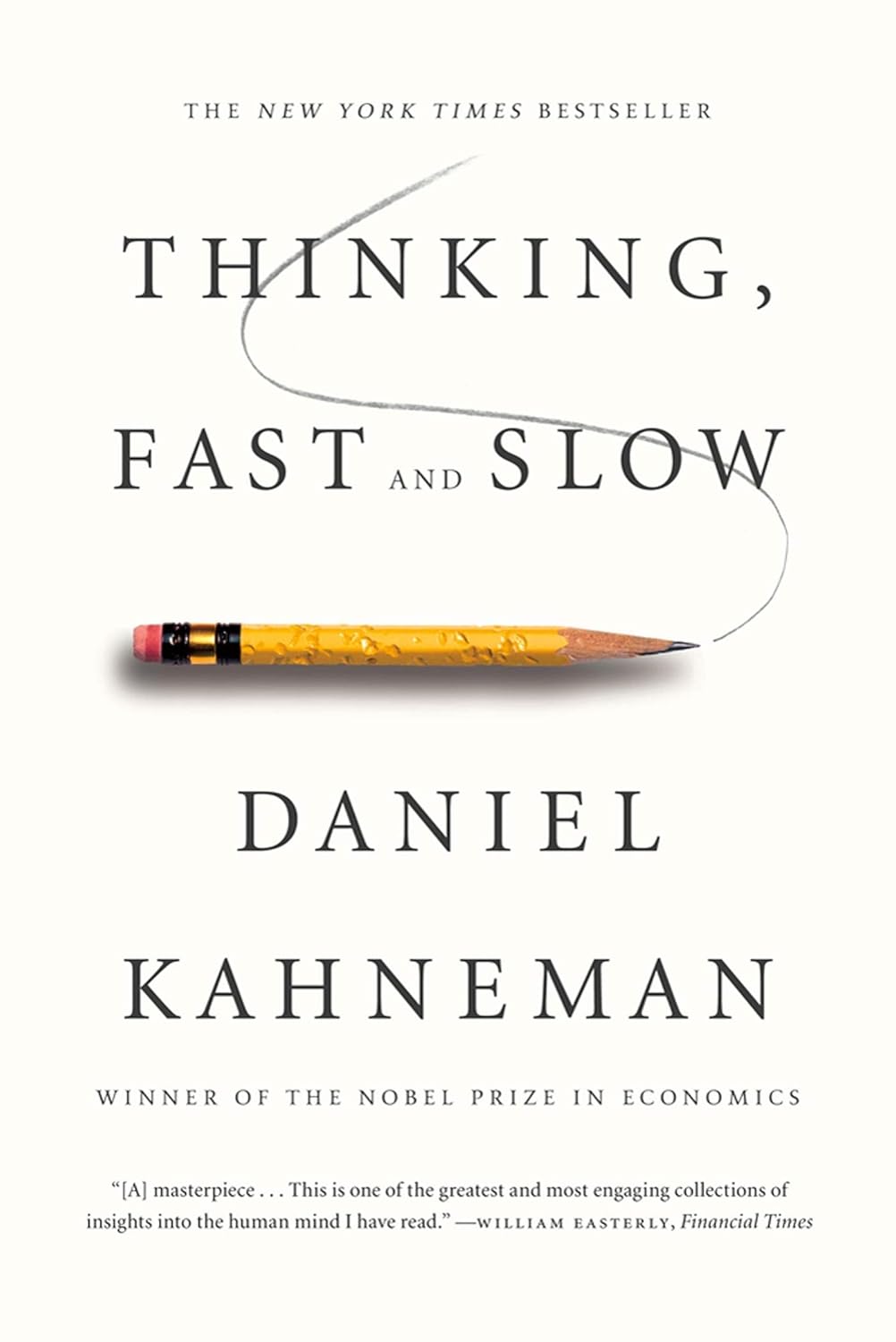
Book overview
System 1 operates automatically and quickly with little or no effort and no sense of voluntary control, while System 2 allocates attention to effortful mental activities and is associated with subjective experiences of agency and choice. Their interaction produces most of our thoughts and decisions: System 1 generates impressions and feelings that System 2 can endorse, modify, or override.
This page is built to be a compact learning hub for Thinking, Fast and Slow. You can move from the high-level summary into takeaways, quiz prompts, chapter review, and related books without breaking the reading flow.
Best takeaways to keep
System 1 = fast, automatic, intuitive; System 2 = slow, deliberate, effortful.
System 1 continuously generates suggestions (impressions, intuitions, impulses) that System 2 may monitor.
System 2 has limited capacity and is often lazy, accepting System 1’s outputs unless a reason to intervene appears.
Many errors arise when System 1’s shortcuts are applied inappropriately and System 2 fails to correct them.
Be mindful of when a quick intuition might need deliberate, System 2 scrutiny.
Understanding the two-system model explains why people reliably make predictable errors and how bias and intuition shape judgment in everyday life and policy. It provides a framework for improving decisions by recognizing when to engage deliberate thinking.
Retrieval practice
What are the two systems of thought described in the book?
What is the main characteristic of System 1?
What does the availability heuristic rely on?
What is the conjunction fallacy?
Quiz preview
What are the two systems of thought described in the book?
- System A and System B
- System 1 and System 2
- Fast System and Slow System
What is the main characteristic of System 1?
- It is slow and deliberate
- It requires effort and attention
- It is fast and automatic
What does the availability heuristic rely on?
- Statistical data
- Ease of recalling examples
- Logical reasoning
What is the conjunction fallacy?
- Believing that two events are less likely than one
- Assuming specific conditions are more probable than general ones
- Overestimating the likelihood of rare events
Chapter map
The Two Systems
System 1 operates automatically and quickly with little or no effort and no sense of voluntary control, while System 2 allocates attention to effortful mental activities and is associated with subjective experiences of agency and choice. Their interaction produces most of our thoughts and decisions: System 1 generates impressions and feelings that System 2 can endorse, modify, or override.
Attention and Effort
Mental effort and focused attention are limited and costly, and tasks requiring concentration slow down thinking and reduce the capacity for other operations. System 2 controls attention and exerts cognitive effort, producing a subjective sense of strain when performing demanding tasks.
The Lazy Controller
System 2 is often reluctant to engage and tends to conserve effort, leading to a default reliance on System 1’s intuitive responses. This laziness explains why errors persist: System 2 will not correct mistaken intuitions unless sufficiently motivated or prompted.
The Associative Machine
System 1 is an associative machine that links ideas, memories, and impressions into coherent patterns, producing a narrative that feels natural and fluent. These associations create automatic inferences, primes, and emotional responses that guide behavior without conscious awareness.
Cognitive Ease
Cognitive ease—how fluent and effortless information feels—influences belief, judgment, and willingness to accept statements as true. Familiar, clear, and simple information produces positive feelings and reduces skepticism, while cognitive strain triggers more careful scrutiny.
Next best step
Move next into the questions page if you want better retention, or into the takeaways page if you want the shortest useful review loop for this book.