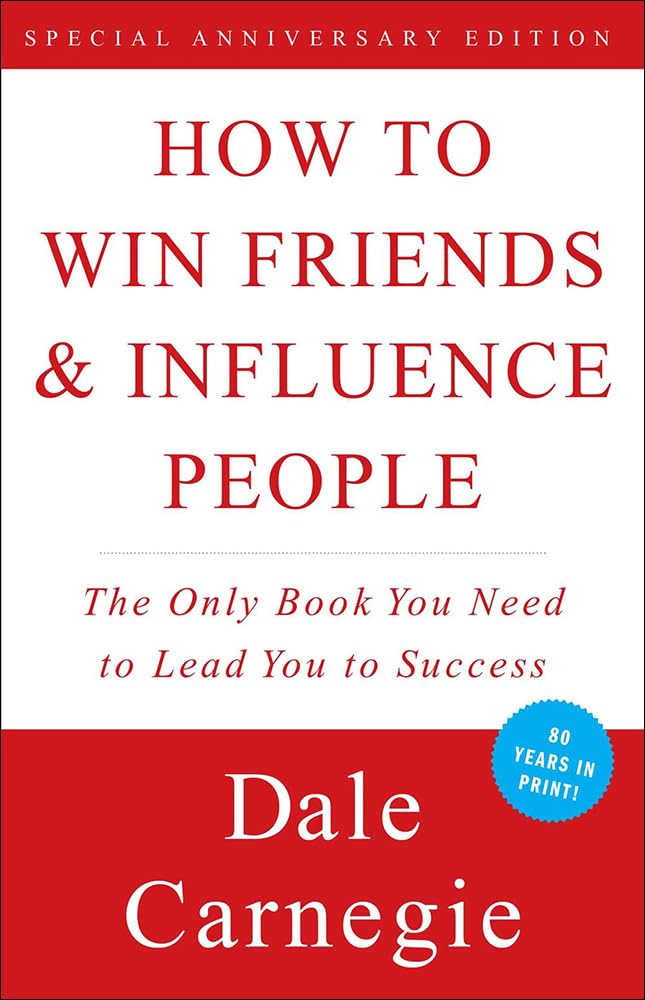
Book overview
Dale Carnegie presents three core principles for dealing with people effectively: avoid criticism, give sincere appreciation, and arouse an eager want in others. These fundamentals shift relationships from adversarial to cooperative by focusing on respect and motivating others toward mutual goals.
This page is built to be a compact learning hub for How to Win Friends and Influence People. You can move from the high-level summary into takeaways, quiz prompts, chapter review, and related books without breaking the reading flow.
Best takeaways to keep
Do not criticize, condemn, or complain — criticism breeds resentment and rarely changes behavior.
Give honest and sincere appreciation to make people feel valued and motivated.
Arouse in the other person an eager want by aligning requests with their desires and showing how they benefit.
Stop criticizing, start appreciating, and frame requests around what the other person wants.
Respect, recognition, and empathy are foundational to influence and remain directly applicable in personal, managerial, and sales contexts. These principles reduce conflict and increase cooperation in modern interpersonal situations.
Dale Carnegie presents three core principles for dealing with people effectively: avoid criticism, give sincere appreciation, and arouse an eager want in others. These fundamentals shift relationships from adversarial to cooperative by focusing on respect and motivating others toward mutual goals.
Retrieval practice
What is the first principle of handling people according to Carnegie?
Which technique is suggested to make people like you?
What should you do to win people to your way of thinking?
How should leaders provide feedback according to Carnegie?
Quiz preview
What is the first principle of handling people according to Carnegie?
- Criticize them
- Show appreciation
- Ignore them
Which technique is suggested to make people like you?
- Frown often
- Talk about yourself
- Smile genuinely
What should you do to win people to your way of thinking?
- Argue your point
- Respect their opinions
- Dismiss their ideas
How should leaders provide feedback according to Carnegie?
- With harsh criticism
- By ignoring issues
- With praise first
Chapter map
Fundamental Techniques in Handling People
Dale Carnegie presents three core principles for dealing with people effectively: avoid criticism, give sincere appreciation, and arouse an eager want in others. These fundamentals shift relationships from adversarial to cooperative by focusing on respect and motivating others toward mutual goals.
Six Ways to Make People Like You
Carnegie outlines six practical habits that build rapport quickly: show genuine interest, smile, remember names, be a good listener, talk in terms of the other person's interests, and make people feel important sincerely. These behaviors create warmth and trust that make people naturally inclined to like you.
How to Win People to Your Way of Thinking
This chapter offers strategies to persuade without provoking resistance: avoid arguments, show respect for others’ opinions, admit errors if you’re wrong, begin in a friendly way, and get people saying “yes” early. The methods emphasize empathy, tact, and guiding others to conclusions rather than forcing them.
Be a Leader: How to Change People Without Giving Offense or Arousing Resentment
\nCarnegie describes leadership techniques for correcting behavior without alienating people, emphasizing praise before criticism, indirect correction, and encouragement. The focus is on preserving dignity while guiding improvement so change is accepted willingly.\n\n#### Key points:\n- Begin with honest praise and appreciation to set a positive tone.\n- Call attention to mistakes indirectly rather than bluntly accusing.\n- Talk about your own mistakes before criticizing others to reduce defensiveness.\n- Ask questions instead of issuing direct orders to involve the other person in solutions.\n- Let people save face and praise every improvement to build confidence.\n\n#### Themes & relevance:\nLeadership that combines empathy and tact fosters cooperation and sustainable change, useful for managers, teachers, and anyone giving feedback. These methods reduce turnover and resistance while improving performance.\n\n#### Takeaway / How to use:\nStart with praise, address errors gently, and use questions to involve people in correction."
The Secret of Socrates
Named for the Socratic method, this chapter shows how asking the right questions and finding common ground leads people to agree and adopt your viewpoint. By securing small yeses and guiding reasoning, you reduce resistance and create collaborative decisions.
Next best step
Move next into the questions page if you want better retention, or into the takeaways page if you want the shortest useful review loop for this book.