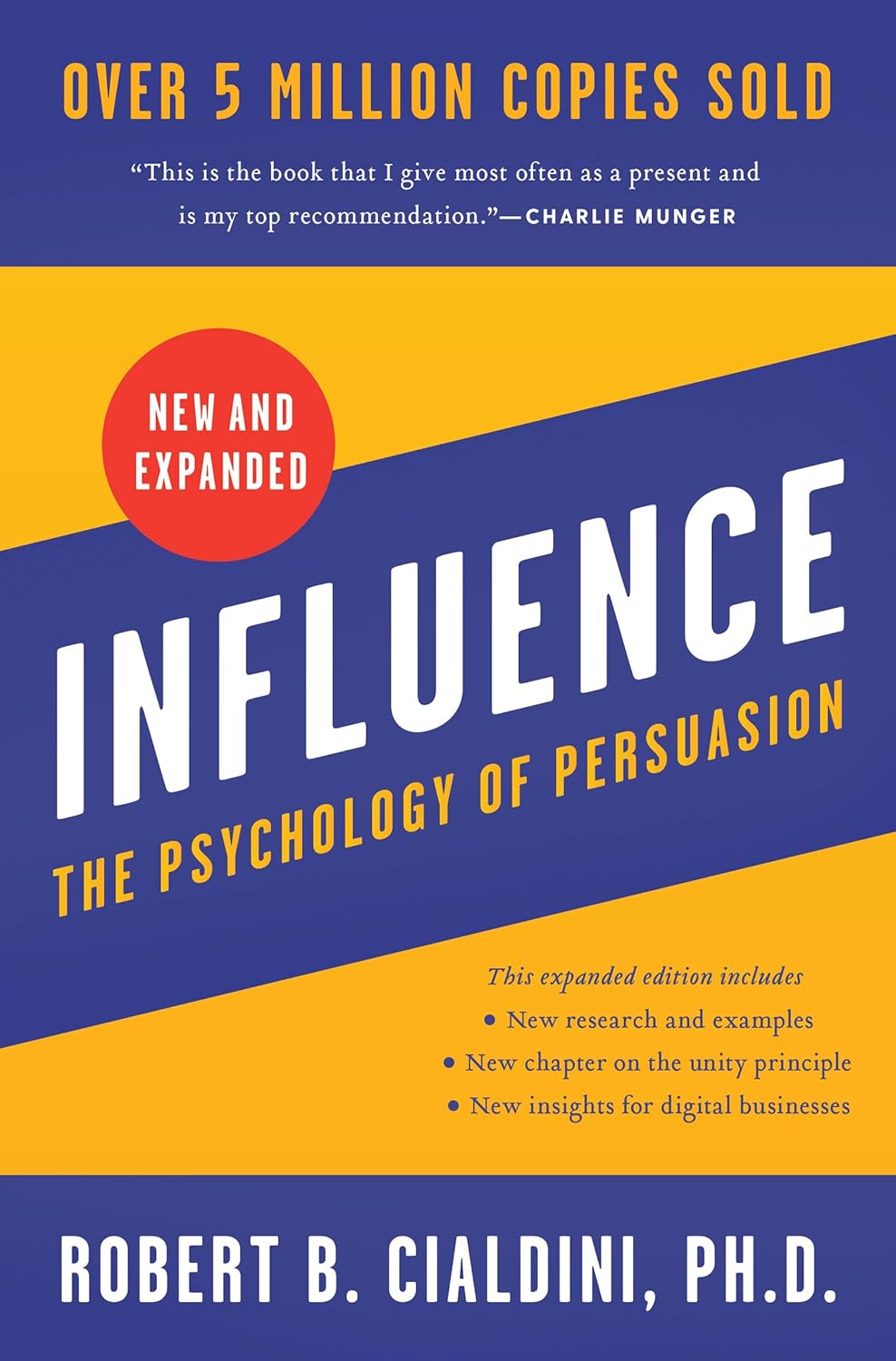
Book overview
Robert Cialdini introduces the idea that humans rely on automatic mental shortcuts—fixed-action patterns or "click, whirr" responses—that simplify decision making and make people vulnerable to manipulation. He outlines how specific trigger features and trained responses can produce predictable compliance without thoughtful analysis.
This page is built to be a compact learning hub for Influence: The Psychology of Persuasion. You can move from the high-level summary into takeaways, quiz prompts, chapter review, and related books without breaking the reading flow.
Best takeaways to keep
People use automatic heuristics to conserve effort, responding to simple cues rather than full analysis.
Trigger features (specific stimuli) reliably evoke preprogrammed responses (fixed
action patterns).
Compliance professionals exploit these shortcuts with predictable tactics and sequences.
Understanding these mechanisms helps recognize when one is being led into automatic compliance.
The chapter sets up the later discussion of specific principles (reciprocity, commitment, social proof, liking, authority, scarcity, unity).
Retrieval practice
Which persuasion principle describes a social rule where people feel obliged to repay gifts, favors, or concessions?
Which tactic relies on getting someone to make a small initial commitment so they'll later behave consistently with it?
Cialdini's 'click, whirr' metaphor refers to what psychological process?
Which principle states that people look to others' behavior to decide how to act in uncertain situations?
Quiz preview
Which persuasion principle describes a social rule where people feel obliged to repay gifts, favors, or concessions?
- Reciprocation
- Scarcity
- Authority
Which tactic relies on getting someone to make a small initial commitment so they'll later behave consistently with it?
- Commitment and Consistency
- Social Proof
- Reciprocation
Cialdini's 'click, whirr' metaphor refers to what psychological process?
- Automatic fixed-action patterns that trigger predictable responses
- Deliberate cost-benefit analysis
- Conscious resistance to persuasion
Which principle states that people look to others' behavior to decide how to act in uncertain situations?
- Social Proof
- Authority
- Unity
Chapter map
Weapons of Influence
Robert Cialdini introduces the idea that humans rely on automatic mental shortcuts—fixed-action patterns or "click, whirr" responses—that simplify decision making and make people vulnerable to manipulation. He outlines how specific trigger features and trained responses can produce predictable compliance without thoughtful analysis.
Reciprocation: The Old Give and Take
Cialdini explains the universal rule of reciprocity: people feel obligated to return favors, concessions, or gifts, even when unsolicited. This rule fosters social cohesion but is also exploited by persuaders who give small gifts or make concessions to elicit larger returns.
Commitment and Consistency: Hobgoblins of the Mind
This chapter shows that once people commit—especially publicly or actively—to a position or action, they strongly prefer consistency between that commitment and later behavior. Small initial commitments are often used to create larger compliance over time (the foot-in the-door effect).
Social Proof: Truths Are Us
Cialdini describes social proof: in uncertain situations people look to the behavior of others to determine correct action, assuming others' behavior reflects the right choice. This heuristic can rapidly amplify behaviors—useful in learning but exploitable in group influences and emergencies.
Liking: The Friendly Thief
Cialdini shows that people are more likely to comply with requests from people they like, and liking is increased by factors such as similarity, compliments, contact and cooperation, and physical attractiveness. Persuaders cultivate rapport and affinity to gain influence.
Next best step
Move next into the questions page if you want better retention, or into the takeaways page if you want the shortest useful review loop for this book.