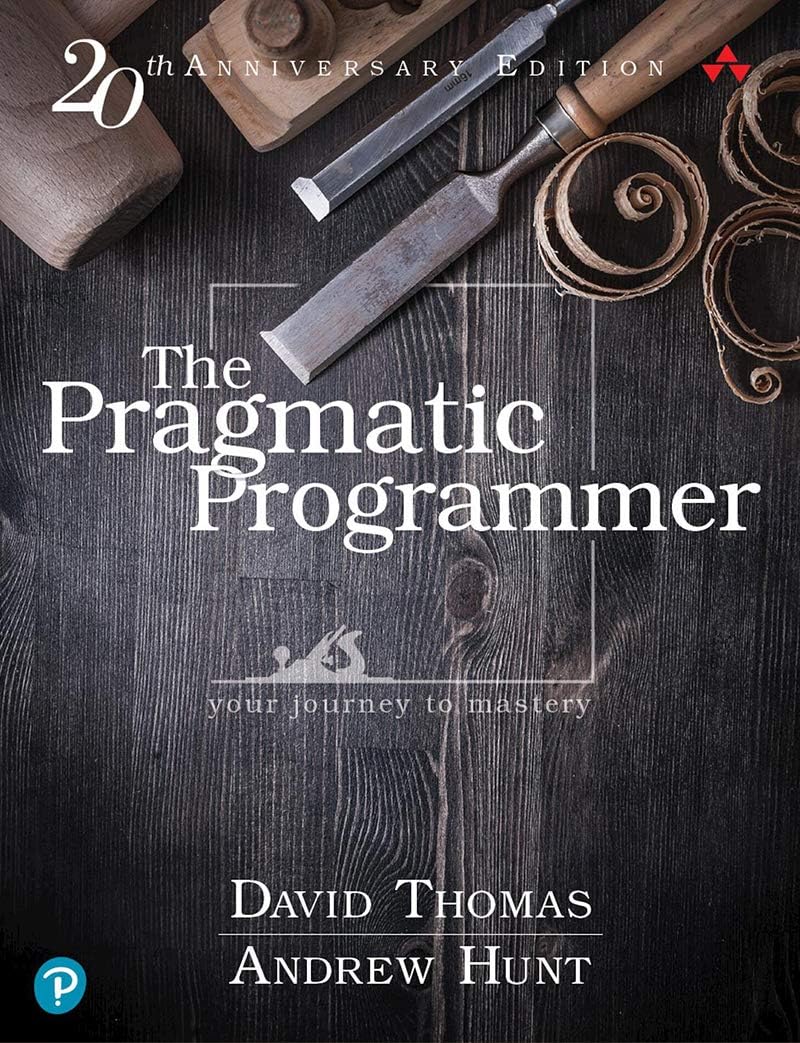
ReadSprintBooksThe Pragmatic ProgrammerThe Pragmatic Programmer Questions, Quiz, and Active Recall Prompts
The Pragmatic Programmer
The Pragmatic Programmer Questions, Quiz, and Active Recall Prompts

The Pragmatic Programmer Questions, Quiz, and Active Recall Prompts

by David Thomas and Andrew Hunt

Test your understanding of The Pragmatic Programmer by David Thomas and Andrew Hunt with quiz questions, active recall prompts, and related learning resources.

Reading without retrieval fades fast. Use these The Pragmatic Programmer questions and active recall prompts to pressure-test what you understood and keep the book usable later.

Built for retention

ReadSprint combines concise summaries, quizzes, active recall, and related reading paths so the useful part of the book is easier to keep.

Open full summary

8

Chapter summaries

5

Quiz questions

12

Key takeaways

6

Related books

Quiz questions

Question 1

What is the core philosophy of a pragmatic programmer?

  • Embrace change and continuous learning
  • Focus solely on coding skills
  • Avoid taking responsibility
  • Stick to one programming language
Question 2

Which tool is essential for version control?

  • Git
  • Excel
  • Photoshop
  • PowerPoint
Question 3

What is 'pragmatic paranoia'?

  • Ignoring potential risks
  • Anticipating and mitigating risks
  • Over-engineering solutions
  • Avoiding code reviews
Question 4

What should be avoided in software design?

  • Over-engineering
  • Using design patterns
  • Embracing simplicity
  • Creating adaptable systems
Question 5

What is a key practice while coding?

  • Writing clean, readable code
  • Focusing on speed over quality
  • Ignoring testing
  • Using vague variable names

Active recall prompts

What is the core philosophy of a pragmatic programmer?

Which tool is essential for version control?

What is 'pragmatic paranoia'?

What should be avoided in software design?

What is the main idea of "A Pragmatic Philosophy", and how would you explain it without looking back?

What is the main idea of "A Pragmatic Approach", and how would you explain it without looking back?

What is the main idea of "The Basic Tools", and how would you explain it without looking back?

What is the main idea of "Pragmatic Paranoia", and how would you explain it without looking back?

Quiz checkpoints

Question 1

What is the core philosophy of a pragmatic programmer?

Question 2

Which tool is essential for version control?

Question 3

What is 'pragmatic paranoia'?

Practice retrieval

Key concepts

A Pragmatic Philosophy

The chapter sets the stage for the entire book, highlighting the importance of a flexible mindset in software development.

A Pragmatic Approach

The chapter emphasizes practical strategies that can be applied to real-world programming challenges.

The Basic Tools

The chapter provides foundational knowledge that supports efficient and effective software development.

Open concept map

Author relationship system

Move from this author into connected writers, nearby themes, and any other books already in the ReadSprint library.

Similar themes and topic pages

Use topic hubs and category pages to keep reading depth aligned with what this book is actually about.

Turn Reading Into Recall

Keep The Pragmatic Programmer review-ready instead of letting it fade.

This page is strongest when it becomes part of a review habit: save the summary, revisit the key takeaways, and use recall prompts before the next meeting, study block, or decision.

Save one strong takeaway instead of over-highlighting.
Use the questions page to test what actually stuck.
Return when the book becomes relevant again, not just when motivation is high.
See pricing
Get Book Review Notes

Get practical notes on remembering and reusing ideas from nonfiction books without building an overly heavy note system.

Retention workflow

Turn this page into a repeatable study loop

Move from summary to takeaways, test yourself with questions, revisit the concept map, and then continue into related books. That keeps The Pragmatic Programmerconnected instead of turning into a one-time skim.

Frequently asked questions

Why use quiz questions for The Pragmatic Programmer?

Quiz-style recall is more durable than passive rereading because it forces you to retrieve the idea instead of merely recognizing it.

How should I answer active recall prompts?

Answer from memory first, then review the relevant chapter summary only after you have tried to explain the idea on your own.

What if I miss several questions about The Pragmatic Programmer?

That usually means the book needs a shorter review loop. Revisit the chapter summaries, keep only a few high-value takeaways, and test yourself again later.