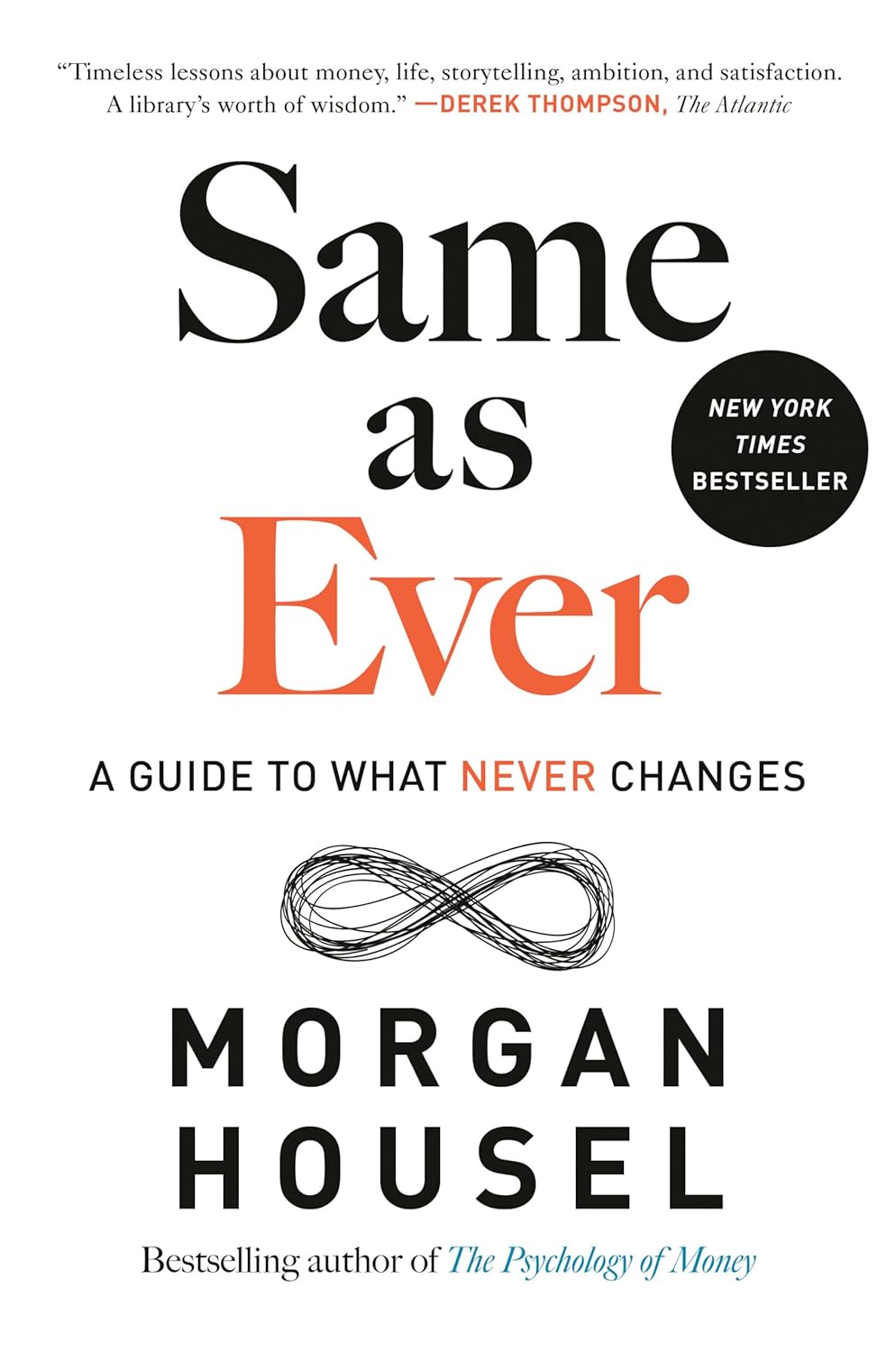
Same as Ever: A Guide to What Never Changes: ReadSprint summary highlights
ReadSprint paraphrases for review. These highlights are not verbatim quotations from the book or its author. Check the original edition for exact wording and context.
Same as Ever: A Guide to What Never Changes
by Morgan Housel
This opening chapter frames the book’s central claim: beneath surface change there are enduring patterns that shape behavior and institutions.
ReadSprint paraphrase · Not a quotation from the author.
This opening chapter frames the book’s central claim: beneath surface change there are enduring patterns that shape behavior and institutions.
Persistent patterns often arise from basic human motives and physical constraints.
Share with the ReadSprint source so others can read the context.
Same as Ever: A Guide to What Never Changes
by Morgan Housel
It outlines why identifying constants matters for decision-making and sets out the analytical lens used throughout the book.
ReadSprint paraphrase · Not a quotation from the author.
It outlines why identifying constants matters for decision-making and sets out the analytical lens used throughout the book.
Distinguishing transient change from structural stability improves forecasting.
Share with the ReadSprint source so others can read the context.
Same as Ever: A Guide to What Never Changes
by Morgan Housel
This chapter argues that many apparent changes in behavior are variations on fixed aspects of human nature such as self-interest, social motives, and cognitive limits.
ReadSprint paraphrase · Not a quotation from the author.
This chapter argues that many apparent changes in behavior are variations on fixed aspects of human nature such as self-interest, social motives, and cognitive limits.
Historical continuity provides repeatable lessons for policy and personal choices.
Share with the ReadSprint source so others can read the context.
Same as Ever: A Guide to What Never Changes
by Morgan Housel
It explains how these deep traits reliably shape choices across time and cultures.
ReadSprint paraphrase · Not a quotation from the author.
It explains how these deep traits reliably shape choices across time and cultures.
Recognizing constants reduces overreaction to novelty and hype.
Share with the ReadSprint source so others can read the context.
Same as Ever: A Guide to What Never Changes
by Morgan Housel
This chapter contrasts volatile short-term fluctuations with slower moving structural trends, showing how noise can obscure the signal that matters for long-term outcomes.
ReadSprint paraphrase · Not a quotation from the author.
This chapter contrasts volatile short-term fluctuations with slower moving structural trends, showing how noise can obscure the signal that matters for long-term outcomes.
Look for underlying patterns before reacting to surface-level change.
Share with the ReadSprint source so others can read the context.
Same as Ever: A Guide to What Never Changes
by Morgan Housel
It offers heuristics for separating the temporary from the persistent to avoid costly misjudgments.
ReadSprint paraphrase · Not a quotation from the author.
It offers heuristics for separating the temporary from the persistent to avoid costly misjudgments.
The chapter emphasizes stability as a practical tool for navigating complexity, arguing that long-term planning depends on spotting what doesn’t change. This provides the framing for later, more specific chapters.
Share with the ReadSprint source so others can read the context.
Same as Ever: A Guide to What Never Changes
by Morgan Housel
This chapter unpacks how luck and skill interact and why people systematically over-attribute outcomes to personal control.
ReadSprint paraphrase · Not a quotation from the author.
This chapter unpacks how luck and skill interact and why people systematically over-attribute outcomes to personal control.
This opening chapter frames the book’s central claim: beneath surface change there are enduring patterns that shape behavior and institutions. It outlines why identifying constants matters for decision-making and sets out the analytical lens used throughout the book.
Share with the ReadSprint source so others can read the context.
Same as Ever: A Guide to What Never Changes
by Morgan Housel
It explores cognitive biases and selection effects that create the illusion of causation where random variation plays a big role.
ReadSprint paraphrase · Not a quotation from the author.
It explores cognitive biases and selection effects that create the illusion of causation where random variation plays a big role.
Core motives (survival, status, affiliation) persist and guide decisions.
Share with the ReadSprint source so others can read the context.
Same as Ever: A Guide to What Never Changes
by Morgan Housel
This chapter examines adaptation—how people and societies adjust to new conditions so that initial gains or shocks fade over time.
ReadSprint paraphrase · Not a quotation from the author.
This chapter examines adaptation—how people and societies adjust to new conditions so that initial gains or shocks fade over time.
Cognitive biases and bounded rationality produce predictable errors.
Share with the ReadSprint source so others can read the context.
Same as Ever: A Guide to What Never Changes
by Morgan Housel
It explains mechanisms like hedonic adaptation and expectation adjustment that restore equilibrium after change.
ReadSprint paraphrase · Not a quotation from the author.
It explains mechanisms like hedonic adaptation and expectation adjustment that restore equilibrium after change.
Social incentives and norms channel individual behavior in stable ways.
Share with the ReadSprint source so others can read the context.