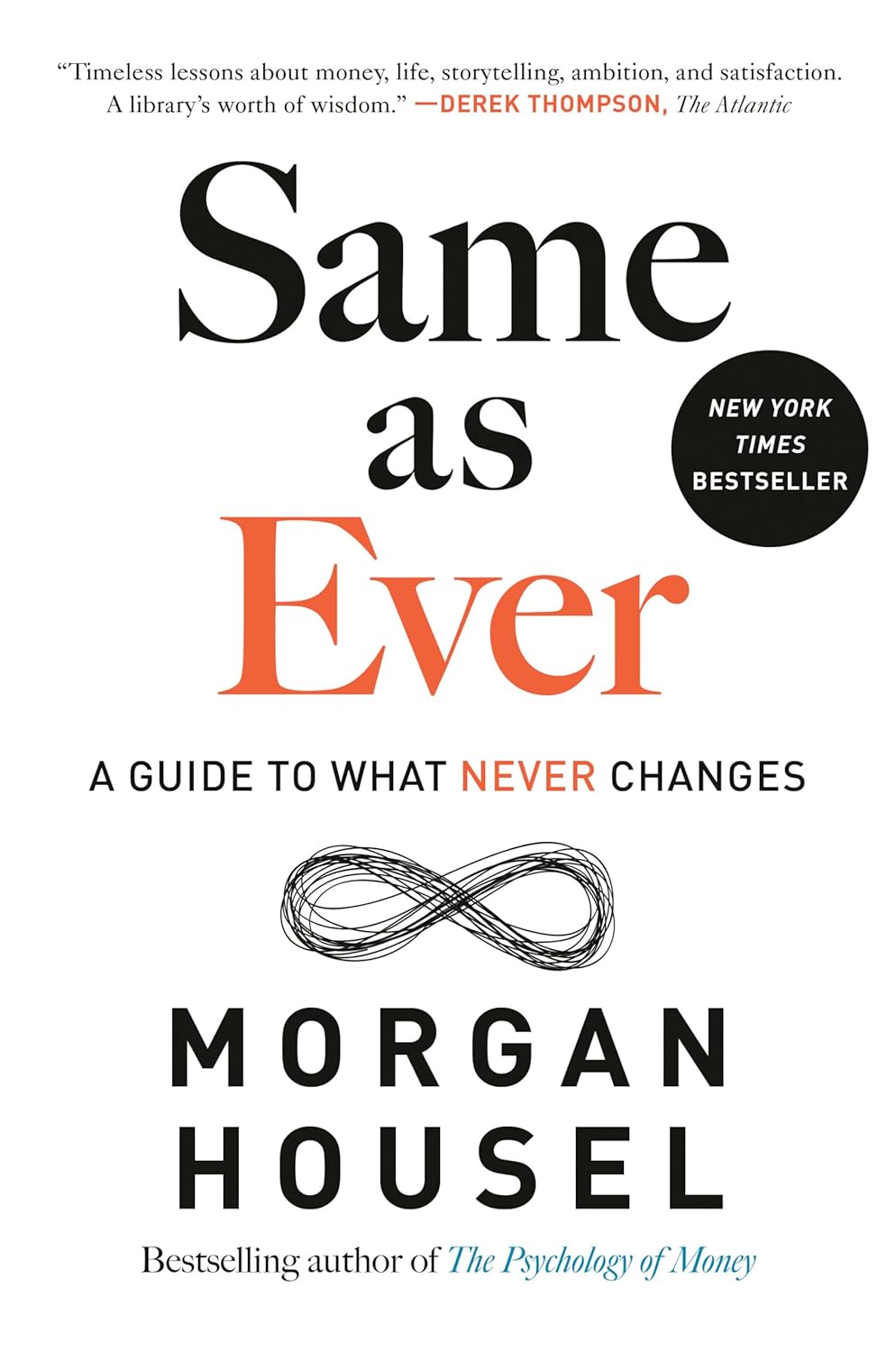
Same as Ever: Why Some Things Never Change
Summary:
This opening chapter frames the book’s central claim: beneath surface change there are enduring patterns that shape behavior and institutions. It outlines why identifying constants matters for decision-making and sets out the analytical lens used throughout the book.
Key points:
- Persistent patterns often arise from basic human motives and physical constraints.
- Distinguishing transient change from structural stability improves forecasting.
- Historical continuity provides repeatable lessons for policy and personal choices.
- Recognizing constants reduces overreaction to novelty and hype.
Themes & relevance:
The chapter emphasizes stability as a practical tool for navigating complexity, arguing that long-term planning depends on spotting what doesn’t change. This provides the framing for later, more specific chapters.
Takeaway / How to use:
Look for underlying patterns before reacting to surface-level change.
Key points
- Persistent patterns often arise from basic human motives and physical constraints.
- Distinguishing transient change from structural stability improves forecasting.
- Historical continuity provides repeatable lessons for policy and personal choices.
- Recognizing constants reduces overreaction to novelty and hype.
Human Nature: The Unmoving Heart of Decision
Summary:
This chapter argues that many apparent changes in behavior are variations on fixed aspects of human nature such as self-interest, social motives, and cognitive limits. It explains how these deep traits reliably shape choices across time and cultures.
Key points:
- Core motives (survival, status, affiliation) persist and guide decisions.
- Cognitive biases and bounded rationality produce predictable errors.
- Social incentives and norms channel individual behavior in stable ways.
- Personality and temperament exert long
- term influence even as context shifts.
Themes & relevance:
Understanding human nature offers a stable foundation for predicting behavior amid changing circumstances. Applying this insight improves policy design and personal strategy.
Takeaway / How to use:
Anchor forecasts and interventions in enduring human motives rather than ephemeral trends.
Key points
- Core motives (survival, status, affiliation) persist and guide decisions.
- Cognitive biases and bounded rationality produce predictable errors.
- Social incentives and norms channel individual behavior in stable ways.
- Personality and temperament exert long
- term influence even as context shifts.
Short-Term Noise, Long-Term Signal
Summary:
This chapter contrasts volatile short-term fluctuations with slower
- moving structural trends, showing how noise can obscure the signal that matters for long-term outcomes. It offers heuristics for separating the temporary from the persistent to avoid costly misjudgments.
Key points:
- Markets, media, and emotions amplify short
- term noise.
- Long
- term trends reflect fundamentals like technology, demographics, and institutions.
- Misreading noise as signal leads to bad timing and suboptimal decisions.
- Simple rules (e.g., time horizons, checklists) help maintain focus on durable signals.
Themes & relevance:
The theme is patience and perspective: successful decisions privilege enduring signals over headline volatility. This is relevant for investing, planning, and leadership.
Takeaway / How to use:
Adopt time horizons and rules that filter out short-term noise.
Key points
- Markets, media, and emotions amplify short
- term noise.
- Long
- term trends reflect fundamentals like technology, demographics, and institutions.
- Misreading noise as signal leads to bad timing and suboptimal decisions.
- Simple rules (e.g., time horizons, checklists) help maintain focus on durable signals.
Luck, Skill, and the Illusion of Control
Summary:
This chapter unpacks how luck and skill interact and why people systematically over-attribute outcomes to personal control. It explores cognitive biases and selection effects that create the illusion of causation where random variation plays a big role.
Key points:
- Outcomes often combine skill and luck; separating them requires careful analysis.
- Survivorship bias and retrospective storytelling inflate perceived skill.
- Overconfidence arises from underestimating randomness and overestimating control.
- Systems that reward outcomes rather than processes incentivize risky behavior.
Themes & relevance:
Recognizing the role of luck tempers hubris and improves evaluation of performance and institutions. This insight helps design fairer incentives and more resilient plans.
Takeaway / How to use:
Evaluate outcomes by examining processes and variance, not just success.
Key points
- Outcomes often combine skill and luck; separating them requires careful analysis.
- Survivorship bias and retrospective storytelling inflate perceived skill.
- Overconfidence arises from underestimating randomness and overestimating control.
- Systems that reward outcomes rather than processes incentivize risky behavior.
Adaptation: How Expectations Catch Up
Summary:
This chapter examines adaptation—how people and societies adjust to new conditions so that initial gains or shocks fade over time. It explains mechanisms like hedonic adaptation and expectation adjustment that restore equilibrium after change.
Key points:
- Hedonic adaptation reduces the lasting impact of new pleasures or setbacks.
- Expectations shift with experience, moderating perceived change.
- Institutions and markets adapt, eroding first
- mover advantages and novelty premiums.
- Policy and product design must anticipate adaptive responses to be effective.
Themes & relevance:
Adaptation shows why novelty often has transient effects and why sustainable advantage requires ongoing innovation or structural change. Anticipating adaptation improves strategy and policy design.
Takeaway / How to use:
Plan for adaptation by testing for persistent effects and updating strategies accordingly.
Key points
- Hedonic adaptation reduces the lasting impact of new pleasures or setbacks.
- Expectations shift with experience, moderating perceived change.
- Institutions and markets adapt, eroding first
- mover advantages and novelty premiums.
- Policy and product design must anticipate adaptive responses to be effective.
Incentives and Predictable Behavior
Summary:
This chapter focuses on incentives as a primary mechanism by which stable patterns of behavior emerge. It demonstrates how well-aligned incentives produce predictable responses while misaligned incentives create perverse outcomes.
Key points:
- Incentives shape behavior more reliably than appeals to virtue or rhetoric.
- Principal
- agent problems and information asymmetries distort incentives.
- Institutions work when incentives are aligned with desired outcomes.
- Simple incentive
- aware interventions often outperform complex moral arguments.
Themes & relevance:
The central message is pragmatic: design incentives thoughtfully to harness predictable human responses toward better outcomes. This is essential for organizations, markets, and public policy.
Takeaway / How to use:
Map incentives explicitly before designing policies or systems.
Key points
- Incentives shape behavior more reliably than appeals to virtue or rhetoric.
- Principal
- agent problems and information asymmetries distort incentives.
- Institutions work when incentives are aligned with desired outcomes.
- Simple incentive
- aware interventions often outperform complex moral arguments.
Emotion and the Economics of Choice
Summary:
This chapter explores how emotion systematically interacts with economic decision-making, influencing risk preferences, time discounting, and social choices. It argues that emotional regularities are part of what never changes, shaping predictable patterns of economic behavior.
Key points:
- Emotions bias judgments but do so in consistent, often predictable ways.
- Affective forecasting errors lead people to choose suboptimally for future states.
- Social emotions (guilt, pride, envy) powerfully shape cooperative and competitive behavior.
- Designing choice environments that account for emotions improves outcomes.
Themes & relevance:
Emotional forces are stable drivers of choice and should be integrated into economic models and practical design. Accounting for emotion increases the effectiveness of interventions.
Takeaway / How to use:
Include emotional drivers when modeling behavior or designing choices.
Key points
- Emotions bias judgments but do so in consistent, often predictable ways.
- Affective forecasting errors lead people to choose suboptimally for future states.
- Social emotions (guilt, pride, envy) powerfully shape cooperative and competitive behavior.
- Designing choice environments that account for emotions improves outcomes.
Risk, Uncertainty, and Resilience
Summary:
The final chapter synthesizes how enduring factors—human nature, incentives, adaptation, and emotion—interact with risk and uncertainty to produce robust or fragile systems. It emphasizes building resilience to rare but consequential shocks rather than attempting perfect prediction.
Key points:
- Distinguish between measurable risk and true uncertainty where probabilities are unknown.
- Robustness and redundancy often outperform fragile optimization when facing uncertainty.
- Diversification, stress testing, and optionality increase resilience.
- Institutions that learn and adapt maintain stability in the face of shocks.
Themes & relevance:
The chapter ties permanence to prudence: recognizing what never changes helps design systems that survive uncertainty. Resilience is presented as the practical priority under deep uncertainty.
Takeaway / How to use:
Prioritize robustness and optionality when planning under uncertainty.
Key points
- Distinguish between measurable risk and true uncertainty where probabilities are unknown.
- Robustness and redundancy often outperform fragile optimization when facing uncertainty.
- Diversification, stress testing, and optionality increase resilience.
- Institutions that learn and adapt maintain stability in the face of shocks.
Wealth, Happiness, and What Lasts
Summary:
The chapter contrasts transient markers of success (income, possessions) with lasting sources of well-being like relationships, purpose, and health, arguing that wealth is a tool rather than an end in itself. It emphasizes how hedonic adaptation, social comparison, and pursuit of novelty can erode the happiness bought by material gains, and encourages reallocating resources toward durable goods of life.
Key points:
- Wealth increases options and security but yields diminishing returns for moment
- to-moment happiness.
- Hedonic adaptation explains why new purchases rarely sustain long
- term satisfaction.
- Durable investments include relationships, health, meaning, autonomy, and time use.
- Measuring lasting value requires long horizons and attention to non
- monetary metrics.
- Financial choices should prioritize optionality, resilience, and experiences over status consumption.
Themes & relevance:
The chapter connects personal finance and psychology, showing why cultural messages about wealth often mislead and how reorienting priorities improves life outcomes.
Takeaway / How to use:
Allocate more of your money and time to relationships, health, and time-saving freedom rather than status goods.
Key points
- Wealth increases options and security but yields diminishing returns for moment
- to-moment happiness.
- Hedonic adaptation explains why new purchases rarely sustain long
- term satisfaction.
- Durable investments include relationships, health, meaning, autonomy, and time use.
- Measuring lasting value requires long horizons and attention to non
- monetary metrics.
- Financial choices should prioritize optionality, resilience, and experiences over status consumption.
Stories, Narratives, and the Truths They Hide
Summary:
This chapter explores how narratives shape perception, decision-making, and identity, while often simplifying or obscuring complex realities. It warns that coherent stories can feel true even when they omit key variables, and offers methods to surface hidden assumptions and counter
- narratives.
Key points:
- Humans prefer coherent stories, which makes narratives powerful tools for meaning and influence.
- Simplification hides uncertainty, leading to overconfidence and poor decisions.
- Narratives can motivate action but also enable bias, groupthink, and manipulation.
- Testing a story requires looking for disconfirming evidence, alternative explanations, and base
- rate thinking.
- Maintain plural narratives: keep multiple frameworks to better capture complexity.
Themes & relevance:
The chapter highlights the interplay between cognition and culture, relevant to politics, markets, media consumption, and personal choice.
Takeaway / How to use:
Regularly challenge your dominant stories by seeking disconfirming data and learning alternative models.
Key points
- Humans prefer coherent stories, which makes narratives powerful tools for meaning and influence.
- Simplification hides uncertainty, leading to overconfidence and poor decisions.
- Narratives can motivate action but also enable bias, groupthink, and manipulation.
- Testing a story requires looking for disconfirming evidence, alternative explanations, and base
- rate thinking.
- Maintain plural narratives: keep multiple frameworks to better capture complexity.
Patience, Time, and Compounding
Summary:
Focusing on patience and long time horizons, the chapter argues that compounding—of money, habits, skills, and relationships—is a central engine of lasting improvement. It shows how small, consistent actions accumulate exponentially and why early starts and long commitments trump short bursts of intensity.
Key points:
- Compounding works for finances, habits, knowledge, and reputation; its effects grow nonlinearly over time.
- Starting early and staying consistent leverages time more than high short
- term effort.
- Patience reduces costly reactions to volatility and enables optionality to pay off.
- Systems and routines beat one
- off goals because they sustain compounding.
- Time horizon alignment (matching decisions to long
- term outcomes) is a practical discipline.
Themes & relevance:
This chapter ties behavioral discipline to real-world outcomes, emphasizing how temporal perspective shapes success across domains.
Takeaway / How to use:
Pick one small habit or savings plan and commit to it consistently to let compounding work for you.
Key points
- Compounding works for finances, habits, knowledge, and reputation; its effects grow nonlinearly over time.
- Starting early and staying consistent leverages time more than high short
- term effort.
- Patience reduces costly reactions to volatility and enables optionality to pay off.
- Systems and routines beat one
- off goals because they sustain compounding.
- Time horizon alignment (matching decisions to long
- term outcomes) is a practical discipline.
Practicing Permanence: Rules That Endure
Summary:
The final chapter offers a set of pragmatic, enduring rules for navigating life and uncertainty, blending first principles with behavioral prescriptions. It advocates simplicity, margin of safety, iterative learning, and prioritizing what survives turbulence over what merely looks good in the moment.
Key points:
- Favor simplicity and redundancy: avoid fragile complex plans that break under stress.
- Maintain margins of safety in finances, time, and commitments to absorb shocks.
- Use first principles thinking to strip problems to fundamentals rather than rely on fads.
- Prefer long
- term optionality and flexibility over short-term optimization.
- Institutionalize learning: test small, iterate, and preserve capital—financial, social, and cognitive.
Themes & relevance:
The chapter synthesizes earlier lessons into actionable rules that help individuals and organizations remain resilient amid change.
Takeaway / How to use:
Adopt one enduring rule (e.g., live below your means) and apply it consistently to build resilience.
Key points
- Favor simplicity and redundancy: avoid fragile complex plans that break under stress.
- Maintain margins of safety in finances, time, and commitments to absorb shocks.
- Use first principles thinking to strip problems to fundamentals rather than rely on fads.
- Prefer long
- term optionality and flexibility over short-term optimization.
- Institutionalize learning: test small, iterate, and preserve capital—financial, social, and cognitive.