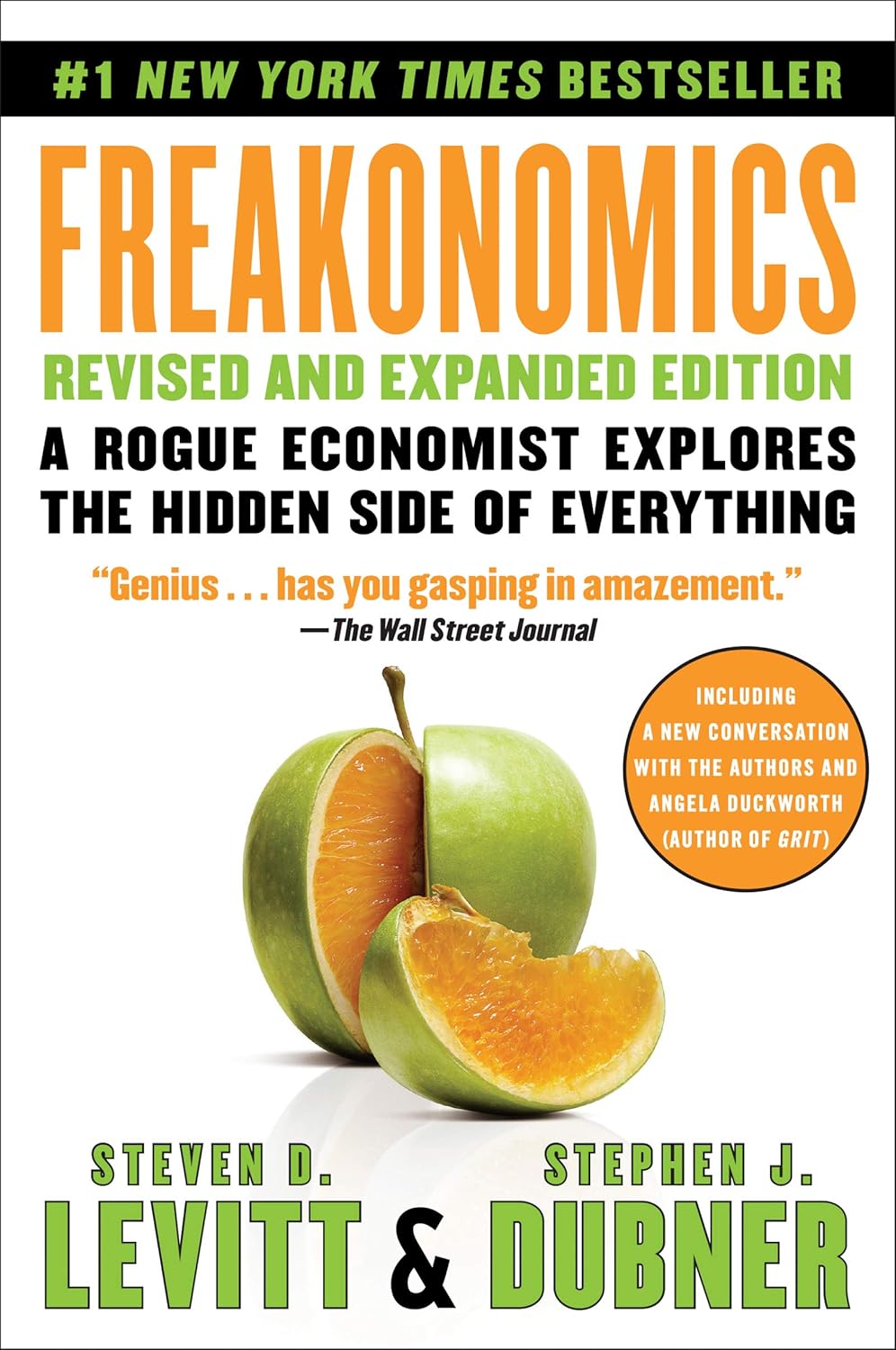
Book overview
Levitt and Dubner open by showing how incentives shape behavior, using detectives-in the-data to uncover cheating among Chicago public school teachers and match fixing among sumo wrestlers. They demonstrate that subtle statistical patterns can reveal powerful incentives and perverse behaviors.
This page is built to be a compact learning hub for Freakonomics: A Rogue Economist Explores the Hidden Side of Everything. You can move from the high-level summary into takeaways, quiz prompts, chapter review, and related books without breaking the reading flow.
Best takeaways to keep
Incentives (financial, reputational, career) strongly influence individual behavior.
Unusual statistical patterns (e.g., improbable test
score gains or win-loss streaks) can reveal cheating or manipulation.
Careful data analysis can detect behavior that direct observation or anecdotes miss.
Correlation can suggest hypotheses but must be tested for alternative explanations.
Look for incentive structures and statistical anomalies when evaluating performance claims.
Retrieval practice
What common insight do Levitt and Dubner use in the opening chapter about schoolteachers and sumo wrestlers?
Why do Levitt and Dubner compare the Ku Klux Klan to real-estate agents?
Why, according to the book, do many drug dealers still live with their mothers?
Which controversial explanation does Levitt give for the large crime decline of the 1990s?
Quiz preview
What common insight do Levitt and Dubner use in the opening chapter about schoolteachers and sumo wrestlers?
- Both respond to incentives that can encourage cheating or match-fixing.
- Both groups are primarily shaped by genetic differences.
- Both are heavily regulated by international bodies.
Why do Levitt and Dubner compare the Ku Klux Klan to real-estate agents?
- Because both exploit information asymmetry and secrecy to gain power or profit.
- Because both are declining due to urbanization.
- Because both primarily function through violent enforcement.
Why, according to the book, do many drug dealers still live with their mothers?
- Because most street-level dealers earn very little and drug organizations have steep hierarchies like corporations.
- Because drug dealing is highly lucrative for everyone involved.
- Because most dealers receive government housing subsidies.
Which controversial explanation does Levitt give for the large crime decline of the 1990s?
- That improved policing was the single dominant cause.
- That legalized abortion reduced the number of high-risk births, substantially lowering later crime.
- That the rise of video games was the primary factor.
Chapter map
What Do Schoolteachers and Sumo Wrestlers Have in Common?
Levitt and Dubner open by showing how incentives shape behavior, using detectives-in the-data to uncover cheating among Chicago public school teachers and match fixing among sumo wrestlers. They demonstrate that subtle statistical patterns can reveal powerful incentives and perverse behaviors.
How Is the Ku Klux Klan Like a Group of Real-Estate Agents?
This chapter explores how information asymmetry and incentives shape organizations, comparing the secretive, membership-driven KKK (and how secrecy and disclosure affect power) with the ways real estate agents can act on private information to benefit themselves. Levitt uses data and records to show how access to information and the incentives of intermediaries change outcomes for principals.
Why Do Drug Dealers Still Live with Their Moms?
Levitt examines the economics of drug-dealing organizations, showing they resemble corporations with steep hierarchies where most street level dealers earn very little while a few at the top reap large rewards. Ethnographic and quantitative evidence explain why low-level dealers tolerate high risks and how organizational structure sustains the trade.
Where Have All the Criminals Gone?
Levitt tackles the large crime decline of the 1990s and uses empirical methods to evaluate possible causes, controversially arguing that legalized abortion (following Roe v. Wade) significantly reduced the pool of high-risk births and thus later crime. He weighs other factors—policing, incarceration, economy, lead reduction—but emphasizes the value of testing competing explanations with data.
What Makes a Perfect Parent?
Using large datasets, Levitt and Dubner investigate which parenting choices correlate with better outcomes (test scores, behavior), finding that many commonly touted practices have small or no measurable effects compared with background factors like parental education and socioeconomic status. They encourage focusing on what data actually show works rather than on parenting myths.
Next best step
Move next into the questions page if you want better retention, or into the takeaways page if you want the shortest useful review loop for this book.