Loading summary…
AI-assisted study material. Check important details against the original book. Chapter details have not been independently verified. How this material is made
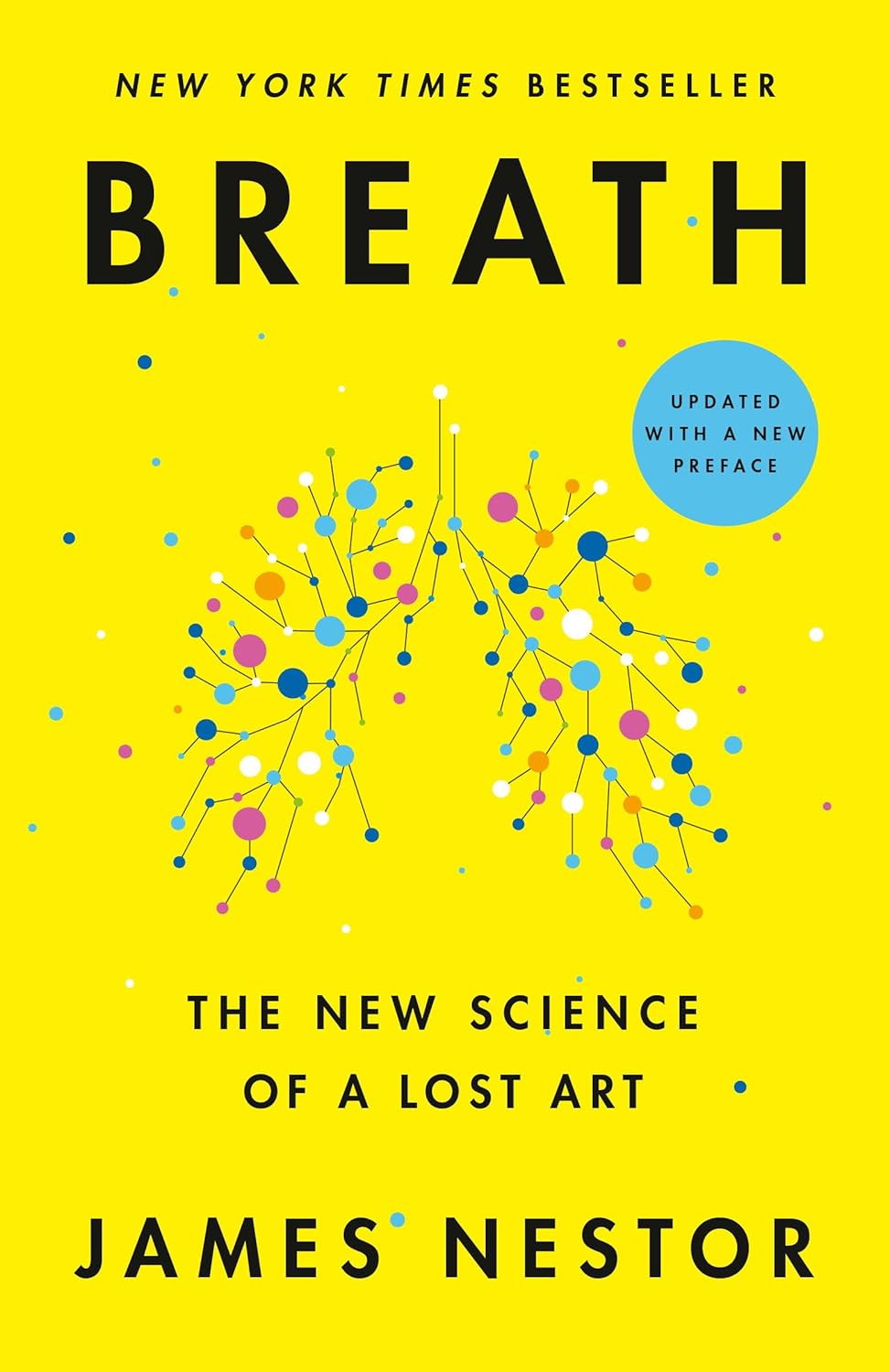
Breath: The New Science of a Lost Art
by James Nestor
13 chapters•Concise summaries and key takeaways
Chapter 1 of 13
7% Complete
Introduction: The Lost Art of Breathing
Summary:
James Nestor introduces the idea that modern humans have largely forgotten how to breathe correctly, linking poor breathing habits to a wide range of chronic health problems. He describes his personal experiments and journeys to meet researchers and practitioners who reclaim and study traditional breathing techniques.
Key points:
- Modern habits (mouth
- breathing, shallow rapid breaths) contrast with how humans evolved to breathe.
- Poor breathing contributes to problems like sleep disturbances, reduced athletic performance, and chronic respiratory issues.
- The book sets up an exploration combining history, science, and hands
- on testing of varied breathing methods.
Themes & relevance:
Breathing is presented as a foundational, often overlooked determinant of health; reconnecting with proper breathing has broad relevance to modern lifestyle illnesses. This chapter frames the rest of the book by arguing that simple changes to breath can yield measurable benefits.
Takeaway / How to use:
Begin paying conscious attention to your breath and whether you breathe through your nose or mouth.
Try one idea, then return to it.
Choose one useful idea, save a practical action, and give yourself a reason to revisit it.
Keep this book
Save it to your library and return to this review after signing in.
Save one action
Write down an idea you want to use in your work or daily life.
Come back to review
Sync your notes and review dates, then find due books on your dashboard.
14-day trial • No credit card required • Sign in with Google
Review this book
Recall prompts, personal cards, saved actions, and downloadable study notes.
Review this book
Recall prompts, personal cards, saved actions, and downloadable study notes.
Loading your saved reviews…
Share this summary
Generate a branded share card or copy a link.
Share this summary
Generate a branded share card or copy a link.
Share this reading moment
Turn your current progress into a branded share page that points people back to the summary.
Share your progress
Breath: The New Science of a Lost Art
by James Nestor
Chapter 1 of 13. 8% of the way through this summary.
Progress
1/13
Complete
8%
Visible progress makes it easier to keep the habit alive.
ReadSprint
Share with the ReadSprint source so others can read the context.
Loading your reading streak…
Related books and topics
Authors, topics, and study links connected to this book.
Related books and topics
Authors, topics, and study links connected to this book.
Topic relationship graph
This graph keeps Breath: The New Science of a Lost Art attached to productivity.
Current book
Breath: The New Science of a Lost Art
topic
Productivity topic page
See how Breath: The New Science of a Lost Art connects to other productivity books and learning paths.
author
James Nestor
Explore James Nestor's books, related authors, and connected reading paths.
book
The Compound Effect
Connects through habits and learning themes and a similar learning intent.
book
Atomic Habits
Connects through habits themes and a similar learning intent.
learning
Best books for productivity
Follow the same execution and systems themes into adjacent titles.
learning
Best books for discipline
Reinforce consistency, follow-through, and habit-driven execution.
Related books
The closest book-to-book matches based on topic overlap, author proximity, and learning intent.
Related book
The Compound Effect
by Darren Hardy
Connects through habits and learning themes and a similar learning intent.
Related book
Atomic Habits
by James Clear
Connects through habits themes and a similar learning intent.
Related book
Gut Feelings: Healing the Shame-Fueled Relationship Between What You Eat and How You Feel
by Dr. Will Cole
Connects through habits themes and a similar learning intent.
Related book
Influence: The Psychology of Persuasion
by Robert B. Cialdini, Ph.D.
Connects through habits themes and a similar learning intent.
Similar themes
Books that reinforce the same core ideas from a different angle so the topic gets deeper, not noisier.
Theme match
The Compound Effect
by Darren Hardy
Shares strong habits and learning themes, so the ideas reinforce each other instead of drifting apart.
Theme match
Atomic Habits
by James Clear
Shares strong habits themes, so the ideas reinforce each other instead of drifting apart.
Theme match
Gut Feelings: Healing the Shame-Fueled Relationship Between What You Eat and How You Feel
by Dr. Will Cole
Shares strong habits themes, so the ideas reinforce each other instead of drifting apart.
Theme match
Influence: The Psychology of Persuasion
by Robert B. Cialdini, Ph.D.
Shares strong habits themes, so the ideas reinforce each other instead of drifting apart.
Recommended next reads
A practical next step if you want to keep momentum after finishing this book.
Next read
The Power of Focus
by Jack Canfield, Mark Victor Hansen, Les Hewitt
A good next read when you want to keep building the habits angle from Breath: The New Science of a Lost Art.
Next read
Deep Work for Distracted People: Simple Methods to Stay Focused, Think Clearly, and Finish What Matters
by MD Saly
A good next read when you want to keep building the learning angle from Breath: The New Science of a Lost Art.
Next read
Software Engineering at Google: Lessons Learned from Programming Over Time
by Hyrum Wright, Titus Winters, et al.
A good next read when you want to keep building the learning angle from Breath: The New Science of a Lost Art.
Next read
The 7 Habits of Highly Effective People
by Stephen R. Covey
A good next read when you want to keep building the habits angle from Breath: The New Science of a Lost Art.
Books readers also liked
Modeled from shared topics, category overlap, and nearby reading paths to surface the closest adjacent titles.
Adjacent pick
The Algebra of Wealth: A Simple Formula for Financial Security
by Scott Galloway
Modeled as a nearby pick for readers following the same habits path.
Adjacent pick
The Four Tendencies
by Gretchen Rubin
Modeled as a nearby pick for readers following the same habits path.
Adjacent pick
The Theory of the Leisure Class
by Thorstein Veblen
Modeled as a nearby pick for readers following the same learning path.
Adjacent pick
The Tibetan Book of Living and Dying
by Sogyal Rinpoche
Modeled as a nearby pick for readers following the same habits path.
Author relationship system
Move from this author into connected writers, nearby themes, and any other books already in the ReadSprint library.
Author
James Nestor
Explore James Nestor's books, related authors, and connected reading paths.
Related author
Darren Hardy
Connected through productivity ideas and adjacent books.
Related author
James Clear
Connected through productivity ideas and adjacent books.
Related author
Dr. Will Cole
Connected through productivity ideas and adjacent books.
Related author
Robert B. Cialdini, Ph.D.
Connected through productivity ideas and adjacent books.
Related author
Jack Canfield, Mark Victor Hansen, Les Hewitt
Connected through productivity ideas and adjacent books.
Related author
MD Saly
Connected through productivity ideas and adjacent books.
Similar themes and topic pages
Use topic hubs and category pages to keep reading depth aligned with what this book is actually about.
Recommended learning pages
These pages extend the educational angle with retention, recall, and adjacent reading systems.
Best books for productivity
Follow the same execution and systems themes into adjacent titles.
Best books for discipline
Reinforce consistency, follow-through, and habit-driven execution.
Reading retention hub
Explore the systems that make book ideas stick after the first read.
Learning and recall hub
Go deeper into quizzes, recall, and faster nonfiction learning workflows.
Nonfiction learning system
A full system for turning summaries, quizzes, and notes into durable knowledge.
Internal study links
Every core page for this book is one click away, which keeps the reading flow crawlable and easy to revisit.
Overview
Book overview
Use the book hub to move between summary, takeaways, quiz, and next reads.
Highlights
Summary highlights
Review memorable summary highlights that pull the argument back into focus.
Review
Takeaways
Compress the book into the practical ideas most worth keeping.
Quiz
Quiz and questions
Test yourself with retrieval prompts instead of passively rereading.
Chapters
Chapter summaries
Jump to the exact part of the book you want to revisit.
Concepts
Key concepts
Study the mental models carrying the book instead of only the chapter order.