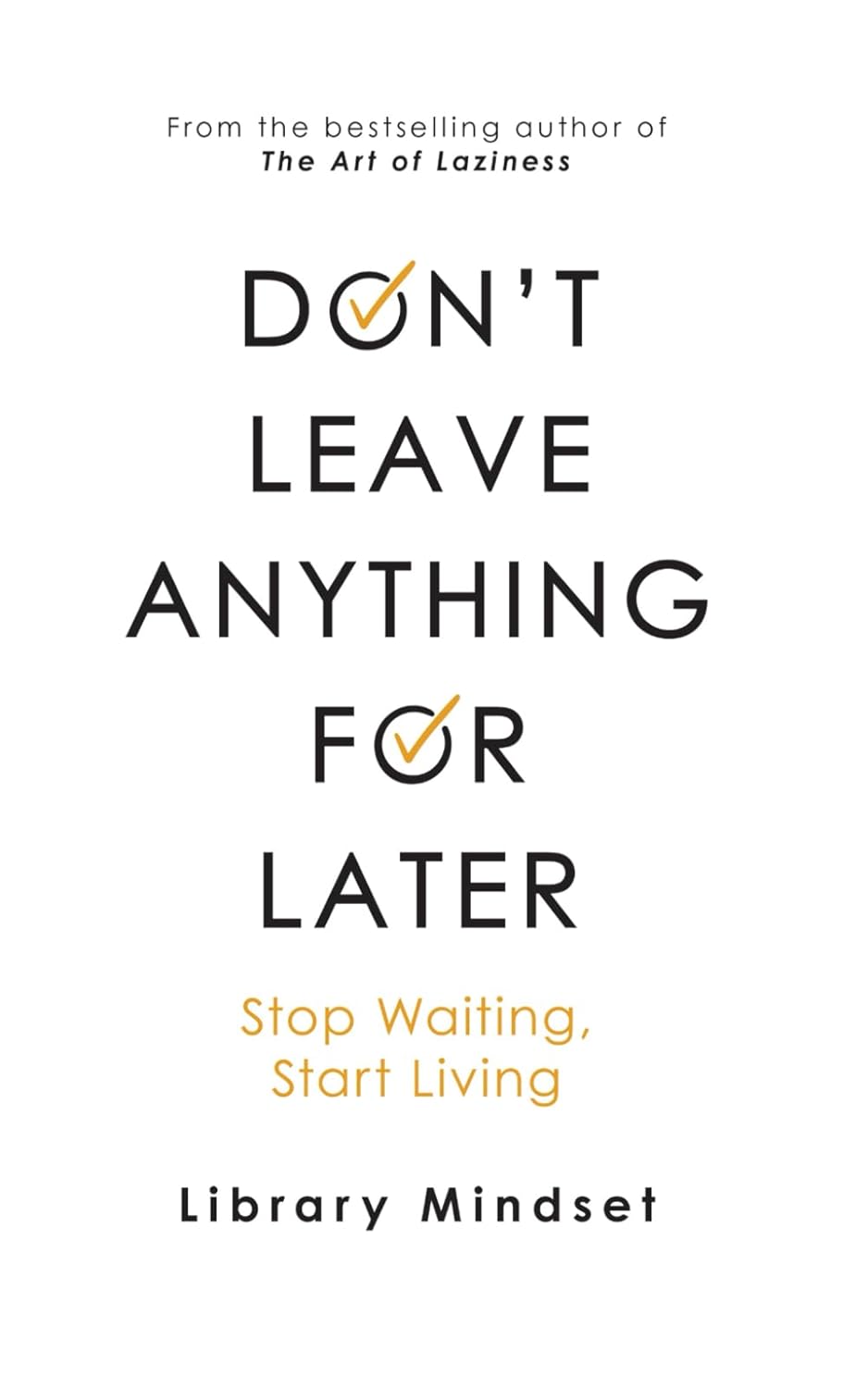
Introduction: The Cost of Waiting
Summary:
This chapter outlines how delaying tasks creates hidden costs in time, energy, and opportunity, arguing that small postponements compound into significant losses. It introduces the core claim that treating work like borrowing from a library of time leads to smarter, immediate action.
Key points:
- Waiting multiplies friction and reduces motivation over time.
- Short delays often become habitual procrastination that undermines goals.
- Opportunity cost: postponed actions foreclose future options.
Themes & relevance:
The chapter frames procrastination as an economic and psychological inefficiency, relevant to anyone wanting to reclaim time and momentum. It sets the tone for practical fixes that follow.
Takeaway / How to use:
Treat small tasks as high-priority loans to your future self and act on them immediately.
Key points
- Waiting multiplies friction and reduces motivation over time.
- Short delays often become habitual procrastination that undermines goals.
- Opportunity cost: postponed actions foreclose future options.
The Library Mindset Explained
Summary:
This chapter defines the "Library Mindset" as the practice of treating available time and resources like a public library—borrow responsibly, return promptly, and avoid hoarding. It explains how this mental model reduces accumulation of unfinished tasks and fosters disciplined stewardship of attention.
Key points:
- Visualize tasks as borrowed items that must be checked out and returned promptly.
- The mindset reduces attachment to perfection and encourages timely completion.
- It creates clear criteria for when to keep, postpone, or discard tasks.
- Adopting this model reorganizes priorities around circulation, not accumulation.
Themes & relevance:
By offering a concrete metaphor, the Library Mindset makes abstract self-management principles actionable and relatable. It’s relevant for building consistent habits around work and time.
Takeaway / How to use:
Adopt the Library Mindset: check out a task, set a return (deadline), and follow through promptly.
Key points
- Visualize tasks as borrowed items that must be checked out and returned promptly.
- The mindset reduces attachment to perfection and encourages timely completion.
- It creates clear criteria for when to keep, postpone, or discard tasks.
- Adopting this model reorganizes priorities around circulation, not accumulation.
Why We Procrastinate
Summary:
This chapter examines the psychological, emotional, and situational causes of procrastination, including fear of failure, decision paralysis, and poor reward structures. It emphasizes that procrastination is often a coping mechanism rather than mere laziness.
Key points:
- Fear (of failure, judgment, or success) triggers avoidance behaviors.
- Overwhelm and unclear next steps lead to decision paralysis.
- Immediate comfort often outweighs long
- term benefits in human motivation.
- Environmental cues and bad habits reinforce delay patterns.
Themes & relevance:
Understanding root causes reframes procrastination from a character flaw to a solvable system problem, making interventions more effective. This insight is essential before applying strategies later in the book.
Takeaway / How to use:
Identify which emotional or situational trigger causes your delay and address that root cause first.
Key points
- Fear (of failure, judgment, or success) triggers avoidance behaviors.
- Overwhelm and unclear next steps lead to decision paralysis.
- Immediate comfort often outweighs long
- term benefits in human motivation.
- Environmental cues and bad habits reinforce delay patterns.
Prioritize: What Truly Matters
Summary:
This chapter provides methods for distinguishing high-impact tasks from low
- value activities, urging readers to focus on work that aligns with long-term goals. It introduces simple prioritization frameworks to reduce decision fatigue and direct energy where it matters most.
Key points:
- Use outcome
- oriented criteria to rank tasks by impact rather than urgency.
- Apply the 80/20 rule: identify the 20% of tasks that create 80% of results.
- Limit daily priorities to a small, manageable set to ensure progress.
- Learn to say no to tasks that don't advance core objectives.
Themes & relevance:
Prioritization turns the Library Mindset into actionable lists, ensuring limited time is spent on meaningful work; it’s crucial for improving productivity without burnout. The chapter connects values to daily action.
Takeaway / How to use:
Each morning, pick the top 1–3 tasks that will move your main goal forward and protect time to complete them.
Key points
- Use outcome
- oriented criteria to rank tasks by impact rather than urgency.
- Apply the 80/20 rule: identify the 20% of tasks that create 80% of results.
- Limit daily priorities to a small, manageable set to ensure progress.
- Learn to say no to tasks that don't advance core objectives.
Chunking: Small Steps, Big Results
Summary:
The chapter explains chunking: breaking large tasks into bite-sized, non
- intimidating steps to reduce friction and build momentum. It shows how consistent small actions compound into significant progress and makes success feel achievable.
Key points:
- Divide projects into specific, time
- boxed chunks to eliminate overwhelm.
- Start with the smallest possible step to overcome initiation inertia.
- Use sequential micro
- goals to sustain motivation and measure progress.
- Combine chunking with deadlines for improved accountability.
Themes & relevance:
Chunking operationalizes procrastination solutions by converting vague intentions into concrete, repeatable actions; it’s relevant for any long-term project or habit change. The approach increases likelihood of starting and finishing work.
Takeaway / How to use:
Break your next big task into a five-minute first step and do it immediately.
Key points
- Divide projects into specific, time
- boxed chunks to eliminate overwhelm.
- Start with the smallest possible step to overcome initiation inertia.
- Use sequential micro
- goals to sustain motivation and measure progress.
- Combine chunking with deadlines for improved accountability.
Planning to Win: Daily and Weekly Systems
Summary:
This chapter lays out practical planning systems—daily and weekly—that structure work, create predictable progress, and reduce reactive scrambling. It recommends short planning rituals that align priorities, chunked tasks, and real-life constraints into sustainable schedules.
Key points:
- Weekly planning identifies key outcomes and schedules focused work blocks.
- Daily planning translates weekly aims into prioritized, realistic tasks.
- Time blocking and theme days limit context switching and improve deep work.
- Review and adjust plans regularly to stay flexible and learn from experience.
Themes & relevance:
Consistent planning systems bridge intention and action, turning motivation into measurable outcomes; this is essential for long-term behavior change and avoiding relapse into procrastination.
Takeaway / How to use:
Create a 10-minute evening routine to plan the next day and a weekly review to set priorities.
Key points
- Weekly planning identifies key outcomes and schedules focused work blocks.
- Daily planning translates weekly aims into prioritized, realistic tasks.
- Time blocking and theme days limit context switching and improve deep work.
- Review and adjust plans regularly to stay flexible and learn from experience.
Routines and Rituals for Consistency
Summary:
This chapter focuses on building daily routines and rituals that automate good behavior, reduce decision fatigue, and create reliable momentum. It highlights the importance of environmental design and cues to make desired actions habitual.
Key points:
- Routines reduce reliance on willpower by creating predictable patterns.
- Rituals (short, repeatable actions) cue focus and mark transitions into work mode.
- Design your environment to make the desired behavior easier and defaults productive.
- Start small and layer routines gradually to avoid overwhelm.
Themes & relevance:
Routines are the practical backbone of the Library Mindset, converting planning into habitual action and preserving cognitive resources for important decisions. They sustain productivity through consistency.
Takeaway / How to use:
Design one small morning or pre-work ritual that reliably signals the start of focused work.
Key points
- Routines reduce reliance on willpower by creating predictable patterns.
- Rituals (short, repeatable actions) cue focus and mark transitions into work mode.
- Design your environment to make the desired behavior easier and defaults productive.
- Start small and layer routines gradually to avoid overwhelm.
Defeating Perfectionism and Fear
Summary:
This chapter tackles perfectionism and fear as major barriers that stall action, offering cognitive reframes and behavioral tactics to move past them. It emphasizes progress over perfection and recommends experiments and deadlines to reduce anxiety around outcomes.
Key points:
- Reframe mistakes as feedback and early iterations as learning opportunities.
- Use time
- boxed experiments to test ideas quickly and lower stakes.
- Set minimal viable standards to avoid endless refinement.
- Build a culture of iteration: publish imperfect work and improve based on response.
Themes & relevance:
Reducing fear and perfectionism aligns emotional regulation with the Library Mindset, enabling faster circulation of ideas and work; this is crucial to maintain momentum and avoid paralysis.
Takeaway / How to use:
Commit to shipping a minimally viable version of a project within a fixed short timeframe.
Key points
- Reframe mistakes as feedback and early iterations as learning opportunities.
- Use time
- boxed experiments to test ideas quickly and lower stakes.
- Set minimal viable standards to avoid endless refinement.
- Build a culture of iteration: publish imperfect work and improve based on response.
Focus, Flow, and Deep Work
Summary:
The chapter explores how concentrated attention and deliberate practice enable high-value output, emphasizing the mechanics of flow and the conditions for deep work. It provides strategies to minimize distractions and structure time for sustained, meaningful effort.
Key points:
- Deep work requires prolonged, uninterrupted blocks of attention; schedule these deliberately rather than hoping they happen.
- Create rituals and a dedicated workspace to cue focused behavior and reduce decision fatigue.
- Eliminate or batch shallow tasks (email, small chores) to protect creative energy for important work.
- Use clear goals and immediate feedback to enter and sustain flow states.
- Boundaries and digital discipline (notifications off, defined times for messages) are essential to maintain focus.
Themes & relevance:
Converting intention into output depends on systems that protect attention and enable flow; this is central to overcoming procrastination and producing meaningful results. These ideas are relevant across careers and personal projects where depth rather than busyness matters.
Takeaway / How to use:
Schedule at least one uninterrupted 60–90 minute deep work block each day and protect it from interruptions.
Key points
- Deep work requires prolonged, uninterrupted blocks of attention; schedule these deliberately rather than hoping they happen.
- Create rituals and a dedicated workspace to cue focused behavior and reduce decision fatigue.
- Eliminate or batch shallow tasks (email, small chores) to protect creative energy for important work.
- Use clear goals and immediate feedback to enter and sustain flow states.
- Boundaries and digital discipline (notifications off, defined times for messages) are essential to maintain focus.
Tools and Techniques to Stay On Track
Summary:
This chapter surveys practical tools and techniques—both digital and behavioral—that help translate plans into consistent action. It recommends combining time-management frameworks with simple technology and automation to reduce friction and keep progress visible.
Key points:
- Time blocking and calendar
- first planning convert priorities into concrete commitments on your day.
- Task managers and checklists prevent things from slipping and enable quick capture and processing of ideas.
- Use the Eisenhower matrix or prioritization rules to focus on what moves the needle rather than what feels urgent.
- Automate repetitive tasks and create templates to remove small decision costs that accumulate into delays.
- Employ minimal, consistent tools rather than many apps; complexity breeds procrastination.
Themes & relevance:
Practical systems and the right tooling reduce cognitive overhead and make follow-through easier, directly combating the inertia that causes delay. These techniques are adaptable across personal, professional, and creative workflows.
Takeaway / How to use:
Pick one time-management technique (e.g., time blocking) and one task tool, implement both consistently for two weeks, then refine.
Key points
- Time blocking and calendar
- first planning convert priorities into concrete commitments on your day.
- Task managers and checklists prevent things from slipping and enable quick capture and processing of ideas.
- Use the Eisenhower matrix or prioritization rules to focus on what moves the needle rather than what feels urgent.
- Automate repetitive tasks and create templates to remove small decision costs that accumulate into delays.
- Employ minimal, consistent tools rather than many apps; complexity breeds procrastination.
Accountability, Habits, and Motivation
Summary:
The chapter connects social structures, habit design, and motivational strategies to sustained action, arguing that accountability and identity-based habits are more durable than raw willpower. It outlines how small, repeatable behaviors and external commitments create momentum and make procrastination less likely.
Key points:
- External accountability (partners, public commitments, deadlines) raises the cost of delay and increases follow
- through.
- Build habits using clear cues, simple routines, and immediate rewards; start tiny to ensure consistency.
- Link tasks to identity (“I am the kind of person who…”) to shift motivation from fleeting to stable.
- Use commitment devices and progress tracking to maintain motivation during low
- incentive stretches.
- Reframe setbacks as data for adjustment rather than proof of failure to preserve long
- term engagement.
Themes & relevance:
Sustainable productivity depends on systems that embed action into identity and social structure; motivation alone is unreliable without habit and accountability scaffolding. These principles help maintain progress on long-term goals and prevent relapse into procrastination.
Takeaway / How to use:
Create one small daily habit tied to your priority and add an accountability check-in (partner or app) to sustain it.
Key points
- External accountability (partners, public commitments, deadlines) raises the cost of delay and increases follow
- through.
- Build habits using clear cues, simple routines, and immediate rewards; start tiny to ensure consistency.
- Link tasks to identity (“I am the kind of person who…”) to shift motivation from fleeting to stable.
- Use commitment devices and progress tracking to maintain motivation during low
- incentive stretches.
- Reframe setbacks as data for adjustment rather than proof of failure to preserve long
- term engagement.
Reflection and Lifelong Action
Summary:
The final chapter emphasizes regular reflection, iteration, and the development of lifelong systems that prevent tasks from being postponed indefinitely. It advocates scheduled reviews and learning practices to adapt goals, celebrate progress, and continuously reduce friction in decision-making.
Key points:
- Regular reviews (daily, weekly, quarterly) surface unfinished items and allow course corrections before small delays become big backlogs.
- Reflective practices—journaling, after
- action reviews, and metrics—turn experience into improvement.
- Treat systems as living: refine workflows, tools, and priorities as circumstances and values evolve.
- Celebrate small wins and document lessons to reinforce motivation and prevent repeat procrastination patterns.
- Long
- term change comes from modest, repeated improvements rather than dramatic one-time efforts.
Themes & relevance:
Ongoing reflection and system maintenance are crucial to converting short-term gains into lifelong capability; without this, old habits and delays resurface. These practices make productivity resilient and aligned with evolving goals.
Takeaway / How to use:
Schedule a weekly 30-minute review to clear backlogs, update priorities, and note one improvement to implement next week.
Key points
- Regular reviews (daily, weekly, quarterly) surface unfinished items and allow course corrections before small delays become big backlogs.
- Reflective practices—journaling, after
- action reviews, and metrics—turn experience into improvement.
- Treat systems as living: refine workflows, tools, and priorities as circumstances and values evolve.
- Celebrate small wins and document lessons to reinforce motivation and prevent repeat procrastination patterns.
- Long
- term change comes from modest, repeated improvements rather than dramatic one-time efforts.