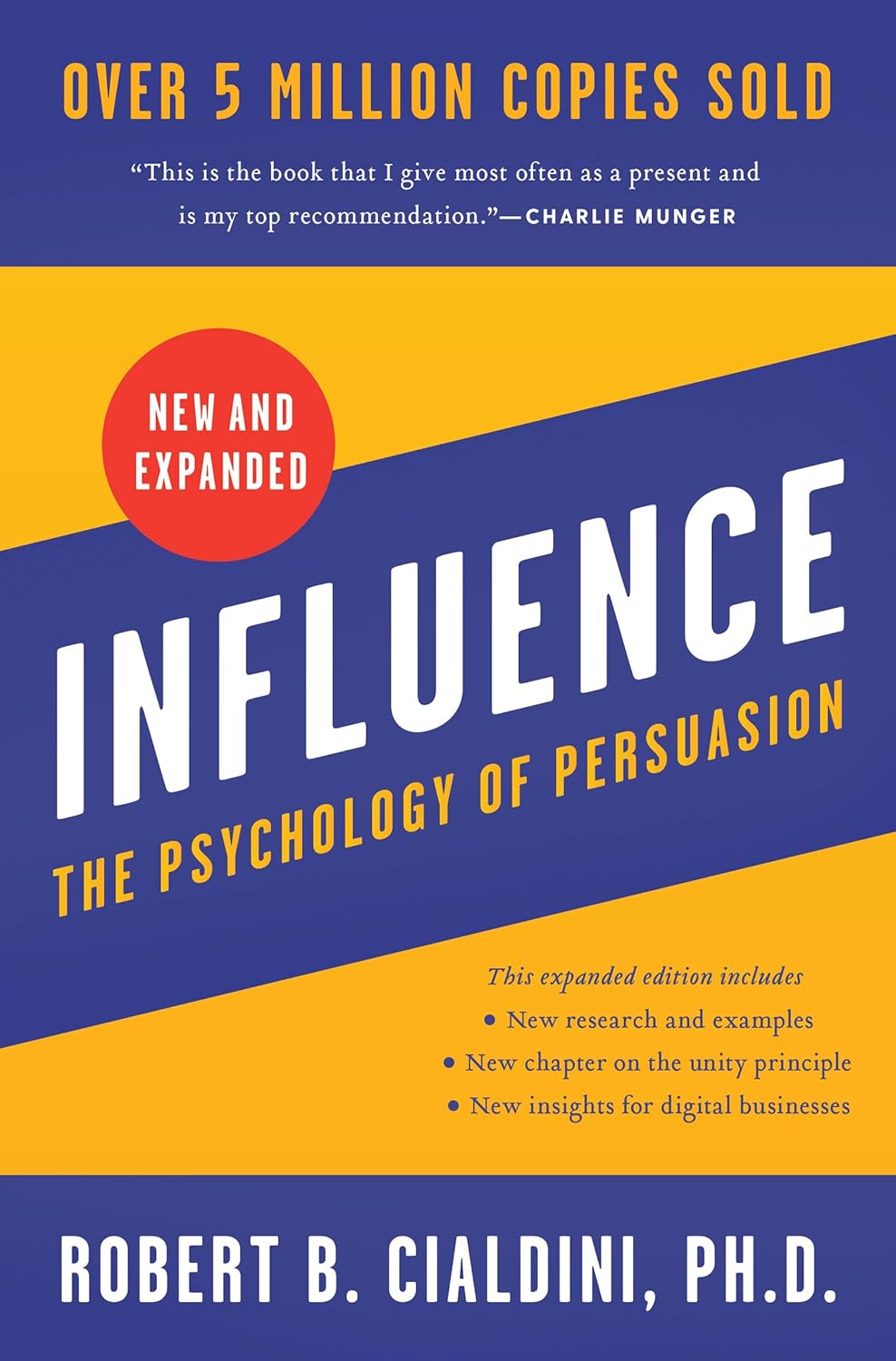
Influence: The Psychology of Persuasion: ReadSprint summary highlights
ReadSprint paraphrases for review. These highlights are not verbatim quotations from the book or its author. Check the original edition for exact wording and context.
Influence: The Psychology of Persuasion
by Robert B. Cialdini, Ph.D.
Robert Cialdini introduces the idea that humans rely on automatic mental shortcuts—fixed-action patterns or "click, whirr" responses—that simplify decision making and make people vulnerable to manipulation.
ReadSprint paraphrase · Not a quotation from the author.
Robert Cialdini introduces the idea that humans rely on automatic mental shortcuts—fixed-action patterns or "click, whirr" responses—that simplify decision making and make people vulnerable to manipulation.
People use automatic heuristics to conserve effort, responding to simple cues rather than full analysis.
Share with the ReadSprint source so others can read the context.
Influence: The Psychology of Persuasion
by Robert B. Cialdini, Ph.D.
He outlines how specific trigger features and trained responses can produce predictable compliance without thoughtful analysis.
ReadSprint paraphrase · Not a quotation from the author.
He outlines how specific trigger features and trained responses can produce predictable compliance without thoughtful analysis.
Trigger features (specific stimuli) reliably evoke preprogrammed responses (fixed
Share with the ReadSprint source so others can read the context.
Influence: The Psychology of Persuasion
by Robert B. Cialdini, Ph.D.
Cialdini explains the universal rule of reciprocity: people feel obligated to return favors, concessions, or gifts, even when unsolicited.
ReadSprint paraphrase · Not a quotation from the author.
Cialdini explains the universal rule of reciprocity: people feel obligated to return favors, concessions, or gifts, even when unsolicited.
action patterns).
Share with the ReadSprint source so others can read the context.
Influence: The Psychology of Persuasion
by Robert B. Cialdini, Ph.D.
This rule fosters social cohesion but is also exploited by persuaders who give small gifts or make concessions to elicit larger returns.
ReadSprint paraphrase · Not a quotation from the author.
This rule fosters social cohesion but is also exploited by persuaders who give small gifts or make concessions to elicit larger returns.
Compliance professionals exploit these shortcuts with predictable tactics and sequences.
Share with the ReadSprint source so others can read the context.
Influence: The Psychology of Persuasion
by Robert B. Cialdini, Ph.D.
This chapter shows that once people commit—especially publicly or actively—to a position or action, they strongly prefer consistency between that commitment and later behavior.
ReadSprint paraphrase · Not a quotation from the author.
This chapter shows that once people commit—especially publicly or actively—to a position or action, they strongly prefer consistency between that commitment and later behavior.
Understanding these mechanisms helps recognize when one is being led into automatic compliance.
Share with the ReadSprint source so others can read the context.
Influence: The Psychology of Persuasion
by Robert B. Cialdini, Ph.D.
Small initial commitments are often used to create larger compliance over time (the foot-in the-door effect).
ReadSprint paraphrase · Not a quotation from the author.
Small initial commitments are often used to create larger compliance over time (the foot-in the-door effect).
The chapter sets up the later discussion of specific principles (reciprocity, commitment, social proof, liking, authority, scarcity, unity).
Share with the ReadSprint source so others can read the context.
Influence: The Psychology of Persuasion
by Robert B. Cialdini, Ph.D.
Cialdini describes social proof: in uncertain situations people look to the behavior of others to determine correct action, assuming others' behavior reflects the right choice.
ReadSprint paraphrase · Not a quotation from the author.
Cialdini describes social proof: in uncertain situations people look to the behavior of others to determine correct action, assuming others' behavior reflects the right choice.
Learn to spot trigger features and pause before responding to automatic cues.
Share with the ReadSprint source so others can read the context.
Influence: The Psychology of Persuasion
by Robert B. Cialdini, Ph.D.
This heuristic can rapidly amplify behaviors—useful in learning but exploitable in group influences and emergencies.
ReadSprint paraphrase · Not a quotation from the author.
This heuristic can rapidly amplify behaviors—useful in learning but exploitable in group influences and emergencies.
The chapter frames persuasion as largely driven by psychological shortcuts rather than rational deliberation, making the insights relevant to anyone who wants to resist manipulation or design ethical influence strategies. It emphasizes awareness of context and cues that elicit automatic responses.
Share with the ReadSprint source so others can read the context.
Influence: The Psychology of Persuasion
by Robert B. Cialdini, Ph.D.
Cialdini shows that people are more likely to comply with requests from people they like, and liking is increased by factors such as similarity, compliments, contact and cooperation, and physical attractiveness.
ReadSprint paraphrase · Not a quotation from the author.
Cialdini shows that people are more likely to comply with requests from people they like, and liking is increased by factors such as similarity, compliments, contact and cooperation, and physical attractiveness.
Robert Cialdini introduces the idea that humans rely on automatic mental shortcuts—fixed-action patterns or "click, whirr" responses—that simplify decision making and make people vulnerable to manipulation. He outlines how specific trigger features and trained responses can produce predictable compliance without thoughtful analysis.
Share with the ReadSprint source so others can read the context.
Influence: The Psychology of Persuasion
by Robert B. Cialdini, Ph.D.
Persuaders cultivate rapport and affinity to gain influence.
ReadSprint paraphrase · Not a quotation from the author.
Persuaders cultivate rapport and affinity to gain influence.
Reciprocity is a powerful, nearly universal social norm that obliges repayment of favors.
Share with the ReadSprint source so others can read the context.