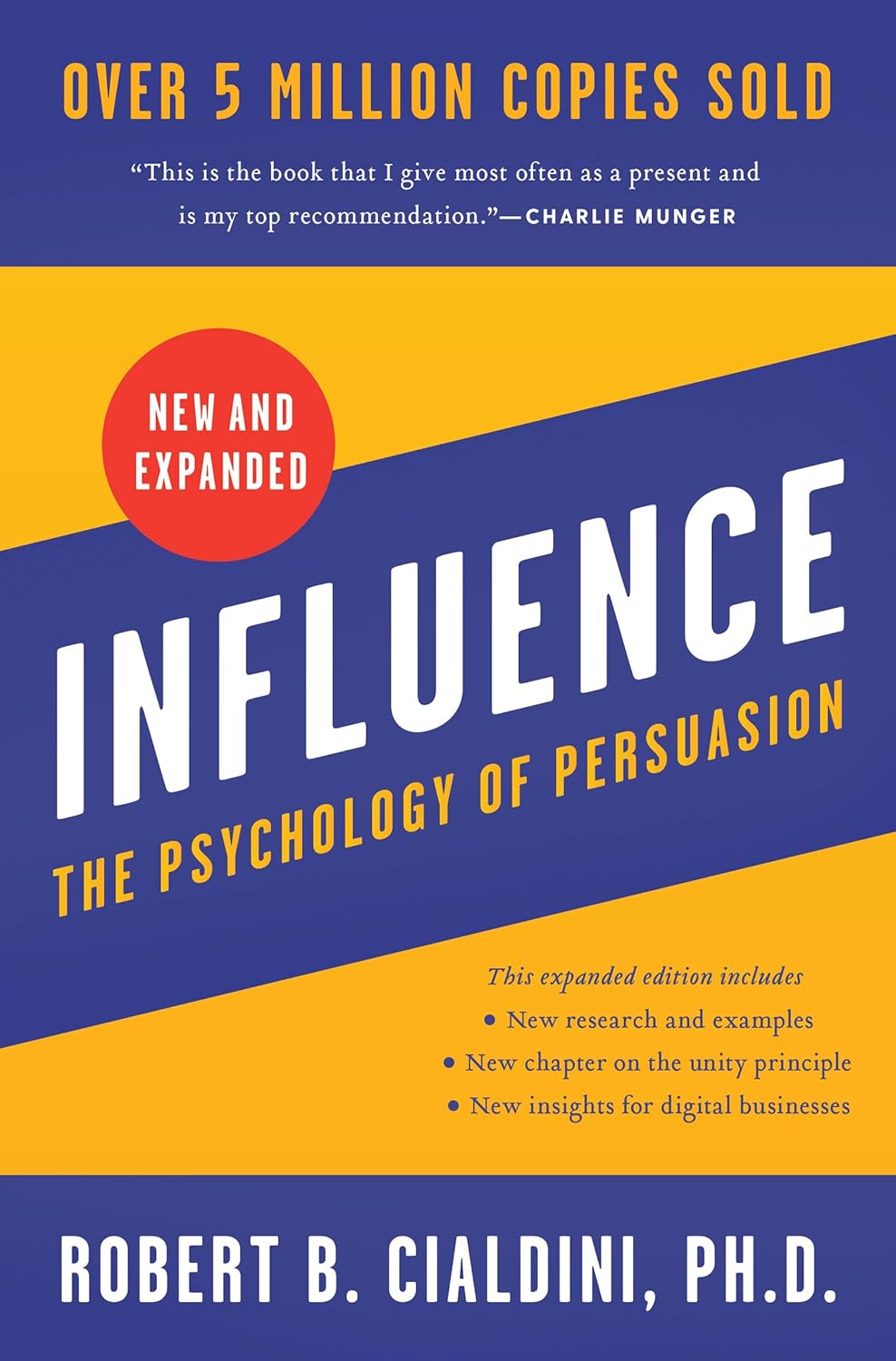
Weapons of Influence
Summary:
Robert Cialdini introduces the idea that humans rely on automatic mental shortcuts—fixed-action patterns or "click, whirr" responses—that simplify decision
- making and make people vulnerable to manipulation. He outlines how specific trigger features and trained responses can produce predictable compliance without thoughtful analysis.
Key points:
- People use automatic heuristics to conserve effort, responding to simple cues rather than full analysis.
- Trigger features (specific stimuli) reliably evoke preprogrammed responses (fixed
- action patterns).
- Compliance professionals exploit these shortcuts with predictable tactics and sequences.
- Understanding these mechanisms helps recognize when one is being led into automatic compliance.
- The chapter sets up the later discussion of specific principles (reciprocity, commitment, social proof, liking, authority, scarcity, unity).
Themes & relevance:
The chapter frames persuasion as largely driven by psychological shortcuts rather than rational deliberation, making the insights relevant to anyone who wants to resist manipulation or design ethical influence strategies. It emphasizes awareness of context and cues that elicit automatic responses.
Takeaway / How to use:
Learn to spot trigger features and pause before responding to automatic cues.
Key points
- People use automatic heuristics to conserve effort, responding to simple cues rather than full analysis.
- Trigger features (specific stimuli) reliably evoke preprogrammed responses (fixed
- action patterns).
- Compliance professionals exploit these shortcuts with predictable tactics and sequences.
- Understanding these mechanisms helps recognize when one is being led into automatic compliance.
- The chapter sets up the later discussion of specific principles (reciprocity, commitment, social proof, liking, authority, scarcity, unity).
Reciprocation: The Old Give and Take
Summary:
Cialdini explains the universal rule of reciprocity: people feel obligated to return favors, concessions, or gifts, even when unsolicited. This rule fosters social cohesion but is also exploited by persuaders who give small gifts or make concessions to elicit larger returns.
Key points:
- Reciprocity is a powerful, nearly universal social norm that obliges repayment of favors.
- Uninvited gifts or concessions create an obligation and increase compliance with requests.
- Techniques such as the "door
- in-the
- face" (large request followed by smaller one) leverage perceived concession to gain agreement.
- Reciprocity can create unbalanced exchanges where recipients feel compelled to comply beyond their interests.
- Awareness of reciprocal tactics can reduce their automatic persuasive power.
Themes & relevance:
The reciprocity principle highlights how moral rules that bind societies can be manipulated in everyday persuasion, making it crucial for consumers, negotiators, and marketers to recognize and manage obligations. It remains relevant in sales, fundraising, and interpersonal influence.
Takeaway / How to use:
Before repaying a perceived favor, evaluate whether the obligation is being used to manipulate your choices.
Key points
- Reciprocity is a powerful, nearly universal social norm that obliges repayment of favors.
- Uninvited gifts or concessions create an obligation and increase compliance with requests.
- Techniques such as the "door
- in-the
- face" (large request followed by smaller one) leverage perceived concession to gain agreement.
- Reciprocity can create unbalanced exchanges where recipients feel compelled to comply beyond their interests.
- Awareness of reciprocal tactics can reduce their automatic persuasive power.
Commitment and Consistency: Hobgoblins of the Mind
Summary:
This chapter shows that once people commit—especially publicly or actively—to a position or action, they strongly prefer consistency between that commitment and later behavior. Small initial commitments are often used to create larger compliance over time (the foot-in
- the-door effect).
Key points:
- People strive for internal consistency; commitments constrain future behavior to align with past statements or acts.
- Active, public, and written commitments are especially potent in producing consistent follow
- through.
- The foot
- in-the
- door technique obtains small compliance first to secure larger compliance later.
- Consistency can lead to irrational persistence if the original commitment was made under poor conditions.
- Recognizing the power of commitment helps both in ethical behavior change and in defending against manipulative sequences.
Themes & relevance:
Commitment and consistency explain many real-world phenomena—brand loyalty, escalation of commitment, and compliance techniques—and are relevant to anyone designing long
- term behavior change or resisting stepwise manipulation. The chapter shows how tiny steps can lock people into major choices.
Takeaway / How to use:
Avoid making small, ambiguous commitments you may later feel forced to honor; pause before agreeing to initial requests.
Key points
- People strive for internal consistency; commitments constrain future behavior to align with past statements or acts.
- Active, public, and written commitments are especially potent in producing consistent follow
- through.
- The foot
- in-the
- door technique obtains small compliance first to secure larger compliance later.
- Consistency can lead to irrational persistence if the original commitment was made under poor conditions.
- Recognizing the power of commitment helps both in ethical behavior change and in defending against manipulative sequences.
Social Proof: Truths Are Us
Summary:
Cialdini describes social proof: in uncertain situations people look to the behavior of others to determine correct action, assuming others' behavior reflects the right choice. This heuristic can rapidly amplify behaviors—useful in learning but exploitable in group influences and emergencies.
Key points:
- People use others' actions as a shortcut to decide how to behave, especially in ambiguity or crisis.
- The influence of social proof grows with the number, similarity, and perceived independence of the model people follow.
- Pluralistic ignorance and the bystander effect arise when everyone looks to others and no one acts.
- Marketers and persuaders exploit social proof with testimonials, crowd cues, and staged popularity.
- Critical thinking and verification reduce blind reliance on social proof.
Themes & relevance:
Social proof ties individual decisions to collective behavior, explaining phenomena from fad adoption to emergency inaction; understanding it is essential for ethical marketing and for avoiding herd-driven mistakes. It highlights the responsibility to seek independent evidence in uncertain contexts.
Takeaway / How to use:
Check whether others' behavior is based on reliable information before using it as your guide.
Key points
- People use others' actions as a shortcut to decide how to behave, especially in ambiguity or crisis.
- The influence of social proof grows with the number, similarity, and perceived independence of the model people follow.
- Pluralistic ignorance and the bystander effect arise when everyone looks to others and no one acts.
- Marketers and persuaders exploit social proof with testimonials, crowd cues, and staged popularity.
- Critical thinking and verification reduce blind reliance on social proof.
Liking: The Friendly Thief
Summary:
Cialdini shows that people are more likely to comply with requests from people they like, and liking is increased by factors such as similarity, compliments, contact and cooperation, and physical attractiveness. Persuaders cultivate rapport and affinity to gain influence.
Key points:
- Liking increases compliance: we say yes more often to people we like.
- Similarity, praise, frequent contact, cooperation toward common goals, and attractiveness all increase liking.
- The halo effect causes desirable traits (like attractiveness) to spill over into perceived trustworthiness or competence.
- Sales and recruitment often manufacture liking through scripted compliments and carefully staged interactions.
- Building genuine rapport ethically increases persuasive effectiveness; manufactured liking can be deceptive.
Themes & relevance:
Liking connects interpersonal chemistry to persuasion, showing how social bonds and surface cues shape decisions—relevant for sales, leadership, and everyday requests. It underscores the importance of authentic relationship-building versus manipulative flattery.
Takeaway / How to use:
Cultivate genuine similarity and rapport rather than relying on superficial flattery to influence others.
Key points
- Liking increases compliance: we say yes more often to people we like.
- Similarity, praise, frequent contact, cooperation toward common goals, and attractiveness all increase liking.
- The halo effect causes desirable traits (like attractiveness) to spill over into perceived trustworthiness or competence.
- Sales and recruitment often manufacture liking through scripted compliments and carefully staged interactions.
- Building genuine rapport ethically increases persuasive effectiveness; manufactured liking can be deceptive.
Authority: Directed Deference
Summary:
This chapter documents how people defer to authority figures and symbols—titles, clothing, and trappings—often without critical scrutiny. Such deference simplifies decisions but can produce harmful blind obedience when authority is false or misapplied (illustrated by Milgram-style findings).
Key points:
- Authority cues (titles, uniforms, badges) act as powerful shortcuts prompting compliance.
- People are conditioned to respect and defer to perceived experts or legitimate officials.
- Obedience to authority can override moral judgment, enabling harmful actions under orders.
- Authority can be faked; apparent credentials should be checked before yielding influence.
- Legitimate use of authority requires ethical responsibility and transparency.
Themes & relevance:
Authority explains why professionals, leaders, and institutions wield disproportionate influence and why verifying credentials and motives is essential for informed consent. The chapter warns of the social danger when authority is accepted reflexively.
Takeaway / How to use:
Verify the legitimacy of authority cues before deferring to them.
Key points
- Authority cues (titles, uniforms, badges) act as powerful shortcuts prompting compliance.
- People are conditioned to respect and defer to perceived experts or legitimate officials.
- Obedience to authority can override moral judgment, enabling harmful actions under orders.
- Authority can be faked; apparent credentials should be checked before yielding influence.
- Legitimate use of authority requires ethical responsibility and transparency.
Scarcity: The Rule of the Few
Summary:
Cialdini explains that items or opportunities that are scarce or becoming scarce are perceived as more valuable, triggering reactance and increased desire. Marketers exploit limited supply and deadlines to create urgency and boost compliance.
Key points:
- Scarcity increases perceived value and desirability by signaling uniqueness or loss of freedom.
- Two main scarcity triggers are limited quantity and limited time; both provoke stronger, faster decisions.
- Psychological reactance (desire to restore lost freedoms) amplifies the appeal of restricted options.
- Scarcity can lead to poor decision
- making, panic buying, and inflated valuations.
- Awareness of manufactured scarcity helps resist pressure and make more deliberate choices.
Themes & relevance:
Scarcity taps into basic loss-avoidance motives, shaping consumer behavior, auctions, and social dynamics; recognizing scarcity tactics helps people avoid rushed, regretful decisions. Ethical communicators should avoid exploiting scarcity artificially.
Takeaway / How to use:
Question urgent or limited-offer claims and pause before acting under scarcity pressure.
Key points
- Scarcity increases perceived value and desirability by signaling uniqueness or loss of freedom.
- Two main scarcity triggers are limited quantity and limited time; both provoke stronger, faster decisions.
- Psychological reactance (desire to restore lost freedoms) amplifies the appeal of restricted options.
- Scarcity can lead to poor decision
- making, panic buying, and inflated valuations.
- Awareness of manufactured scarcity helps resist pressure and make more deliberate choices.
Unity
Summary:
Cialdini introduces unity as a principle of persuasion based on shared identity—people are more influenced by those they see as part of the same group or kin (the "we" factor). Bonds of family, race, religion, and shared experiences create obligations and trust that increase compliance.
Key points:
- Unity operates through perceived shared essence: family ties, common history, and group identifiers strengthen influence.
- Unity
- based appeals create obligations that are stronger than ordinary liking or social proof.
- Marketers and persuaders use labels, rituals, and symbols to cultivate a sense of "we
- ness."
- Unity can produce rapid cooperation but also in
- group bias and exclusion of outsiders.
- Ethical use of unity emphasizes genuine shared interests rather than manufactured tribalism.
Themes & relevance:
Unity adds a relational dimension to persuasion, showing that shared identity can be the most compelling basis for influence in politics, marketing, and community organizing. It highlights the double-edged nature of tribal bonds for both cohesion and manipulation.
Takeaway / How to use:
Leverage genuine shared identity to build influence responsibly and be wary of appeals that invent tribal ties to manipulate you.
Key points
- Unity operates through perceived shared essence: family ties, common history, and group identifiers strengthen influence.
- Unity
- based appeals create obligations that are stronger than ordinary liking or social proof.
- Marketers and persuaders use labels, rituals, and symbols to cultivate a sense of "we
- ness."
- Unity can produce rapid cooperation but also in
- group bias and exclusion of outsiders.
- Ethical use of unity emphasizes genuine shared interests rather than manufactured tribalism.