Book overview
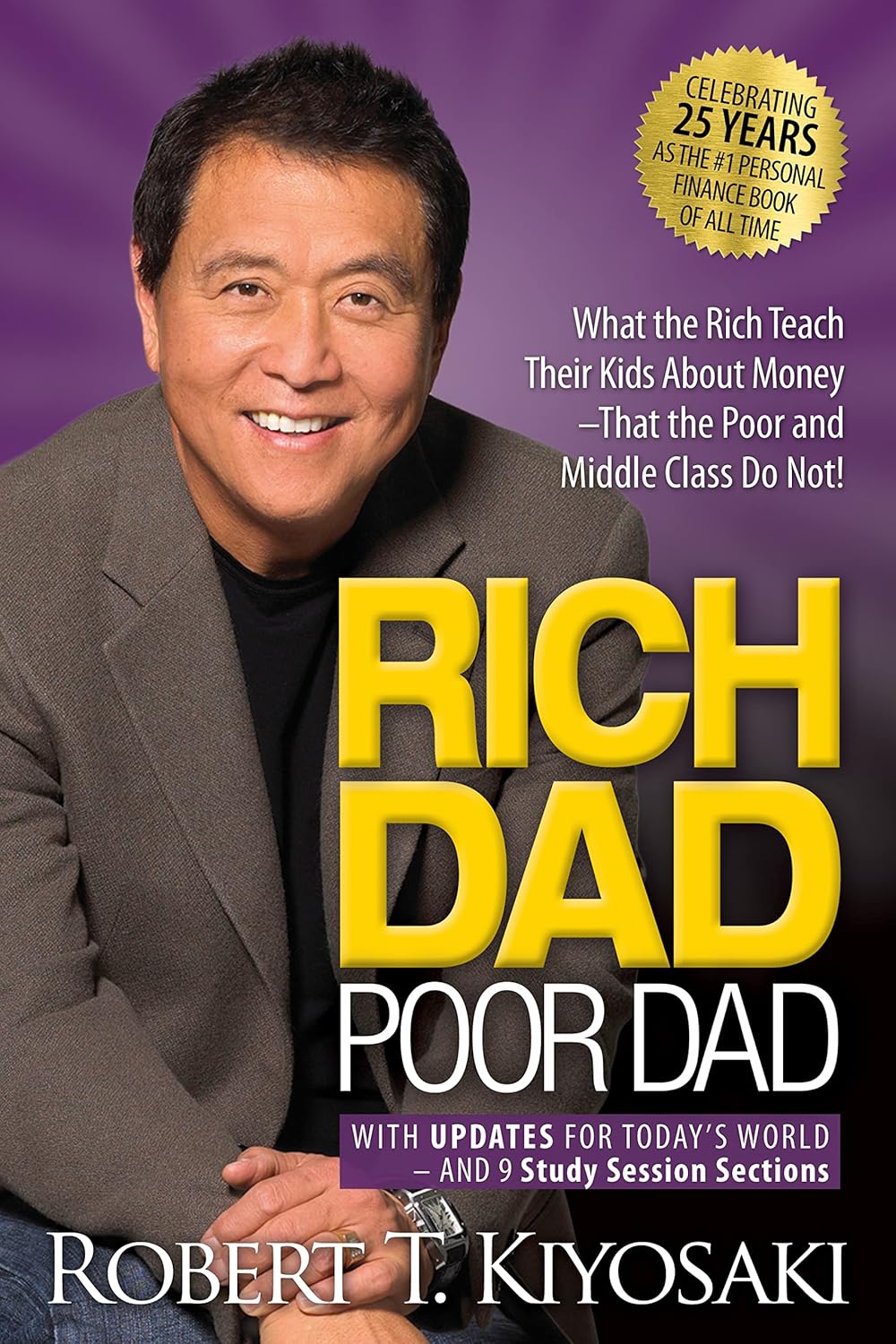
Robert Kiyosaki contrasts his two "dads" to show that the poor and middle-class work for money while the rich make money work for them. He emphasizes changing mindset from earning a paycheck to seeking financial intelligence and opportunities.
This page is built to be a compact learning hub for Rich Dad Poor Dad. You can move from the high-level summary into takeaways, quiz prompts, chapter review, and related books without breaking the reading flow.
Best takeaways to keep
Fear and desire drive people to work for money instead of learning how money works.
The rich focus on acquiring assets that produce income rather than working for salary alone.
Financial education teaches you to recognize opportunities and manage risk.
Learn to let money generate passive income so you are not dependent on a job.
Shift your focus from earning a bigger paycheck to acquiring or creating income-producing assets.
Mindset and financial education are foundational: how you think about money determines your actions and long-term outcomes. This is directly relevant to anyone aiming to build wealth beyond employment.
Retrieval practice
According to Rich Dad Poor Dad, how do the rich handle money differently from the poor and middle class?
What key financial concept does Kiyosaki say is essential to build true wealth?
What does Kiyosaki mean by 'Mind Your Own Business'?
How does the book describe the advantage wealthy people gain from corporations and tax history?
Quiz preview
According to Rich Dad Poor Dad, how do the rich handle money differently from the poor and middle class?
- They make money work for them (focus on creating assets that generate income)
- They work harder for a paycheck and save what remains
- They avoid all risks and keep money in cash
What key financial concept does Kiyosaki say is essential to build true wealth?
- Knowing the difference between assets and liabilities and focusing on acquiring assets
- Maximizing household consumption to stimulate economic growth
- Relying on employer-provided benefits as your main asset
What does Kiyosaki mean by 'Mind Your Own Business'?
- Focus on building your own asset column—businesses, investments, intellectual property—rather than only advancing someone else’s business
- Switch jobs frequently to avoid employer loyalty
- Spend most of your income on personal branding and appearance
How does the book describe the advantage wealthy people gain from corporations and tax history?
- Wealthy people use corporations and legal structures to reduce taxes and protect/grow wealth
- Corporations were created to increase taxes on the wealthy exclusively
- Taxes have no impact on investment decisions
Chapter map
Lesson 1: The Rich Don't Work for Money
Robert Kiyosaki contrasts his two "dads" to show that the poor and middle-class work for money while the rich make money work for them. He emphasizes changing mindset from earning a paycheck to seeking financial intelligence and opportunities.
Lesson 2: Why Teach Financial Literacy?
Kiyosaki argues that without financial literacy people confuse liabilities for assets and never build true wealth. He presents simple accounting concepts—assets vs. liabilities and cash flow—as essential tools for making smarter financial decisions.
Lesson 3: Mind Your Own Business
Kiyosaki advises readers to focus on building their own asset column—businesses, investments, and intellectual property—rather than solely advancing someone else’s business. He recommends treating your career earnings as capital to create and buy assets that work for you.
Lesson 4: The History of Taxes and the Power of Corporations
Kiyosaki explains how the tax system evolved to tax individuals heavily while corporations gained advantages, and how the wealthy use corporations and legal structures to protect and grow wealth. He highlights that understanding tax law and corporate structures is a form of financial intelligence.
Lesson 5: The Rich Invent Money
Kiyosaki asserts that financial creativity—combining knowledge, courage, and opportunity—allows the wealthy to "invent" money by seeing value where others do not. He stresses that financial intelligence, not just capital, enables people to create and leverage deals.
Next best step
Move next into the questions page if you want better retention, or into the takeaways page if you want the shortest useful review loop for this book.