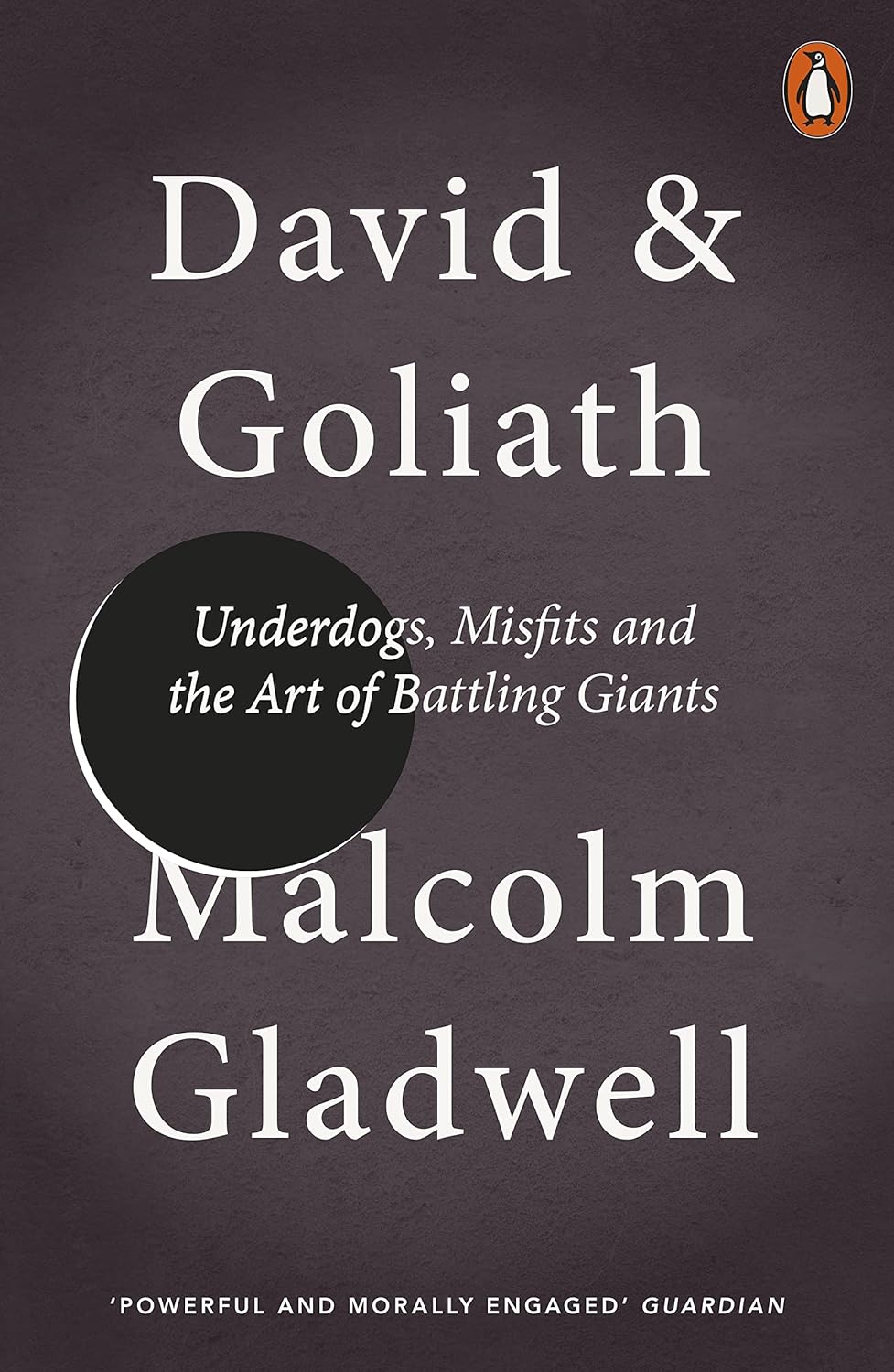
Goliath
Summary:
Gladwell opens with the biblical story of David and Goliath to challenge the conventional understanding of advantage and disadvantage, arguing that apparent strength can contain hidden weaknesses and that apparent weakness can conceal real strengths. He reframes the encounter as an illustration of how strategy, perception, and context matter more than raw size or power.
Key points:
- The visible advantage (Goliath's size and armor) obscures vulnerabilities (limited mobility, predictable tactics).
- David's apparent weakness (youth, light armament) became an advantage through speed, skill, and strategy.
- Success often depends on choosing the form of engagement that neutralizes an opponent's strengths.
- Perception of power can shape behavior and outcomes more than material power itself.
Themes & relevance:
The chapter reframes how we evaluate strength and weakness, showing this concept applies to business, education, and personal challenges. It invites readers to look past appearances and consider deeper dynamics in conflicts.
Takeaway / How to use:
When facing a stronger opponent, identify and exploit their hidden vulnerabilities rather than confronting their strength directly.
Key points
- The visible advantage (Goliath's size and armor) obscures vulnerabilities (limited mobility, predictable tactics).
- David's apparent weakness (youth, light armament) became an advantage through speed, skill, and strategy.
- Success often depends on choosing the form of engagement that neutralizes an opponent's strengths.
- Perception of power can shape behavior and outcomes more than material power itself.
The Theory of Desirable Difficulty
Summary:
Gladwell introduces the idea that certain obstacles and hardships can produce unexpected advantages, a concept he calls the "theory of desirable difficulty." He uses examples (including dyslexia and other adversity-driven stories) to show how difficulties can force people to develop compensatory skills, resilience, and alternative strategies.
Key points:
- Hardship can catalyze development of compensatory strengths (e.g., creativity, problem
- solving).
- Not all difficulties are desirable; context and individual resources determine outcomes.
- The theory explains why some apparent disadvantages correlate with later success.
- Success from difficulty often involves reframing and leveraging the constraint rather than simply overcoming it.
Themes & relevance:
This chapter highlights how adversity can be an engine for growth and innovation, relevant for educators, leaders, and individuals facing setbacks. It cautions against simplistic pity and encourages strategic use of constraints.
Takeaway / How to use:
Treat challenges as potential incubators for unique skills and seek ways to turn constraints into competitive advantages.
Key points
- Hardship can catalyze development of compensatory strengths (e.g., creativity, problem
- solving).
- Not all difficulties are desirable; context and individual resources determine outcomes.
- The theory explains why some apparent disadvantages correlate with later success.
- Success from difficulty often involves reframing and leveraging the constraint rather than simply overcoming it.
The Advantages of Disadvantages (and the Disadvantages of Advantages)
Summary:
Gladwell examines paradoxes where disadvantages become advantages and advantages create new vulnerabilities, showing that wealth, privilege, or size can produce complacency, poor decision-making, or fragility. He argues that giving people a big advantage can sometimes remove incentives or capabilities that would have made them stronger.
Key points:
- Privilege can breed dependence and reduce resourcefulness.
- Small setbacks can force innovation, while large safety nets can blunt initiative.
- The value of an advantage depends on how it changes incentives and behavior.
- Policymakers should weigh long
- term effects of remedies that eliminate difficulties.
Themes & relevance:
The chapter challenges intuitive policy and personal choices by revealing complex trade-offs between comfort and character
- building struggle. It is relevant for managers, educators, and anyone designing systems of support.
Takeaway / How to use:
Assess whether an advantage is creating complacency and consider introducing calibrated constraints to foster growth.
Key points
- Privilege can breed dependence and reduce resourcefulness.
- Small setbacks can force innovation, while large safety nets can blunt initiative.
- The value of an advantage depends on how it changes incentives and behavior.
- Policymakers should weigh long
- term effects of remedies that eliminate difficulties.
Legitimacy and Authority
Summary:
Gladwell shifts to the social dynamics of power, arguing that legitimacy — the perception that authority is fair and just — is often more effective than raw coercive force in producing cooperation. He uses policing and governance examples to show that when people view institutions as legitimate, compliance and public safety improve.
Key points:
- Legitimacy increases voluntary compliance and reduces the need for force.
- Heavy
- handed tactics erode legitimacy and can provoke resistance and instability.
- Fair procedures, respectful treatment, and proportionality build perceived legitimacy.
- Authority that lacks legitimacy must rely on costly coercion with diminishing returns.
Themes & relevance:
The chapter underscores the moral and practical importance of perceived fairness in institutions, applicable to law enforcement, management, and leadership. It shows that building consent can be a strategic priority.
Takeaway / How to use:
Cultivate fairness, transparency, and respectful procedures to strengthen authority and cooperation.
Key points
- Legitimacy increases voluntary compliance and reduces the need for force.
- Heavy
- handed tactics erode legitimacy and can provoke resistance and instability.
- Fair procedures, respectful treatment, and proportionality build perceived legitimacy.
- Authority that lacks legitimacy must rely on costly coercion with diminishing returns.
The Limits of Power
Summary:
Gladwell explores how excessive or misapplied power can backfire, creating resistance and diminishing effectiveness. He illustrates that the limits of power become apparent when authorities rely on intimidation or blanket solutions that ignore local context and legitimacy.
Key points:
- Overuse of force can delegitimize institutions and provoke backlash.
- Power has diminishing returns if it undermines the very compliance it seeks to secure.
- Effective power is often selective, calculated, and mindful of perception.
- Understanding constraints and human psychology is crucial to applying power wisely.
Themes & relevance:
This chapter tempers assumptions about the efficacy of strength, stressing that strategic, context-sensitive use of power works better than brute force. Leaders and policymakers can apply this to avoid counterproductive interventions.
Takeaway / How to use:
Exercise power strategically and monitor its effects on legitimacy and long-term cooperation.
Key points
- Overuse of force can delegitimize institutions and provoke backlash.
- Power has diminishing returns if it undermines the very compliance it seeks to secure.
- Effective power is often selective, calculated, and mindful of perception.
- Understanding constraints and human psychology is crucial to applying power wisely.
The Art of Battling Giants
Summary:
Gladwell synthesizes lessons on how underdogs can successfully confront much stronger adversaries by choosing unconventional tactics, changing the terms of engagement, and exploiting the opponent's blind spots. He emphasizes strategy, adaptability, and psychological awareness over direct confrontation.
Key points:
- Underdogs win by reframing the contest and choosing advantageous battlegrounds.
- Unconventional tactics (surprise, speed, asymmetry) neutralize superior resources.
- Understanding an opponent’s expectations creates opportunities for disruption.
- Preparation and creativity often trump brute strength in asymmetric conflicts.
Themes & relevance:
The chapter provides a practical playbook for entrepreneurs, activists, and small teams facing larger rivals, stressing that smart strategy can offset material inferiority. It celebrates ingenuity over size.
Takeaway / How to use:
Identify the opponent’s expectations and craft asymmetric tactics that turn their strengths into liabilities.
Key points
- Underdogs win by reframing the contest and choosing advantageous battlegrounds.
- Unconventional tactics (surprise, speed, asymmetry) neutralize superior resources.
- Understanding an opponent’s expectations creates opportunities for disruption.
- Preparation and creativity often trump brute strength in asymmetric conflicts.
The Underdogs: Misfits and Mavericks
Summary:
Gladwell profiles misfits and mavericks who transformed personal disadvantages or nonconformity into distinctive sources of strength, showing how outsider perspectives foster innovation and bold action. He celebrates the creative benefits of being an underdog and the social value of eccentricity.
Key points:
- Misfits often develop original approaches because they are unconstrained by orthodoxy.
- Social exclusion can produce determination, resourcefulness, and novel problem
- solving.
- Mavericks may succeed precisely because they are willing to accept risks others avoid.
- Supportive contexts can amplify an underdog's unconventional talents.
Themes & relevance:
The chapter affirms the cultural and strategic importance of diversity in thought and experience, encouraging institutions to value unconventional talent. It suggests organizations benefit from tolerating and harnessing misfit creativity.
Takeaway / How to use:
Leverage nonconformist perspectives as strategic assets by creating space for their ideas to be tested.
Key points
- Misfits often develop original approaches because they are unconstrained by orthodoxy.
- Social exclusion can produce determination, resourcefulness, and novel problem
- solving.
- Mavericks may succeed precisely because they are willing to accept risks others avoid.
- Supportive contexts can amplify an underdog's unconventional talents.
Courage, Perception, and Strategy
Summary:
In the concluding chapter Gladwell ties together courage, perception, and strategic thinking as the essential elements that allow underdogs to succeed against giants. He reiterates that reframing problems, behaving boldly, and choosing the right tactics often determine outcomes more than material power.
Key points:
- Courage changes perceptions and can force opponents into unfamiliar responses.
- How a challenge is perceived shapes available strategies and results.
- Strategy involves matching means to context and exploiting asymmetric advantages.
- Success often depends on psychological factors as much as material ones.
Themes & relevance:
The finale synthesizes the book’s central thesis: that human judgment, courage, and creativity can overturn structural imbalances, which is relevant to individuals and institutions confronting entrenched power. It calls for thoughtful risk-taking and perceptual reframing.
Takeaway / How to use:
Frame challenges strategically, act with calculated courage, and seek asymmetrical approaches that play to your strengths.
Key points
- Courage changes perceptions and can force opponents into unfamiliar responses.
- How a challenge is perceived shapes available strategies and results.
- Strategy involves matching means to context and exploiting asymmetric advantages.
- Success often depends on psychological factors as much as material ones.
Conclusion: Rethinking Strength and Weakness
Summary:
Malcolm Gladwell closes by urging readers to rethink conventional ideas about strength and weakness, arguing that apparent disadvantages often contain hidden advantages. He summarizes how context, strategy, and the creative use of limits can flip presumed liabilities into sources of power.
Key points:
- Apparent weaknesses can be reframed as strategic assets when understood in context.
- Giants’ strengths can create vulnerabilities; overwhelming power often provokes adaptive responses from underdogs.
- ‘Desirable difficulties’ (limitations that force alternative strategies) can produce resilience and innovation.
- Success depends less on absolute advantage and more on how people use constraints, narrative, and tactics.
- Policies and leadership should account for the complex, sometimes counterintuitive dynamics between power and disadvantage.
Themes & relevance:
The chapter emphasizes reassessing assumptions about power, adversity, and advantage—insights relevant to leaders, educators, parents, and anyone dealing with imbalance. It connects empirical anecdotes to practical questions about strategy and social design.
Takeaway / How to use:
Look for ways to turn constraints into leverage by adapting strategy rather than trying to match strength pound-for
- pound.
Key points
- Apparent weaknesses can be reframed as strategic assets when understood in context.
- Giants’ strengths can create vulnerabilities; overwhelming power often provokes adaptive responses from underdogs.
- ‘Desirable difficulties’ (limitations that force alternative strategies) can produce resilience and innovation.
- Success depends less on absolute advantage and more on how people use constraints, narrative, and tactics.
- Policies and leadership should account for the complex, sometimes counterintuitive dynamics between power and disadvantage.