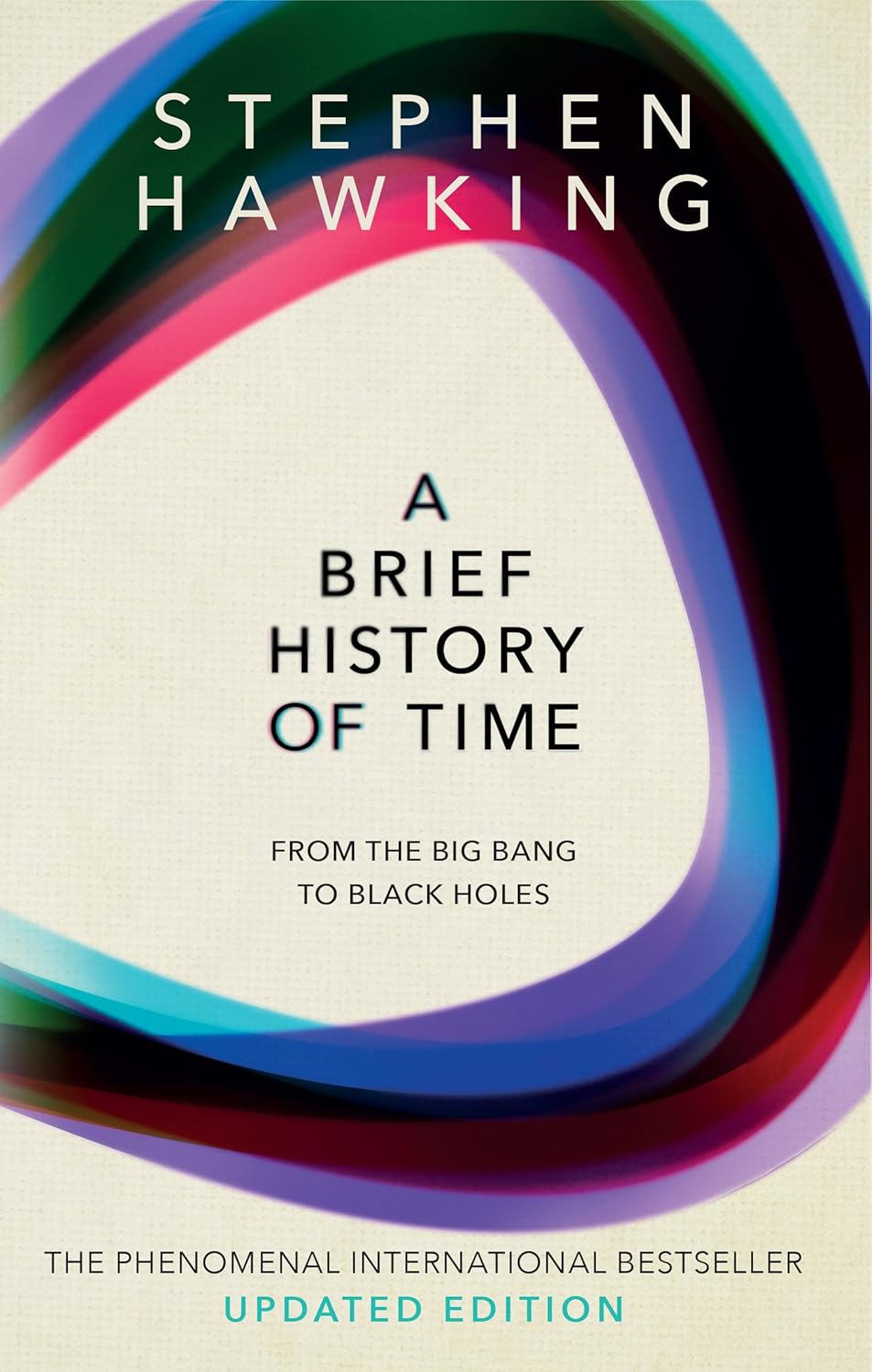
A Brief History of Time: ReadSprint summary highlights
ReadSprint paraphrases for review. These highlights are not verbatim quotations from the book or its author. Check the original edition for exact wording and context.
A Brief History of Time
by Stephen Hawking
Our understanding of the universe has evolved from ancient geocentric models to a modern framework based on general relativity and quantum mechanics.
ReadSprint paraphrase · Not a quotation from the author.
Our understanding of the universe has evolved from ancient geocentric models to a modern framework based on general relativity and quantum mechanics.
Historical progression from Aristotle and Ptolemy to Copernicus, Kepler, and Newton.
Share with the ReadSprint source so others can read the context.
A Brief History of Time
by Stephen Hawking
Observations and theoretical advances have progressively replaced intuitive pictures with mathematical descriptions that explain large-scale structure and fundamental laws.
ReadSprint paraphrase · Not a quotation from the author.
Observations and theoretical advances have progressively replaced intuitive pictures with mathematical descriptions that explain large-scale structure and fundamental laws.
Modern picture relies on general relativity for gravity and quantum theory for small scales.
Share with the ReadSprint source so others can read the context.
A Brief History of Time
by Stephen Hawking
Special and general relativity reformulate space and time as a unified four-dimensional spacetime where measurements of time and distance depend on the observer.
ReadSprint paraphrase · Not a quotation from the author.
Special and general relativity reformulate space and time as a unified four-dimensional spacetime where measurements of time and distance depend on the observer.
Observations (e.g., galactic motions, cosmic background) drive and test theoretical models.
Share with the ReadSprint source so others can read the context.
A Brief History of Time
by Stephen Hawking
Gravity is not a force in the Newtonian sense but a manifestation of spacetime curvature produced by mass and energy.
ReadSprint paraphrase · Not a quotation from the author.
Gravity is not a force in the Newtonian sense but a manifestation of spacetime curvature produced by mass and energy.
Update your explanations to match evidence and use both theory and observation to build reliable models.
Share with the ReadSprint source so others can read the context.
A Brief History of Time
by Stephen Hawking
Observations of galactic redshifts show the universe is expanding, leading to the idea that it was denser and hotter in the past.
ReadSprint paraphrase · Not a quotation from the author.
Observations of galactic redshifts show the universe is expanding, leading to the idea that it was denser and hotter in the past.
Scientific models change as evidence improves, and contemporary cosmology unifies observations with fundamental laws to describe the universe.
Share with the ReadSprint source so others can read the context.
A Brief History of Time
by Stephen Hawking
This empirical expansion underlies the Big Bang model and is supported by further evidence such as the cosmic microwave background.
ReadSprint paraphrase · Not a quotation from the author.
This empirical expansion underlies the Big Bang model and is supported by further evidence such as the cosmic microwave background.
Our understanding of the universe has evolved from ancient geocentric models to a modern framework based on general relativity and quantum mechanics. Observations and theoretical advances have progressively replaced intuitive pictures with mathematical descriptions that explain large-scale structure and fundamental laws.
Share with the ReadSprint source so others can read the context.
A Brief History of Time
by Stephen Hawking
Quantum mechanics replaces deterministic trajectories with probabilistic descriptions, encapsulated by the uncertainty principle that limits simultaneous knowledge of complementary quantities like position and momentum.
ReadSprint paraphrase · Not a quotation from the author.
Quantum mechanics replaces deterministic trajectories with probabilistic descriptions, encapsulated by the uncertainty principle that limits simultaneous knowledge of complementary quantities like position and momentum.
Special relativity: constancy of the speed of light and relativity of simultaneity.
Share with the ReadSprint source so others can read the context.
A Brief History of Time
by Stephen Hawking
These quantum effects dominate at small scales and influence processes from atomic structure to particle creation.
ReadSprint paraphrase · Not a quotation from the author.
These quantum effects dominate at small scales and influence processes from atomic structure to particle creation.
Time dilation and length contraction follow from Lorentz transformations.
Share with the ReadSprint source so others can read the context.
A Brief History of Time
by Stephen Hawking
Matter is built from a small set of elementary particles whose interactions are governed by fundamental forces mediated by exchange particles.
ReadSprint paraphrase · Not a quotation from the author.
Matter is built from a small set of elementary particles whose interactions are governed by fundamental forces mediated by exchange particles.
General relativity: equivalence principle and gravity as spacetime curvature.
Share with the ReadSprint source so others can read the context.
A Brief History of Time
by Stephen Hawking
The Standard Model organizes these particles and forces, while ongoing efforts seek a deeper unified theory that includes gravity.
ReadSprint paraphrase · Not a quotation from the author.
The Standard Model organizes these particles and forces, while ongoing efforts seek a deeper unified theory that includes gravity.
Predictions include gravitational time dilation and light bending by mass.
Share with the ReadSprint source so others can read the context.