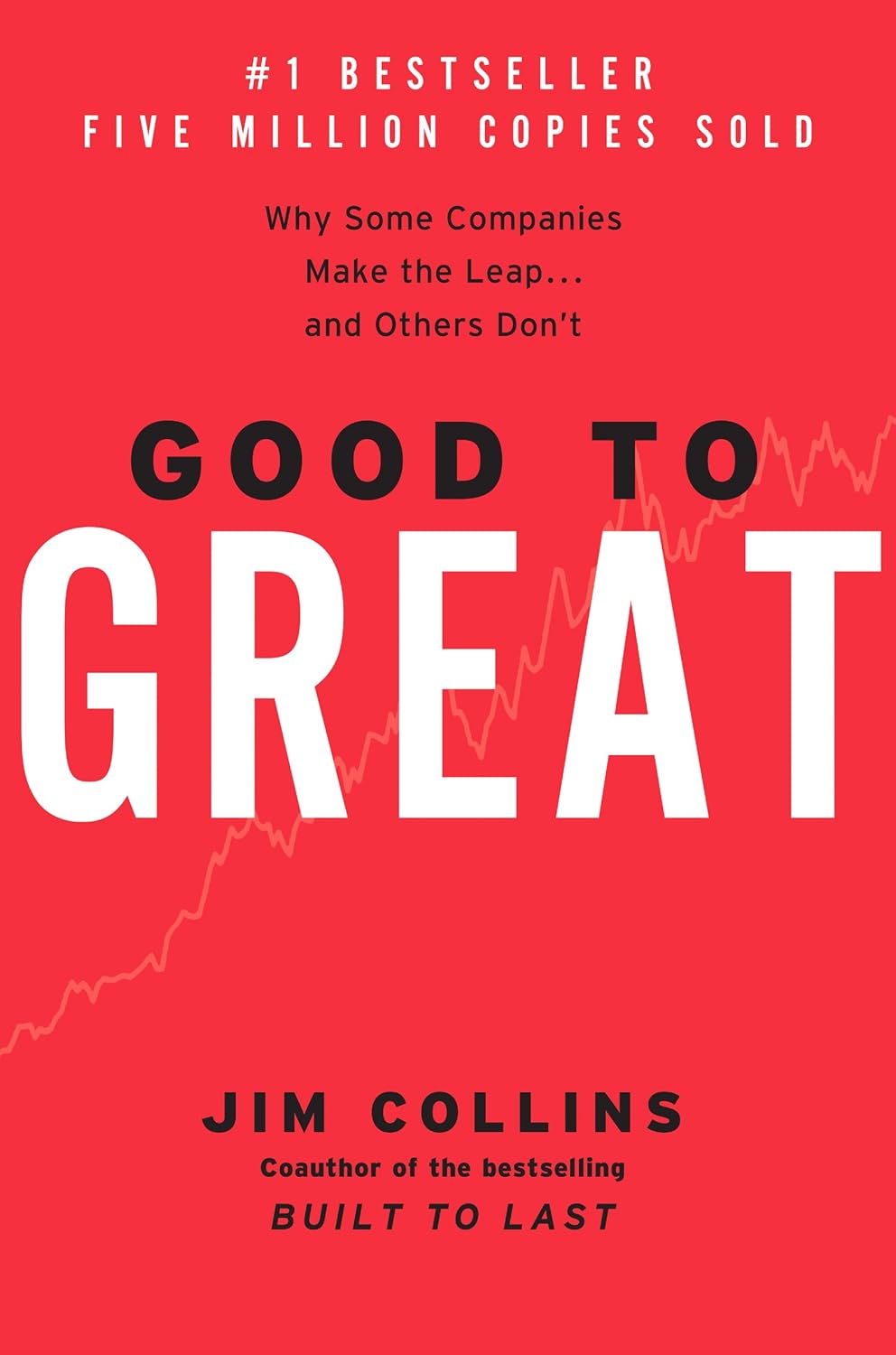
Good Is the Enemy of Great
Summary:
Good is a comfortable, common state that prevents organizations from pursuing the much rarer and harder state of greatness. Collins argues that settling for good outcomes blocks the discipline and leadership required to achieve sustained superior results.
Key points:
- Being "good" creates complacency that stifles ambition and change.
- Greatness requires rigorous, sustained effort and disciplined choices over time.
- The research identifies a small set of companies that made the leap and sustained it, showing that greatness is achievable but uncommon.
Themes & relevance:
The chapter frames the book’s central premise: overcoming the inertia of "good enough" is the first step toward lasting transformation; this is relevant to any leader or organization seeking breakthrough improvement.
Takeaway / How to use:
Challenge comfort and set a clear intention to pursue greatness rather than settle for good.
Key points
- Being "good" creates complacency that stifles ambition and change.
- Greatness requires rigorous, sustained effort and disciplined choices over time.
- The research identifies a small set of companies that made the leap and sustained it, showing that greatness is achievable but uncommon.
Level 5 Leadership
Summary:
Level 5 leaders combine personal humility with intense professional will, prioritizing company success over personal ego. They channel ambition into the organization, build successors, and take responsibility for failures while crediting others for successes.
Key points:
- Level 5 leaders are modest, reserved, and focused on long
- term results rather than personal praise.
- They show fierce resolve to do whatever it takes to make the company great.
- They create conditions for lasting success by developing strong teams and effective systems.
Themes & relevance:
Leadership quality—especially a blend of humility and will—is a key predictor of sustained organizational greatness and should shape leadership selection and development.
Takeaway / How to use:
Develop or hire leaders who demonstrate humility plus relentless resolve for the organization’s success.
Key points
- Level 5 leaders are modest, reserved, and focused on long
- term results rather than personal praise.
- They show fierce resolve to do whatever it takes to make the company great.
- They create conditions for lasting success by developing strong teams and effective systems.
First Who, Then What
Summary:
Put the right people on the bus (and the wrong people off) before deciding direction; people matter more than strategy. With the right team in place, effective strategies and adaptations follow more naturally.
Key points:
- Prioritize recruiting the right people before setting strategy or priorities.
- Right people are self
- disciplined and fit the culture; they don’t need heavy management.
- Remove those who don’t fit quickly to avoid slowing momentum.
Themes & relevance:
Organizational success depends on people first—strategy without the right team is fragile; this matters for hiring, restructuring, and succession planning.
Takeaway / How to use:
Build your team first by hiring and retaining people who fit the culture and standards before finalizing strategic choices.
Key points
- Prioritize recruiting the right people before setting strategy or priorities.
- Right people are self
- disciplined and fit the culture; they don’t need heavy management.
- Remove those who don’t fit quickly to avoid slowing momentum.
Confront the Brutal Facts (The Stockdale Paradox)
Summary:
Face the brutal facts of your current reality while maintaining unwavering faith that you will prevail (the Stockdale Paradox). Creating a culture where facts are heard enables better decisions and sustained progress.
Key points:
- Encourage candor and create mechanisms for truth
- telling throughout the organization.
- Leaders must balance realism about difficulties with confidence in eventual success.
- Decisions should be guided by empirical evidence rather than optimism or denial.
Themes & relevance:
A culture of honest assessment paired with resilient optimism fosters adaptive responses and durable improvement across sectors and situations.
Takeaway / How to use:
Instill processes and habits that surface real data and uncomfortable truths while keeping faith in a successful outcome.
Key points
- Encourage candor and create mechanisms for truth
- telling throughout the organization.
- Leaders must balance realism about difficulties with confidence in eventual success.
- Decisions should be guided by empirical evidence rather than optimism or denial.
The Hedgehog Concept (Simplicity Within the Three Circles)
Summary:
The Hedgehog Concept is the intersection of three circles: what you can be best in the world at, what drives your economic engine, and what you are deeply passionate about. Simplicity and clarity from this intersection guide focused strategy and discipline.
Key points:
- Identify the single economic denominator that drives your company’s engine.
- Determine where passion, capability, and economic logic overlap to form your core focus.
- Use the hedgehog as a criterion to say no to distractions and align resources.
Themes & relevance:
Clarity of purpose and focus—rooted in realistic self-assessment—enables organizations to allocate effort effectively and achieve sustainable advantage.
Takeaway / How to use:
Define your three-circle hedgehog and use it as the touchstone for strategic choices.
Key points
- Identify the single economic denominator that drives your company’s engine.
- Determine where passion, capability, and economic logic overlap to form your core focus.
- Use the hedgehog as a criterion to say no to distractions and align resources.
A Culture of Discipline
Summary:
Sustained greatness arises from disciplined people who engage in disciplined thought and take disciplined action, operating within a framework that allows freedom but enforces responsibility. Discipline replaces bureaucracy and fuels consistent progress.
Key points:
- Discipline is about consistent adherence to core concepts, not rigid controls.
- "Freedom within a framework" empowers people to act while staying aligned to the hedgehog concept.
- Disciplined organizations avoid ad hoc initiatives and rely on sustained, focused effort.
Themes & relevance:
Building systems and norms that promote self-discipline at all levels produces reliable execution and momentum important for any organization.
Takeaway / How to use:
Create clear boundaries and expectations so teams can operate with disciplined autonomy.
Key points
- Discipline is about consistent adherence to core concepts, not rigid controls.
- "Freedom within a framework" empowers people to act while staying aligned to the hedgehog concept.
- Disciplined organizations avoid ad hoc initiatives and rely on sustained, focused effort.
Technology Accelerators
Summary:
Technology is an accelerator of momentum for companies that already have the right people, culture, and hedgehog concept—not a primary driver by itself. Great companies use technology selectively to amplify their core strengths.
Key points:
- Technology should be chosen to support the hedgehog, not drive strategy.
- Pioneering technology adoption is useful when it aligns with disciplined strategy and capabilities.
- Misusing technology as a silver bullet leads to wasted effort and distraction.
Themes & relevance:
Technology has strategic value when it reinforces existing advantages; organizations should evaluate tech investments through the lens of their core concept.
Takeaway / How to use:
Adopt technology only when it clearly accelerates your hedgehog-driven strategy.
Key points
- Technology should be chosen to support the hedgehog, not drive strategy.
- Pioneering technology adoption is useful when it aligns with disciplined strategy and capabilities.
- Misusing technology as a silver bullet leads to wasted effort and distraction.
The Flywheel and the Doom Loop
Summary:
Transformation to greatness is a cumulative process—small, consistent actions build momentum like pushing a heavy flywheel until it turns; by contrast, the doom loop describes reactive, inconsistent change that destroys momentum. Sustained results come from steady accumulation of aligned decisions.
Key points:
- Success builds slowly through consistent, aligned effort that compounds over time.
- The doom loop occurs when organizations chase quick fixes, overhaul direction frequently, or lack discipline.
- Leadership patience and persistent execution are required to create flywheel momentum.
Themes & relevance:
Long-term consistency and alignment produce durable results, a principle relevant to strategy, change management, and leadership behavior.
Takeaway / How to use:
Commit to consistent, aligned actions that accumulate into unstoppable momentum.
Key points
- Success builds slowly through consistent, aligned effort that compounds over time.
- The doom loop occurs when organizations chase quick fixes, overhaul direction frequently, or lack discipline.
- Leadership patience and persistent execution are required to create flywheel momentum.
From Good to Great to Built to Last
Summary:
Jim Collins connects the Good to Great findings with themes from Built to Last, arguing that true greatness must be enduring and rooted in a company's core ideology. He emphasizes that sustainable transformation combines the disciplined practices identified in Good to Great with the long-term vision and core values central to Built to Last.
Key points:
- Good
- to-Great principles (Level 5 leadership, the Hedgehog Concept, culture of discipline, technology as an accelerator, and the flywheel) are complementary to Built to Last's focus on core ideology and preserving a company’s fundamental purpose.
- Enduring greatness requires both preserving core values and stimulating relentless progress—"preserve the core, stimulate progress."
- BHAGs (Big Hairy Audacious Goals) and a clear, compelling vision help translate long
- term purpose into concrete momentum when aligned with the Hedgehog Concept.
- Technology should be used as an accelerator of momentum, not a primary driver; disciplined people and thought must lead before technological investments follow.
- Sustained success is a cumulative process (the flywheel) rather than a one
- time breakthrough; companies must build systems and cultures that support long-term evolution.
Themes & relevance:
The chapter ties short-to
- medium-term transformation techniques to long
- term institutional durability, showing leaders how to make greatness stick across generations.
Takeaway / How to use:
Protect and...
Key points
- Good
- to-Great principles (Level 5 leadership, the Hedgehog Concept, culture of discipline, technology as an accelerator, and the flywheel) are complementary to Built to Last's focus on core ideology and preserving a company’s fundamental purpose.
- Enduring greatness requires both preserving core values and stimulating relentless progress—"preserve the core, stimulate progress."
- BHAGs (Big Hairy Audacious Goals) and a clear, compelling vision help translate long
- term purpose into concrete momentum when aligned with the Hedgehog Concept.
- Technology should be used as an accelerator of momentum, not a primary driver; disciplined people and thought must lead before technological investments follow.
- Sustained success is a cumulative process (the flywheel) rather than a one
- time breakthrough; companies must build systems and cultures that support long-term evolution.