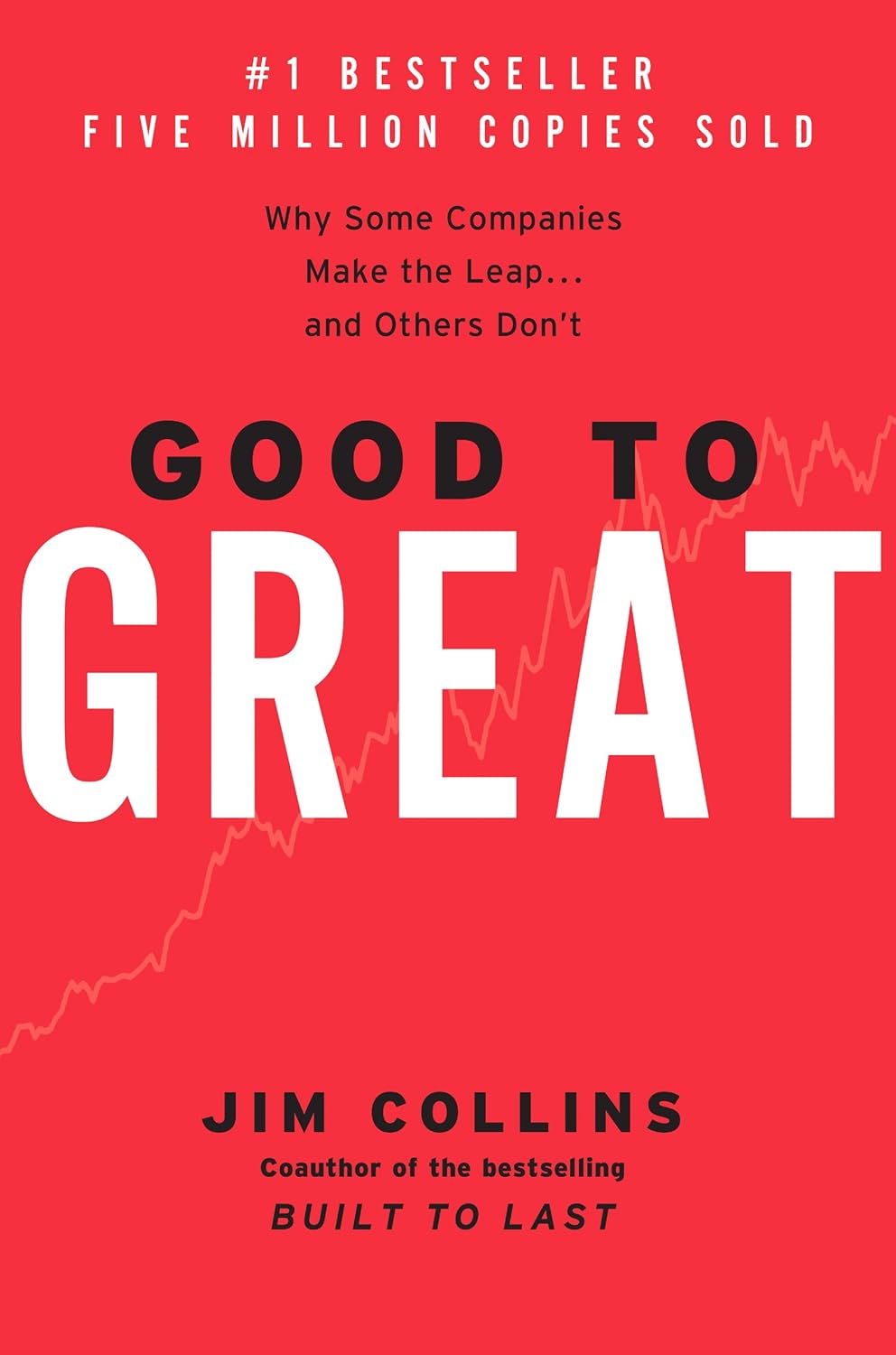
Book overview
Good is a comfortable, common state that prevents organizations from pursuing the much rarer and harder state of greatness. Collins argues that settling for good outcomes blocks the discipline and leadership required to achieve sustained superior results.
This page is built to be a compact learning hub for Good to Great. You can move from the high-level summary into takeaways, quiz prompts, chapter review, and related books without breaking the reading flow.
Best takeaways to keep
Being "good" creates complacency that stifles ambition and change.
Greatness requires rigorous, sustained effort and disciplined choices over time.
The research identifies a small set of companies that made the leap and sustained it, showing that greatness is achievable but uncommon.
Challenge comfort and set a clear intention to pursue greatness rather than settle for good.
The chapter frames the book’s central premise: overcoming the inertia of "good enough" is the first step toward lasting transformation; this is relevant to any leader or organization seeking breakthrough improvement.
Good is a comfortable, common state that prevents organizations from pursuing the much rarer and harder state of greatness. Collins argues that settling for good outcomes blocks the discipline and leadership required to achieve sustained superior results.
Retrieval practice
Which description best matches Jim Collins' concept of a Level 5 leader in Good to Great?
What does the principle "First Who, Then What" recommend as the first priority for organizations?
What is the Stockdale Paradox as described in the book's chapter on confronting the brutal facts?
Which best summarizes the Hedgehog Concept from Good to Great?
Quiz preview
Which description best matches Jim Collins' concept of a Level 5 leader in Good to Great?
- A charismatic, high-profile leader who seeks personal recognition
- A leader who combines personal humility with intense professional will and prioritizes company success
- A leader who centralizes control and makes all tactical decisions alone
What does the principle "First Who, Then What" recommend as the first priority for organizations?
- Put the right people on the bus (and the wrong people off) before deciding direction
- Decide the strategy first, then hire people to implement it
- Rely on external consultants to set direction, then recruit staff
What is the Stockdale Paradox as described in the book's chapter on confronting the brutal facts?
- Avoid discussing difficult realities to keep morale high
- Maintain blind optimism and ignore negative data
- Confront the brutal facts of the situation while retaining unwavering faith you will prevail
Which best summarizes the Hedgehog Concept from Good to Great?
- Pursue expansion into as many markets and opportunities as possible
- Create a complex multi-pronged strategy to hedge against risk
- Find the intersection of what you can be best at, what drives your economic engine, and what you are deeply passionate about
Chapter map
Good Is the Enemy of Great
Good is a comfortable, common state that prevents organizations from pursuing the much rarer and harder state of greatness. Collins argues that settling for good outcomes blocks the discipline and leadership required to achieve sustained superior results.
Level 5 Leadership
Level 5 leaders combine personal humility with intense professional will, prioritizing company success over personal ego. They channel ambition into the organization, build successors, and take responsibility for failures while crediting others for successes.
First Who, Then What
Put the right people on the bus (and the wrong people off) before deciding direction; people matter more than strategy. With the right team in place, effective strategies and adaptations follow more naturally.
Confront the Brutal Facts (The Stockdale Paradox)
Face the brutal facts of your current reality while maintaining unwavering faith that you will prevail (the Stockdale Paradox). Creating a culture where facts are heard enables better decisions and sustained progress.
The Hedgehog Concept (Simplicity Within the Three Circles)
The Hedgehog Concept is the intersection of three circles: what you can be best in the world at, what drives your economic engine, and what you are deeply passionate about. Simplicity and clarity from this intersection guide focused strategy and discipline.
Next best step
Move next into the questions page if you want better retention, or into the takeaways page if you want the shortest useful review loop for this book.