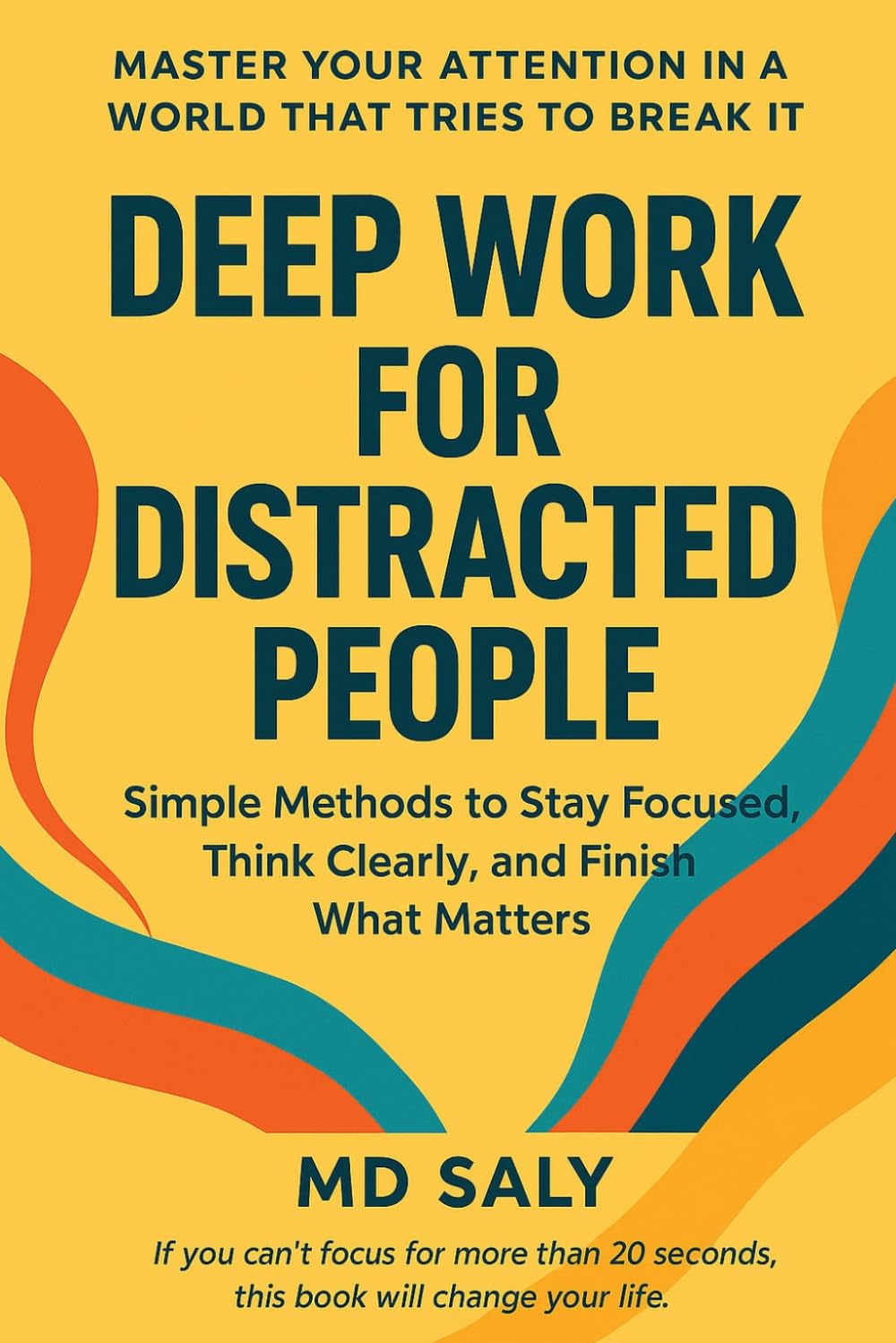
Introduction: The Case for Deep Work
Summary:
Deep Work for Distracted People makes the case that sustained, focused work is the most valuable skill in an age of constant interruptions. It argues that deliberate focus produces higher-quality output, faster learning, and deeper satisfaction than fragmented attention.
Key points:
- Deep work is defined as cognitively demanding, distraction
- free work that pushes your abilities to their limits.
- The modern attention economy rewards shallow responsiveness, making deep work a rare and valuable differentiator.
- Shallow work (emails, meetings, routines) consumes time but produces little long
- term value.
- Reclaiming focus requires intentional habits and systemic changes to your schedule and environment.
Themes & relevance:
The chapter frames deep work as both an economic advantage and a personal well-being practice, relevant to anyone facing frequent digital interruptions. It sets the moral and practical urgency for adopting focus disciplines.
Takeaway / How to use:
Commit to protecting regular, uninterrupted blocks of time for meaningful work.
Key points
- Deep work is defined as cognitively demanding, distraction
- free work that pushes your abilities to their limits.
- The modern attention economy rewards shallow responsiveness, making deep work a rare and valuable differentiator.
- Shallow work (emails, meetings, routines) consumes time but produces little long
- term value.
- Reclaiming focus requires intentional habits and systemic changes to your schedule and environment.
Why Focus Fails: Understanding Distraction
Summary:
This chapter examines the cognitive, environmental, and social causes of distraction that derail focus. It shows how attention is hijacked by habits, notifications, decision fatigue, and social expectations, and how these factors compound over time.
Key points:
- Habitual checking and novelty
- seeking are powerful drivers of attention loss.
- Notifications and always
- on communication create reactive work patterns that fragment cognition.
- Multitasking and frequent task
- switching impose hidden cognitive costs and reduce performance.
- Social pressure and cultural norms can penalize deep work, favoring visibility over substance.
Themes & relevance:
Understanding the root causes of distraction makes it easier to design targeted countermeasures; this analysis is relevant to individuals and teams trying to improve productivity. It emphasizes that distraction is both internal (habits) and external (tools, people).
Takeaway / How to use:
Identify your main distraction triggers and remove or control them proactively.
Key points
- Habitual checking and novelty
- seeking are powerful drivers of attention loss.
- Notifications and always
- on communication create reactive work patterns that fragment cognition.
- Multitasking and frequent task
- switching impose hidden cognitive costs and reduce performance.
- Social pressure and cultural norms can penalize deep work, favoring visibility over substance.
The Science of Attention and Productivity
Summary:
This chapter summarizes research on attention, memory, and cognitive load to explain why uninterrupted focus boosts learning and output. It links neuroscience and behavioral studies to practical recommendations for managing mental energy and optimizing work periods.
Key points:
- Attention is a limited resource; sustained focus depletes but also trains attentional capacity.
- Working in deep, uninterrupted bursts leads to better encoding of information and higher
- quality results.
- Decision fatigue and cognitive load reduce willpower and increase susceptibility to distraction.
- Recovery, sleep, and breaks are essential to restore attentional resources and maintain performance.
Themes & relevance:
By grounding recommendations in science, this chapter makes clear that deep work practices are not merely preference but follow predictable cognitive principles; this relevance applies to students, knowledge workers, and creators. It stresses the interplay of effort and restoration.
Takeaway / How to use:
Schedule deep work when your cognitive energy is highest and protect recovery periods.
Key points
- Attention is a limited resource; sustained focus depletes but also trains attentional capacity.
- Working in deep, uninterrupted bursts leads to better encoding of information and higher
- quality results.
- Decision fatigue and cognitive load reduce willpower and increase susceptibility to distraction.
- Recovery, sleep, and breaks are essential to restore attentional resources and maintain performance.
Clarifying What Matters: Prioritizing Deep Work
Summary:
This chapter helps readers define which tasks deserve deep work and which are shallow but necessary. It offers frameworks for aligning daily activities with long-term goals so focused effort yields the most meaningful results.
Key points:
- Not all work benefits equally from deep focus; identify high
- impact tasks that require concentration.
- Use criteria such as rarity, leverage, and long
- term importance to prioritize projects for deep work.
- Create explicit goals and success metrics to avoid mistaking busywork for progress.
- Learn to delegate, automate, or minimize shallow tasks to free time for deep work.
Themes & relevance:
Prioritization ensures scarce deep-work time is invested where it multiplies value, making the practice practical rather than aspirational; this approach is relevant to goal
- driven professionals. The chapter connects values to daily choices.
Takeaway / How to use:
List your top 1–3 high-impact tasks each week and reserve deep sessions for them.
Key points
- Not all work benefits equally from deep focus; identify high
- impact tasks that require concentration.
- Use criteria such as rarity, leverage, and long
- term importance to prioritize projects for deep work.
- Create explicit goals and success metrics to avoid mistaking busywork for progress.
- Learn to delegate, automate, or minimize shallow tasks to free time for deep work.
Designing Your Deep Work Schedule
Summary:
This chapter provides templates and principles for building a sustainable deep work schedule tailored to personal rhythms and responsibilities. It discusses block lengths, frequency, and integrating deep sessions into a realistic calendar.
Key points:
- Choose a scheduling philosophy (e.g., monastic, bimodal, rhythmic, journalistic) that fits your role and constraints.
- Block long, uninterrupted time for deep work when your energy and attention are highest.
- Protect transitions and buffer time to reduce task
- switching costs and decision fatigue.
- Regularly review and adjust your schedule based on results and changing priorities.
Themes & relevance:
Practical scheduling makes deep work actionable within diverse life contexts, from knowledge workers to creatives; the chapter highlights customization and iteration. It emphasizes consistency over perfection.
Takeaway / How to use:
Put recurring deep-work blocks on your calendar and treat them as non
- negotiable appointments.
Key points
- Choose a scheduling philosophy (e.g., monastic, bimodal, rhythmic, journalistic) that fits your role and constraints.
- Block long, uninterrupted time for deep work when your energy and attention are highest.
- Protect transitions and buffer time to reduce task
- switching costs and decision fatigue.
- Regularly review and adjust your schedule based on results and changing priorities.
Creating a Distraction-Free Environment
Summary:
This chapter outlines how to shape physical and digital spaces to minimize interruptions and signal intent to yourself and others. It covers workspace layout, device policies, and social agreements that support sustained concentration.
Key points:
- Declutter and design your physical workspace to reduce visual and tactile distractions.
- Enforce digital boundaries: turn off nonessential notifications, use app restrictions, and create focus profiles.
- Communicate availability rules to colleagues, family, or housemates to prevent social interruptions.
- Use environmental cues (lighting, sound, signage) to reinforce deep
- work periods.
Themes & relevance:
A supportive environment lowers the friction of entering deep work, making sustained focus easier to maintain; this is relevant for home offices, coworking, and corporate settings. The chapter shows small changes can yield big benefits.
Takeaway / How to use:
Set up one dedicated, distraction-minimized workspace for your deep sessions.
Key points
- Declutter and design your physical workspace to reduce visual and tactile distractions.
- Enforce digital boundaries: turn off nonessential notifications, use app restrictions, and create focus profiles.
- Communicate availability rules to colleagues, family, or housemates to prevent social interruptions.
- Use environmental cues (lighting, sound, signage) to reinforce deep
- work periods.
Rituals and Routines for Sustained Focus
Summary:
This chapter recommends establishing rituals that cue focused behavior and make deep work habitual. It discusses pre-work routines, start/stop rituals, and habits that minimize decision
- making and increase the likelihood of sustained attention.
Key points:
- Rituals reduce friction by automating the steps needed to begin and sustain deep work.
- Include concrete elements: start time, place, duration, rules, and a small pre
- work routine to signal the brain.
- End
- of-session rituals help consolidate progress and make transitions smoother.
- Habit stacking and incremental repetition increase the probability of long
- term adherence.
Themes & relevance:
Rituals transform the intent to do deep work into repeatable practice, making focus easier to achieve consistently; this is relevant for anyone rebuilding attention habits. The chapter ties psychological cues to behavior change.
Takeaway / How to use:
Create a simple start-up ritual you follow before every deep
- work session to make focus automatic.
Key points
- Rituals reduce friction by automating the steps needed to begin and sustain deep work.
- Include concrete elements: start time, place, duration, rules, and a small pre
- work routine to signal the brain.
- End
- of-session rituals help consolidate progress and make transitions smoother.
- Habit stacking and incremental repetition increase the probability of long
- term adherence.
Practical Techniques: Time-Blocking, Pomodoro, and Batching
Summary:
This chapter presents concrete methods—time-blocking, Pomodoro, and batching—to structure work and protect focus. It explains when each technique is most effective and how to combine them for different tasks and tolerance levels.
Key points:
- Time
- blocking allocates specific calendar segments to tasks, ensuring intentional use of time and reducing decision overhead.
- The Pomodoro Technique (short focused intervals with regular breaks) helps maintain energy and prevents burnout for those new to long focus periods.
- Batching similar tasks reduces context switching and improves efficiency for routine shallow work.
- Experiment with hybrid approaches: long deep blocks for creative work, Pomodoro for intense learning, and batching for admin tasks.
Themes & relevance:
These techniques translate deep-work principles into immediately usable practices applicable across roles and schedules; they serve both beginners and experienced practitioners. The chapter stresses adaptation to personal rhythms.
Takeaway / How to use:
Choose one technique and apply it consistently for a week to see how it fits your tasks and energy.
Key points
- Time
- blocking allocates specific calendar segments to tasks, ensuring intentional use of time and reducing decision overhead.
- The Pomodoro Technique (short focused intervals with regular breaks) helps maintain energy and prevents burnout for those new to long focus periods.
- Batching similar tasks reduces context switching and improves efficiency for routine shallow work.
- Experiment with hybrid approaches: long deep blocks for creative work, Pomodoro for intense learning, and batching for admin tasks.
Managing Digital Distractions: Email, Social Media, and Notifications
Summary:
Digital distractions — email, social media, and notifications — are primary sources of fragmented attention that undermine deep work. This chapter outlines practical strategies to reduce interruption frequency and cognitive cost so focused work can occur reliably.
Key points:
- Schedule email and message checking into limited blocks rather than responding continuously.
- Turn off nonessential notifications and batch platform usage to reduce context switching.
- Use tools (filters, auto
- replies, focus modes) to route low-value communications away from attention
- sensitive times.
- Create explicit rules for social media use: time windows, purpose
- driven sessions, or complete removal of apps from work devices.
- Treat attention like a scarce resource: apply boundary
- setting and visible signals (e.g., "do not disturb") to protect it.
Themes & relevance:
The chapter ties modern attention economy mechanics to everyday practices, showing how small structural changes in how we handle digital inputs produce disproportionately large gains in concentration. Its relevance is immediate for anyone whose work is mediated by digital tools.
Takeaway / How to use:
Turn off all nonessential notifications and schedule two discrete email/social-checking blocks per workday.
Key points
- Schedule email and message checking into limited blocks rather than responding continuously.
- Turn off nonessential notifications and batch platform usage to reduce context switching.
- Use tools (filters, auto
- replies, focus modes) to route low-value communications away from attention
- sensitive times.
- Create explicit rules for social media use: time windows, purpose
- driven sessions, or complete removal of apps from work devices.
- Treat attention like a scarce resource: apply boundary
- setting and visible signals (e.g., "do not disturb") to protect it.
Building Mental Stamina and Flow
Summary:
This chapter explains how to increase your capacity for sustained concentration and achieve flow by training your mind through deliberate practice and consistent routines. It covers techniques to lengthen deep-work sessions, reduce cognitive fatigue, and cultivate conditions that reliably produce immersive focus.
Key points:
- Use rituals (set location, start routine, defined duration) to signal the brain that deep work begins.
- Start with manageable blocks (e.g., 25–50 minutes) and progressively extend session length to build stamina.
- Minimize decision fatigue before sessions by preparing materials and rules in advance.
- Support physiological needs—sleep, nutrition, exercise—and manage stimulants to sustain attention.
- Employ single
- tasking and remove potential interruptions to maximize the chance of entering flow.
Themes & relevance:
The chapter emphasizes training attention like a muscle: small, consistent stressors increase capacity and quality of thought over time. These techniques are crucial for producing high-quality, creative outcomes in knowledge work.
Takeaway / How to use:
Begin deep-work practice with short, regular sessions and add five to ten minutes each week to build mental stamina.
Key points
- Use rituals (set location, start routine, defined duration) to signal the brain that deep work begins.
- Start with manageable blocks (e.g., 25–50 minutes) and progressively extend session length to build stamina.
- Minimize decision fatigue before sessions by preparing materials and rules in advance.
- Support physiological needs—sleep, nutrition, exercise—and manage stimulants to sustain attention.
- Employ single
- tasking and remove potential interruptions to maximize the chance of entering flow.
Maintaining Momentum: Habits, Accountability, and Review
Summary:
Maintaining deep-work gains requires habit formation, systems of accountability, and regular review to stay on course and refine practices. This chapter provides methods to embed deep work into daily life and prevent backsliding through tracking and external commitments.
Key points:
- Implement habit strategies: cue
- routine-reward loops, habit stacking, and environmental design to make deep work automatic.
- Use accountability partners, public commitments, or coaches to increase follow
- through and raise the cost of skipping sessions.
- Track progress with simple metrics (hours of deep work, completed outcomes) and celebrate small wins to sustain motivation.
- Conduct weekly reviews to inspect priorities, remove friction, and adjust routines based on what’s working.
- Build redundancy: multiple supports (calendar blocks, alarms, peer checks) make momentum resilient to setbacks.
Themes & relevance:
Momentum depends less on willpower and more on systems that reduce friction and provide external structure; this approach makes sustained focus scalable and repeatable. These practices ensure deep work becomes part of identity and daily practice rather than a sporadic effort.
Takeaway / How to use:
Set a weekly review appointment and pair with an accountability partner to track and protect your deep-work hours.
Key points
- Implement habit strategies: cue
- routine-reward loops, habit stacking, and environmental design to make deep work automatic.
- Use accountability partners, public commitments, or coaches to increase follow
- through and raise the cost of skipping sessions.
- Track progress with simple metrics (hours of deep work, completed outcomes) and celebrate small wins to sustain motivation.
- Conduct weekly reviews to inspect priorities, remove friction, and adjust routines based on what’s working.
- Build redundancy: multiple supports (calendar blocks, alarms, peer checks) make momentum resilient to setbacks.
Conclusion: Putting It All Together and Next Steps
Summary:
The conclusion synthesizes the book’s frameworks into a practical plan: structure your environment, discipline digital inputs, train your attention, and support progress with habits and accountability. It encourages iterative experimentation and long-term commitment to integrate deep work into one’s professional life.
Key points:
- Combine rules for digital hygiene, focused rituals, and gradual stamina
- building into a coherent schedule.
- Start with small, measurable experiments (time
- boxing, notification edits, habit protocols) and evaluate results.
- Prioritize high
- value outcomes and use elimination or delegation to reduce low-impact work.
- Treat deep work as a skill that requires ongoing practice, review, and adaptation as responsibilities change.
Themes & relevance:
The final chapter reframes deep work as a long-term practice rather than a one
- off fix, linking daily techniques to career-level impact and sustained clarity of thought. It is relevant as a call to action for continuous improvement.
Takeaway / How to use:
Choose one element of the system and commit to a 30-day experiment to see measurable improvement.
Key points
- Combine rules for digital hygiene, focused rituals, and gradual stamina
- building into a coherent schedule.
- Start with small, measurable experiments (time
- boxing, notification edits, habit protocols) and evaluate results.
- Prioritize high
- value outcomes and use elimination or delegation to reduce low-impact work.
- Treat deep work as a skill that requires ongoing practice, review, and adaptation as responsibilities change.