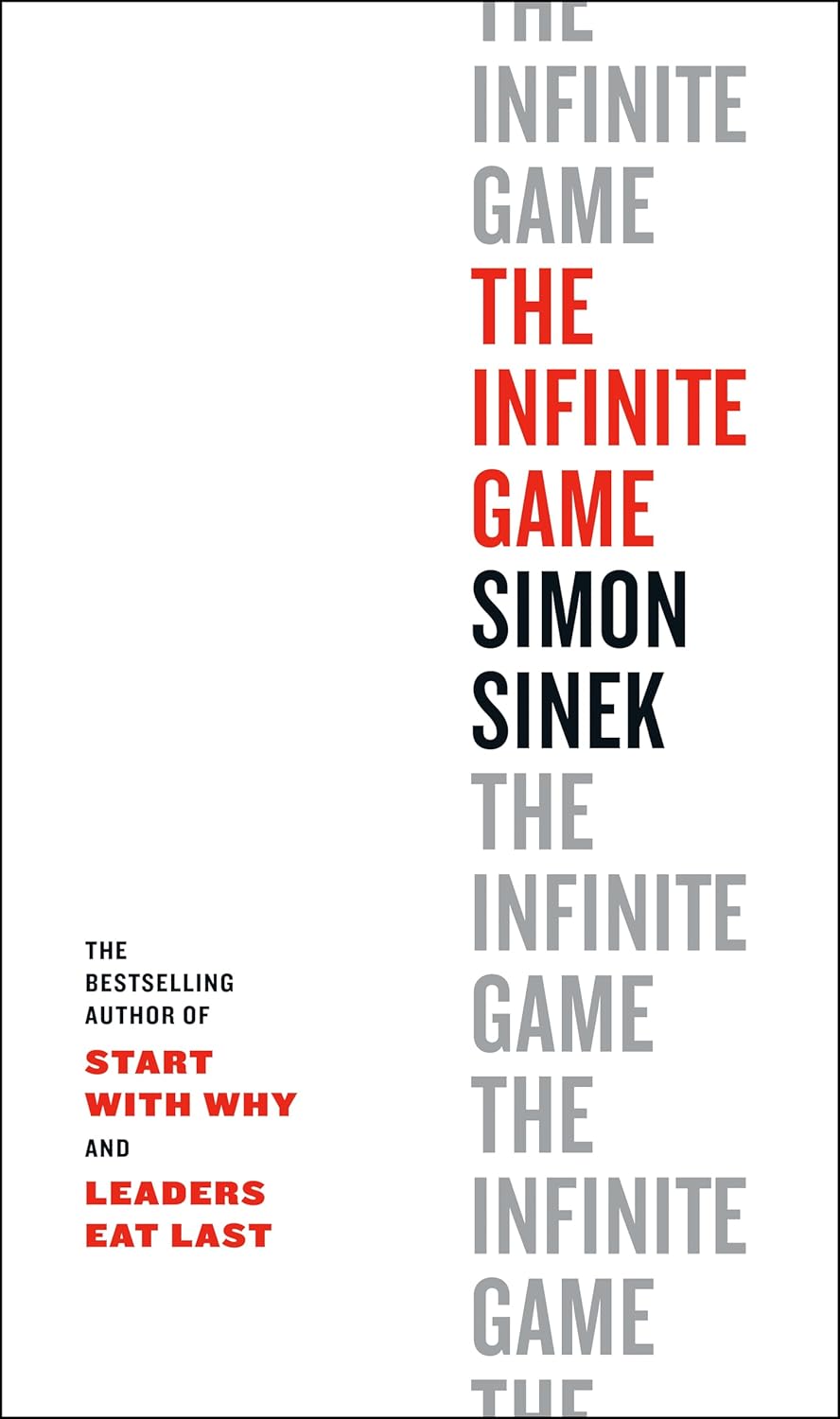
Book overview
The book introduces the distinction between finite and infinite games: finite games have known players, fixed rules and defined endings, while infinite games have changing players, no fixed rules and the objective is to continue play. Sinek argues that many leaders and organizations mistakenly operate with a finite mindset, and shifting to an infinite mindset produces more resilient, ethical and sustainable organizations.
This page is built to be a compact learning hub for The Infinite Game. You can move from the high-level summary into takeaways, quiz prompts, chapter review, and related books without breaking the reading flow.
Best takeaways to keep
Finite games = clear winners and losers; infinite games = continuing play and long
term endurance.
Playing with an infinite mindset changes decisions, strategies and what success means.
Short
term metrics and competition-focused thinking can undermine long
term viability.
Retrieval practice
Which statement best describes the difference between finite and infinite games as presented in The Infinite Game?
Which of the following best captures the characteristics of a 'Just Cause'?
What is the primary function of 'Trusting Teams' in organizations playing an infinite game?
What does Sinek mean by 'Worthy Rivals'?
Quiz preview
Which statement best describes the difference between finite and infinite games as presented in The Infinite Game?
- Finite games have fixed rules and defined endings; infinite games have changing players, no fixed rules, and aim to continue play.
- Infinite games are always longer versions of finite games with more players.
- Finite games allow rule changes to adapt to longer play.
Which of the following best captures the characteristics of a 'Just Cause'?
- A flexible profit target for the next quarter.
- A specific, optimistic, inclusive vision of the future that inspires long-term sacrifice and direction.
- A vague mission statement that avoids committing resources.
What is the primary function of 'Trusting Teams' in organizations playing an infinite game?
- To enforce compliance through strict monitoring.
- To create psychological safety so people can take risks, admit mistakes, and be candid without fear.
- To rank employees by performance to encourage competition.
What does Sinek mean by 'Worthy Rivals'?
- Competitors who must be destroyed to win the game.
- Individuals or organizations that expose our weaknesses and motivate us to improve, not enemies to be eliminated.
- Teammates who always agree with our strategies.
Chapter map
Introduction
The book introduces the distinction between finite and infinite games: finite games have known players, fixed rules and defined endings, while infinite games have changing players, no fixed rules and the objective is to continue play. Sinek argues that many leaders and organizations mistakenly operate with a finite mindset, and shifting to an infinite mindset produces more resilient, ethical and sustainable organizations.
A Just Cause
A Just Cause is a specific, optimistic and inclusive vision of a future state that inspires people to sacrifice and contribute over the long term. Sinek explains the attributes of a valid Just Cause and how it directs decisions, attracts people, and keeps an organization focused on an infinite game.
Trusting Teams
Trusting teams are the organizational condition that allow people to take risks, admit mistakes and be candid without fear of punishment—essential for playing an infinite game. Sinek shows that leaders create trust by prioritizing safety, reducing internal competition and demonstrating vulnerability.
Worthy Rivals
Worthy rivals are competitors or peers who expose our weaknesses and motivate us to improve rather than enemies to be destroyed. Sinek argues that recognizing rivals as worthy encourages humility, continuous learning and better performance in an infinite game.
Existential Flexibility
Existential flexibility is the capacity to make a dramatic, sometimes costly strategic shift to protect or advance a Just Cause when circumstances demand it. Sinek explains that organizations need the will, resources and alignment to pivot decisively when incremental change is insufficient.
Next best step
Move next into the questions page if you want better retention, or into the takeaways page if you want the shortest useful review loop for this book.