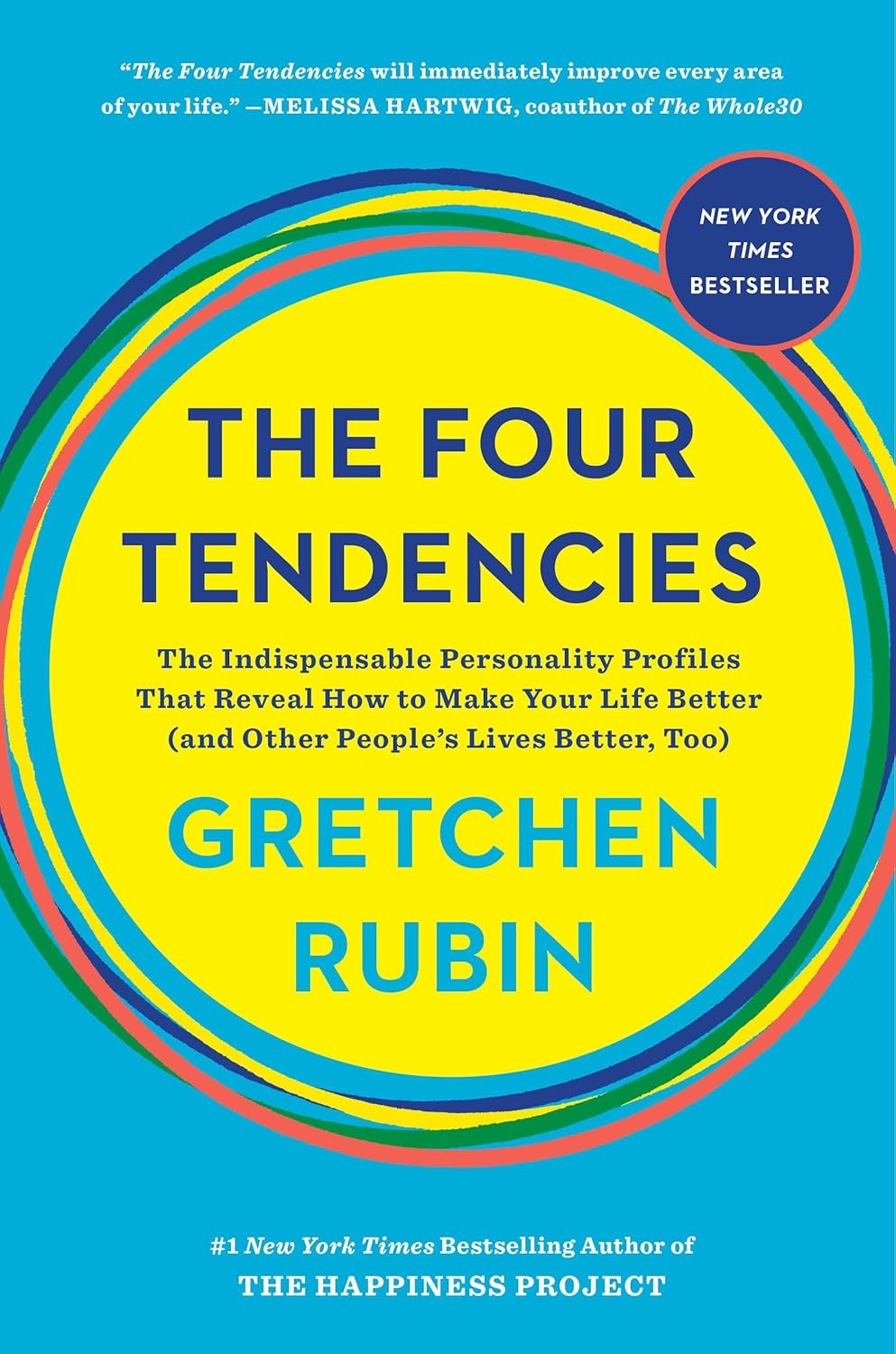
Introduction: Why the Four Tendencies Matter
Summary:
The Four Tendencies framework explains how people respond to inner and outer expectations, organizing behavior into four profiles that predict motivation and habits. Understanding these tendencies helps improve communication, productivity, relationships, and self-understanding.
Key points:
- The framework divides people into Upholders, Questioners, Obligers, and Rebels based on responses to expectations.
- Tendencies predict how people form habits and respond to rules, requests, and deadlines.
- Knowing tendencies helps tailor strategies for motivation, scheduling, and accountability.
- The framework is descriptive and pragmatic rather than moralizing.
Themes & relevance:
Recognizing differing motivational dynamics reveals why the same approach works for some people and fails for others, making it useful in homes, workplaces, and personal planning. The concept reframes common conflicts as mismatches of expectation response rather than willful flaws.
Takeaway / How to use:
Use the Four Tendencies as a simple diagnostic to tailor requests and routines to someone’s motivational profile.
Key points
- The framework divides people into Upholders, Questioners, Obligers, and Rebels based on responses to expectations.
- Tendencies predict how people form habits and respond to rules, requests, and deadlines.
- Knowing tendencies helps tailor strategies for motivation, scheduling, and accountability.
- The framework is descriptive and pragmatic rather than moralizing.
How to Identify Your Tendency
Summary:
This chapter presents questions and scenarios to help readers identify which of the Four Tendencies they are, emphasizing patterns in responding to outer versus inner expectations. It offers practical examples, quizzes, and reflections to distinguish similar tendencies.
Key points:
- Ask whether you readily meet outer expectations, inner expectations, both, or neither to locate your tendency.
- Situational examples (deadlines, New Year’s resolutions, requests from others) clarify differences between tendencies.
- Short quizzes and diagnostic questions are provided to increase certainty about your tendency.
- Some people show mixed or context
- dependent behavior; label uncertain cases with ''.
Themes & relevance:
Accurate self-identification is critical because the usefulness of strategies depends on correctly understanding how you or others respond to expectations. This chapter equips readers with practical tools to make that identification.
Takeaway / How to use:
Answer targeted questions about typical behavior under deadlines and requests to determine your primary tendency.
Key points
- Ask whether you readily meet outer expectations, inner expectations, both, or neither to locate your tendency.
- Situational examples (deadlines, New Year’s resolutions, requests from others) clarify differences between tendencies.
- Short quizzes and diagnostic questions are provided to increase certainty about your tendency.
- Some people show mixed or context
- dependent behavior; label uncertain cases with ''.
The Upholder: Responding to Outer and Inner Expectations
Summary:
Upholders meet both outer and inner expectations readily, valuing rules, plans, and personal standards. The chapter explores strengths (reliability, discipline) and pitfalls (rigidity, overcommitment), and suggests how upholders can balance flexibility and self-care.
Key points:
- Upholders respond well to schedules, rules, and self
- imposed goals and are often seen as dependable.
- They can struggle when rules conflict or when others expect them to be flexible without noticing limits.
- Strategies include setting explicit boundaries, allowing intentional flexibility, and prioritizing rest to avoid burnout.
- Upholders make effective leaders but must guard against holding others to unrealistic standards.
Themes & relevance:
Understanding the upholder tendency explains why some people thrive on structure yet may resent ambiguity or continual negotiation; it helps tailor expectations placed on them. Addressing their tendency helps maintain consistency without sacrificing relationships or adaptability.
Takeaway / How to use:
Set clear rules and personal limits, then deliberately schedule flexibility and recovery time.
Key points
- Upholders respond well to schedules, rules, and self
- imposed goals and are often seen as dependable.
- They can struggle when rules conflict or when others expect them to be flexible without noticing limits.
- Strategies include setting explicit boundaries, allowing intentional flexibility, and prioritizing rest to avoid burnout.
- Upholders make effective leaders but must guard against holding others to unrealistic standards.
The Questioner: Needing Reasons and Justifications
Summary:
Questioners meet expectations only if they make sense to them; they turn outer expectations into inner ones by demanding justification. The chapter details how their need for reason leads to efficiency and skepticism, but can also cause analysis paralysis and strained relationships.
Key points:
- Questioners require reasons and data before complying and prioritize efficiency and logic.
- They excel at improving systems and cutting waste but may resist authority without clear rationale.
- To act, questioners benefit from clear criteria, decision rules, and limits on information
- gathering to prevent endless deliberation.
- In relationships and workplaces, offering reasons and transparent rationale increases buy
- in from Questioners.
Themes & relevance:
The Questioner tendency illuminates why evidence and logic persuade some people more than others and why blanket rules without explanation often backfire. Catering to their need for reason can convert resistance into committed action.
Takeaway / How to use:
Provide clear reasons and decision rules up front, and set deadlines on information-gathering to prompt action.
Key points
- Questioners require reasons and data before complying and prioritize efficiency and logic.
- They excel at improving systems and cutting waste but may resist authority without clear rationale.
- To act, questioners benefit from clear criteria, decision rules, and limits on information
- gathering to prevent endless deliberation.
- In relationships and workplaces, offering reasons and transparent rationale increases buy
- in from Questioners.
The Obliger: Meeting Outer Expectations
Summary:
Obligers readily meet outer expectations but struggle to meet inner expectations, thriving with external accountability yet often neglecting their own priorities. The chapter examines how obligers can harness accountability and protect against resentment and burnout.
Key points:
- Obligers are dependable for others but need external accountability to follow through on personal goals.
- They are vulnerable to overcommitment, saying yes too often, and losing sight of their own needs.
- Effective strategies include finding accountability partners, public commitments, and pre
- committing systems.
- Obligers must learn to negotiate requests, set boundaries, and create structures that serve their priorities.
Themes & relevance:
Recognizing the obliger tendency clarifies why some people excel at teamwork but struggle with self-directed projects and underscores the importance of designing external accountability into plans. It reframes perceived laziness or selfishness as a mismatch in expectation type.
Takeaway / How to use:
Use external accountability—partners, deadlines, or public commitments—to ensure personal goals are met.
Key points
- Obligers are dependable for others but need external accountability to follow through on personal goals.
- They are vulnerable to overcommitment, saying yes too often, and losing sight of their own needs.
- Effective strategies include finding accountability partners, public commitments, and pre
- committing systems.
- Obligers must learn to negotiate requests, set boundaries, and create structures that serve their priorities.
The Rebel: Resisting Expectations
Summary:
Rebels resist both outer and inner expectations, valuing freedom and identity-driven choices; they act from a sense of choice rather than obligation. The chapter explores how rebels can harness their self
- authoring nature productively while avoiding impulsivity and instability.
Key points:
- Rebels prioritize authenticity and choice, often responding negatively to demands and prescriptions.
- They are creative, spontaneous, and action
- oriented when they feel ownership over decisions.
- Rebels succeed when offered choices, autonomy, and identity
- aligned reasons rather than directives.
- Potential pitfalls include inconsistent follow
- through and friction with authority or structure.
Themes & relevance:
Understanding the rebel tendency reveals why direct requests often fail and why framing actions as expressions of identity or autonomy is more effective. It helps design approaches that respect independence while channeling energy constructively.
Takeaway / How to use:
Frame requests as invitations and emphasize choice and identity-aligned benefits to motivate Rebels.
Key points
- Rebels prioritize authenticity and choice, often responding negatively to demands and prescriptions.
- They are creative, spontaneous, and action
- oriented when they feel ownership over decisions.
- Rebels succeed when offered choices, autonomy, and identity
- aligned reasons rather than directives.
- Potential pitfalls include inconsistent follow
- through and friction with authority or structure.
Strategies Tailored to Each Tendency
Summary:
This chapter compiles practical strategies customized to each tendency for habit formation, motivation, and managing obligations. It highlights how the same tactic can succeed or fail depending on whether it aligns with an individual’s tendency.
Key points:
- Upholders: use clear plans, deadlines, and defined limits while building intentional flexibility.
- Questioners: provide reasons and design decision rules; limit research time to avoid paralysis.
- Obligers: create external accountability, partners, and public commitments to drive follow
- through.
- Rebels: offer choice, autonomy, and identity
- based framing rather than mandates.
- Combining tendencies in teams or families requires mixing strategies to suit different members.
Themes & relevance:
Tailored strategies maximize effectiveness by aligning interventions with motivational styles, improving habit success and interpersonal cooperation across contexts. The chapter serves as a practical toolkit for applying the framework.
Takeaway / How to use:
Choose and apply the strategy that corresponds to the person’s tendency rather than using a one-size
- fits-all approach.
Key points
- Upholders: use clear plans, deadlines, and defined limits while building intentional flexibility.
- Questioners: provide reasons and design decision rules; limit research time to avoid paralysis.
- Obligers: create external accountability, partners, and public commitments to drive follow
- through.
- Rebels: offer choice, autonomy, and identity
- based framing rather than mandates.
- Combining tendencies in teams or families requires mixing strategies to suit different members.
Tendencies at Work: Productivity and Motivation
Summary:
This chapter applies the Four Tendencies to workplace settings, showing how roles, management, communication, and teams function differently depending on tendencies. It offers guidance for hiring, delegating, motivating, and designing accountability systems that respect varied motivational profiles.
Key points:
- Managers can boost performance by matching tasks and accountability styles to employees’ tendencies.
- Communication that includes reasons, choices, or clear expectations will resonate differently across tendencies.
- Team composition benefits from awareness of tendencies to prevent gaps (e.g., lack of follow
- through or excessive rule-following).
- Hiring and delegation should consider tendency fit for roles requiring autonomy versus constant deadlines.
Themes & relevance:
Applying tendency awareness at work reduces friction, increases productivity, and fosters better delegation by recognizing that motivation is not uniform. The approach helps design policies and incentives that actually motivate diverse employees.
Takeaway / How to use:
Tailor management and accountability methods to employees’ tendencies to improve engagement and results.
Key points
- Managers can boost performance by matching tasks and accountability styles to employees’ tendencies.
- Communication that includes reasons, choices, or clear expectations will resonate differently across tendencies.
- Team composition benefits from awareness of tendencies to prevent gaps (e.g., lack of follow
- through or excessive rule-following).
- Hiring and delegation should consider tendency fit for roles requiring autonomy versus constant deadlines.
Tendencies in Relationships and Marriage
Summary:
Two to three sentences that explain how each of the Four Tendencies shows up in close relationships and marriage: how expectations and accountability differ, how friction often arises from mismatched inner/outer motivation, and how understanding tendencies helps partners set realistic expectations and cooperate more effectively. The chapter emphasizes strategies for communicating needs, dividing responsibilities, and creating systems that respect each partner’s tendency.
Key points:
- Differences in how people respond to expectations (outer vs. inner) are a common source of conflict in relationships.
- Upholders value rules and mutual agreements; Questioners need reasons and information; Obligers need external accountability; Rebels resist control and value autonomy.
- Successful partners translate vague expectations into concrete plans or external accountability that fit the other’s tendency.
- Practical strategies include negotiating responsibilities, creating explicit agreements, assigning external deadlines, and offering respectful autonomy.
- Recognizing and appreciating each other’s tendency reduces resentment and enables partners to leverage complementary strengths.
Themes & relevance:
Understanding tendencies reframes relationship problems as predictable personality dynamics rather than personal failings, making solutions practical and relational. This insight is relevant for couples seeking better communication, division of labor, and mutual...
Key points
- Differences in how people respond to expectations (outer vs. inner) are a common source of conflict in relationships.
- Upholders value rules and mutual agreements; Questioners need reasons and information; Obligers need external accountability; Rebels resist control and value autonomy.
- Successful partners translate vague expectations into concrete plans or external accountability that fit the other’s tendency.
- Practical strategies include negotiating responsibilities, creating explicit agreements, assigning external deadlines, and offering respectful autonomy.
- Recognizing and appreciating each other’s tendency reduces resentment and enables partners to leverage complementary strengths.
Parenting and Raising Children with the Tendencies
Summary:
Two to three sentences describing how parents can use the Four Tendencies to understand children’s motivations and tailor parenting strategies, including discipline, chores, homework, and encouragement. The chapter provides guidance for identifying a child’s tendency and adapting expectations, structure, and accountability to support healthy development and cooperation.
Key points:
- Identifying a child’s Tendency helps parents choose approaches that motivate rather than frustrate the child.
- Obligers often do well with external accountability (charts, commitments to others); Questioners respond to explanations and logical reasons; Upholders thrive with clear rules; Rebels need autonomy and choice.
- Parents should avoid forcing a child into strategies that conflict with their Tendency and should instead scaffold skills like internal motivation and self
- accountability over time.
- Family systems (routines, consequences, public commitments) can be tailored to support children’s strengths and shore up weaknesses.
- Parenting approaches should combine warmth and structure while teaching children self
- awareness about their own tendency.
Themes & relevance:
Parenting through the lens of the Four Tendencies makes discipline and habit-formation more humane and effective by aligning methods with how children actually respond to expectations. This is relevant for parents, educators, and caregivers aiming to reduce battles and raise responsible, confident...
Key points
- Identifying a child’s Tendency helps parents choose approaches that motivate rather than frustrate the child.
- Obligers often do well with external accountability (charts, commitments to others); Questioners respond to explanations and logical reasons; Upholders thrive with clear rules; Rebels need autonomy and choice.
- Parents should avoid forcing a child into strategies that conflict with their Tendency and should instead scaffold skills like internal motivation and self
- accountability over time.
- Family systems (routines, consequences, public commitments) can be tailored to support children’s strengths and shore up weaknesses.
- Parenting approaches should combine warmth and structure while teaching children self
- awareness about their own tendency.
Habits, Happiness, and the Four Tendencies
Summary:
Two to three sentences on how the Four Tendencies influence habit formation and overall happiness, explaining that different tendencies require different habit strategies (outer accountability, internal reasons, rules, or autonomy). The chapter links making habits stick to aligning habit design with a person’s Tendency and shows how this alignment supports wellbeing and sustained behavior change.
Key points:
- Habit formation succeeds when the method of motivation matches an individual’s Tendency (e.g., Obligers need external accountability; Questioners need to be convinced; Upholders need rules; Rebels need choice and identity
- aligned reasons).
- Happiness is fostered by routines that create autonomy, competence, and relatedness, adapted to each Tendency’s needs.
- Small, concrete tactics—like public commitments, scheduling, habit tracking, or identity
- based reasons—work differently depending on Tendency.
- Combining strategies (outer accountability plus intrinsic reasons) can help people move beyond their natural limitations to build lasting habits.
- Recognizing when a habit isn’t working because of a Tendency lets you reframe and redesign the approach rather than blaming willpower.
Themes & relevance:
The chapter ties personality to practical behavior change, making the science of habits approachable and actionable for diverse personalities. Its relevance lies in improving personal wellbeing by creating habit systems that respect how people a...
Key points
- Habit formation succeeds when the method of motivation matches an individual’s Tendency (e.g., Obligers need external accountability; Questioners need to be convinced; Upholders need rules; Rebels need choice and identity
- aligned reasons).
- Happiness is fostered by routines that create autonomy, competence, and relatedness, adapted to each Tendency’s needs.
- Small, concrete tactics—like public commitments, scheduling, habit tracking, or identity
- based reasons—work differently depending on Tendency.
- Combining strategies (outer accountability plus intrinsic reasons) can help people move beyond their natural limitations to build lasting habits.
- Recognizing when a habit isn’t working because of a Tendency lets you reframe and redesign the approach rather than blaming willpower.
Putting the Tendencies into Practical Use
Summary:
Two to three sentences explaining how to apply the Four Tendencies across work, health, friendships, and community life by tailoring systems, expectations, and environments to tendencies. The chapter offers concrete tools and questions to help individuals and organizations create schedules, teams, and commitments that play to people’s motivational strengths.
Key points:
- Apply Tendency insights when assigning roles, setting deadlines, and creating feedback systems at work and in teams.
- Practical tools include checklists, public commitments, decision frameworks, and accountability partners tailored to tendencies.
- Use Tendency
- aware strategies for time management, delegation, goal-setting, and negotiating social obligations.
- Small environmental changes and agreed
- upon protocols can dramatically improve cooperation and productivity.
- Encourage people to experiment with different approaches and to document what works for them and their teams.
Themes & relevance:
This chapter emphasizes translating psychological insight into everyday tools and organizational practices, making the Four Tendencies useful beyond the self-help context. It’s relevant to managers, teachers, community leaders, and anyone coordinating with others.
Takeaway / How to use:
Apply Tendency-based strategies to the specific tasks and relationships in your life and iterate until they work.
Key points
- Apply Tendency insights when assigning roles, setting deadlines, and creating feedback systems at work and in teams.
- Practical tools include checklists, public commitments, decision frameworks, and accountability partners tailored to tendencies.
- Use Tendency
- aware strategies for time management, delegation, goal-setting, and negotiating social obligations.
- Small environmental changes and agreed
- upon protocols can dramatically improve cooperation and productivity.
- Encourage people to experiment with different approaches and to document what works for them and their teams.
Conclusion: Living Well with Your Tendency
Summary:
Two to three sentences summarizing the book’s main message: knowing your Tendency is a key to better decision-making, relationships, and habit change, and it’s not a limitation but a tool for designing a life that fits you. The conclusion encourages acceptance, experimentation, and using the insights to create systems that support your values and goals.
Key points:
- The Four Tendencies provide a framework for understanding motivation, not a system of judgment or hierarchy.
- Self
- knowledge allows you to craft strategies that minimize friction and maximize effectiveness in daily life.
- Embrace experiments, small tests, and adjustments to discover what actually works for you and others.
- Use your Tendency to inform long
- term planning, relationship choices, and the creation of supportive structures.
Themes & relevance:
The final chapter reinforces self-compassion and practical application, highlighting that personal and interpersonal flourishing come from tailored systems rather than one
- size-fits
- all solutions. It’s relevant to anyone seeking sustainable change and better relationships.
Takeaway / How to use:
Accept your Tendency and design simple, tailored systems that help you meet your goals.
Key points
- The Four Tendencies provide a framework for understanding motivation, not a system of judgment or hierarchy.
- Self
- knowledge allows you to craft strategies that minimize friction and maximize effectiveness in daily life.
- Embrace experiments, small tests, and adjustments to discover what actually works for you and others.
- Use your Tendency to inform long
- term planning, relationship choices, and the creation of supportive structures.