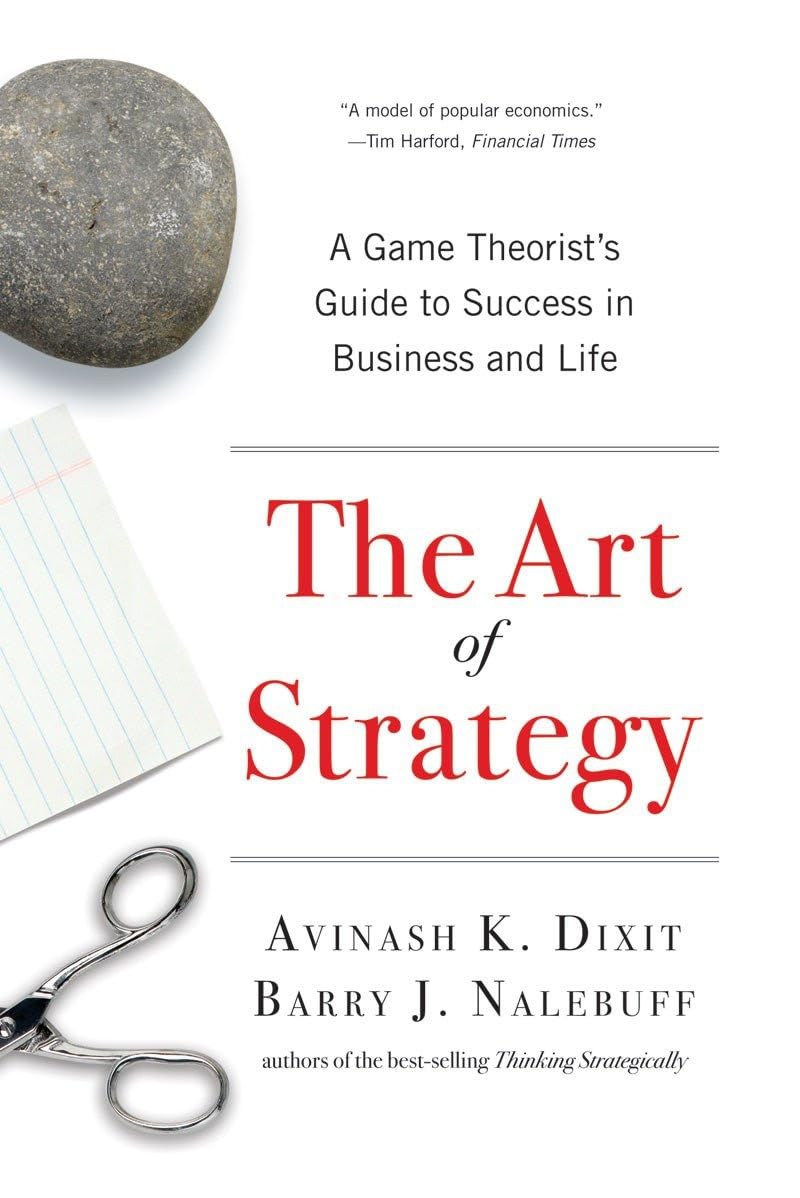
The Art of Strategy: A Game Theorist's Guide to Success in Business and Life: ReadSprint summary highlights
ReadSprint paraphrases for review. These highlights are not verbatim quotations from the book or its author. Check the original edition for exact wording and context.
The Art of Strategy: A Game Theorist's Guide to Success in Business and Life
by Avinash K. Dixit and Barry J. Nalebuff
Thinking strategically means anticipating others' decisions and incorporating their incentives into your planning.
ReadSprint paraphrase · Not a quotation from the author.
Thinking strategically means anticipating others' decisions and incorporating their incentives into your planning.
Strategy depends on interdependent choices, not just individual payoffs.
Share with the ReadSprint source so others can read the context.
The Art of Strategy: A Game Theorist's Guide to Success in Business and Life
by Avinash K. Dixit and Barry J. Nalebuff
It introduces game theory as a toolkit to analyze interactive decision problems in business and life, emphasizing strategic thinking over solitary optimization.
ReadSprint paraphrase · Not a quotation from the author.
It introduces game theory as a toolkit to analyze interactive decision problems in business and life, emphasizing strategic thinking over solitary optimization.
Predicting others' responses is essential to choosing effective actions.
Share with the ReadSprint source so others can read the context.
The Art of Strategy: A Game Theorist's Guide to Success in Business and Life
by Avinash K. Dixit and Barry J. Nalebuff
This chapter defines games formally by listing players, available strategies, and payoffs, and shows how to represent interactions in normal (matrix) and extensive form.
ReadSprint paraphrase · Not a quotation from the author.
This chapter defines games formally by listing players, available strategies, and payoffs, and shows how to represent interactions in normal (matrix) and extensive form.
Games provide models to formalize conflicts and cooperation.
Share with the ReadSprint source so others can read the context.
The Art of Strategy: A Game Theorist's Guide to Success in Business and Life
by Avinash K. Dixit and Barry J. Nalebuff
It explains dominant strategies, dominated strategy elimination, and how payoffs reflect preferences and incentives.
ReadSprint paraphrase · Not a quotation from the author.
It explains dominant strategies, dominated strategy elimination, and how payoffs reflect preferences and incentives.
Simple examples illustrate common strategic patterns (dominance, coordination, conflict).
Share with the ReadSprint source so others can read the context.
The Art of Strategy: A Game Theorist's Guide to Success in Business and Life
by Avinash K. Dixit and Barry J. Nalebuff
Simultaneous-move games are ones where players choose without knowing others' current choices; Nash equilibrium identifies strategy profiles where no player can unilaterally improve their payoff.
ReadSprint paraphrase · Not a quotation from the author.
Simultaneous-move games are ones where players choose without knowing others' current choices; Nash equilibrium identifies strategy profiles where no player can unilaterally improve their payoff.
Begin by identifying the other players, their incentives, and how your actions will change their choices.
Share with the ReadSprint source so others can read the context.
The Art of Strategy: A Game Theorist's Guide to Success in Business and Life
by Avinash K. Dixit and Barry J. Nalebuff
The chapter explains existence, multiplicity, and interpretation of equilibria as stable predictions of play.
ReadSprint paraphrase · Not a quotation from the author.
The chapter explains existence, multiplicity, and interpretation of equilibria as stable predictions of play.
The introduction frames game theory as a practical lens for everyday strategic problems from markets to negotiations. It stresses intuition and structured reasoning rather than complex math.
Share with the ReadSprint source so others can read the context.
The Art of Strategy: A Game Theorist's Guide to Success in Business and Life
by Avinash K. Dixit and Barry J. Nalebuff
When pure-strategy equilibria don't exist or are exploitable, players may randomize over actions; mixed strategies assign probabilities to pure moves and can produce equilibrium.
ReadSprint paraphrase · Not a quotation from the author.
When pure-strategy equilibria don't exist or are exploitable, players may randomize over actions; mixed strategies assign probabilities to pure moves and can produce equilibrium.
Thinking strategically means anticipating others' decisions and incorporating their incentives into your planning. It introduces game theory as a toolkit to analyze interactive decision problems in business and life, emphasizing strategic thinking over solitary optimization.
Share with the ReadSprint source so others can read the context.
The Art of Strategy: A Game Theorist's Guide to Success in Business and Life
by Avinash K. Dixit and Barry J. Nalebuff
The chapter shows how randomization makes players unpredictable and balances opponents' incentives.
ReadSprint paraphrase · Not a quotation from the author.
The chapter shows how randomization makes players unpredictable and balances opponents' incentives.
A game is specified by players, strategy sets, and payoff functions.
Share with the ReadSprint source so others can read the context.
The Art of Strategy: A Game Theorist's Guide to Success in Business and Life
by Avinash K. Dixit and Barry J. Nalebuff
Sequential games model situations with ordered moves and observed actions, using game trees to represent choices; backward induction solves these by reasoning from the end of the game to the beginning.
ReadSprint paraphrase · Not a quotation from the author.
Sequential games model situations with ordered moves and observed actions, using game trees to represent choices; backward induction solves these by reasoning from the end of the game to the beginning.
Dominant strategies win regardless of opponents' moves; dominated strategies can be discarded.
Share with the ReadSprint source so others can read the context.
The Art of Strategy: A Game Theorist's Guide to Success in Business and Life
by Avinash K. Dixit and Barry J. Nalebuff
Subgame perfect equilibrium refines Nash by requiring credible optimality in every subgame.
ReadSprint paraphrase · Not a quotation from the author.
Subgame perfect equilibrium refines Nash by requiring credible optimality in every subgame.
Normal
Share with the ReadSprint source so others can read the context.