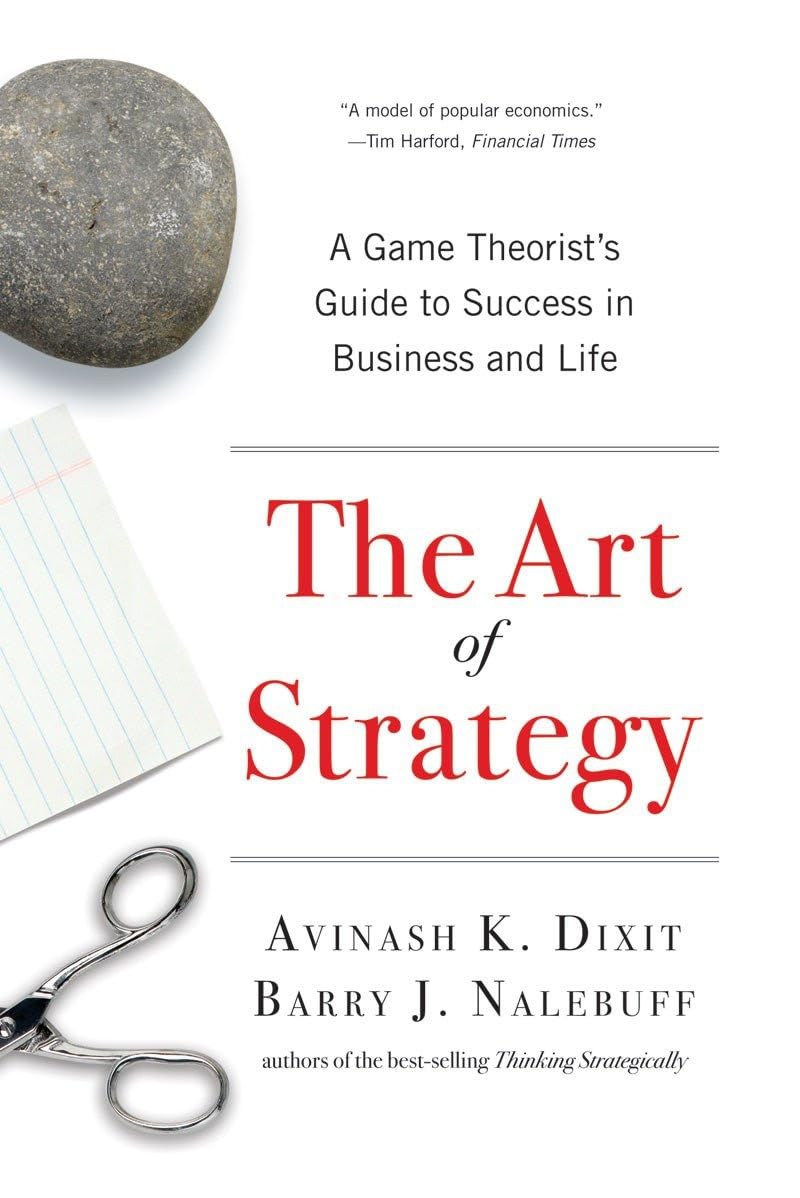
Introduction: Thinking Strategically
Summary:
Thinking strategically means anticipating others' decisions and incorporating their incentives into your planning. It introduces game theory as a toolkit to analyze interactive decision problems in business and life, emphasizing strategic thinking over solitary optimization.
Key points:
- Strategy depends on interdependent choices, not just individual payoffs.
- Predicting others' responses is essential to choosing effective actions.
- Games provide models to formalize conflicts and cooperation.
- Simple examples illustrate common strategic patterns (dominance, coordination, conflict).
Themes & relevance:
The introduction frames game theory as a practical lens for everyday strategic problems from markets to negotiations. It stresses intuition and structured reasoning rather than complex math.
Takeaway / How to use:
Begin by identifying the other players, their incentives, and how your actions will change their choices.
Key points
- Strategy depends on interdependent choices, not just individual payoffs.
- Predicting others' responses is essential to choosing effective actions.
- Games provide models to formalize conflicts and cooperation.
- Simple examples illustrate common strategic patterns (dominance, coordination, conflict).
1. The Basics: Games, Payoffs, and Strategies
Summary:
This chapter defines games formally by listing players, available strategies, and payoffs, and shows how to represent interactions in normal (matrix) and extensive form. It explains dominant strategies, dominated strategy elimination, and how payoffs reflect preferences and incentives.
Key points:
- A game is specified by players, strategy sets, and payoff functions.
- Dominant strategies win regardless of opponents' moves; dominated strategies can be discarded.
- Normal
- form (matrix) and extensive-form (tree) representations suit different problems.
- Payoffs capture rankings of outcomes and guide strategic choice.
Themes & relevance:
Understanding basic ingredients lets you model competitive and cooperative situations across business, politics, and personal decisions. Clear representation uncovers hidden options and simplifies analysis.
Takeaway / How to use:
Model a strategic situation by listing players, possible actions, and payoffs before trying to solve it.
Key points
- A game is specified by players, strategy sets, and payoff functions.
- Dominant strategies win regardless of opponents' moves; dominated strategies can be discarded.
- Normal
- form (matrix) and extensive-form (tree) representations suit different problems.
- Payoffs capture rankings of outcomes and guide strategic choice.
2. Simultaneous-Move Games and Nash Equilibrium
Summary:
Simultaneous-move games are ones where players choose without knowing others' current choices; Nash equilibrium identifies strategy profiles where no player can unilaterally improve their payoff. The chapter explains existence, multiplicity, and interpretation of equilibria as stable predictions of play.
Key points:
- Nash equilibrium: each player's strategy is a best response to others'.
- Games can have multiple equilibria or none in pure strategies, creating coordination or indeterminacy problems.
- Dominance
- solvable games yield unique predictions; otherwise equilibrium selection matters.
- Equilibrium predicts stability but not how players reach it.
Themes & relevance:
Nash equilibrium is the central solution concept for simultaneous interactions, useful for pricing, competition, and coordination problems. Recognize limits: multiple equilibria and equilibrium selection require extra reasoning.
Takeaway / How to use:
Find best responses and intersection points to identify candidate equilibria and assess their plausibility.
Key points
- Nash equilibrium: each player's strategy is a best response to others'.
- Games can have multiple equilibria or none in pure strategies, creating coordination or indeterminacy problems.
- Dominance
- solvable games yield unique predictions; otherwise equilibrium selection matters.
- Equilibrium predicts stability but not how players reach it.
3. Mixed Strategies and Randomization
Summary:
When pure-strategy equilibria don't exist or are exploitable, players may randomize over actions; mixed strategies assign probabilities to pure moves and can produce equilibrium. The chapter shows how randomization makes players unpredictable and balances opponents' incentives.
Key points:
- Mixed strategy equilibrium exists in many games where no pure equilibrium exists.
- Indifference principle: opponents randomize so each action used yields equal expected payoff.
- Randomization can be strategic (e.g., in pricing, sports, auctions) to avoid being exploited.
- Expected payoffs drive choices under risk
- neutral assumptions.
Themes & relevance:
Randomization is a practical tool when deterministic strategies are punished; understanding it helps in designing competitive tactics and avoiding predictable behavior. It links strategic unpredictability to measurable payoffs.
Takeaway / How to use:
When opponents exploit patterns, introduce controlled randomness that makes their best responses indifferent.
Key points
- Mixed strategy equilibrium exists in many games where no pure equilibrium exists.
- Indifference principle: opponents randomize so each action used yields equal expected payoff.
- Randomization can be strategic (e.g., in pricing, sports, auctions) to avoid being exploited.
- Expected payoffs drive choices under risk
- neutral assumptions.
4. Sequential Games and Backward Induction
Summary:
Sequential games model situations with ordered moves and observed actions, using game trees to represent choices; backward induction solves these by reasoning from the end of the game to the beginning. Subgame perfect equilibrium refines Nash by requiring credible optimality in every subgame.
Key points:
- Extensive
- form trees capture timing, information sets, and moves.
- Backward induction finds optimal strategies by solving later decisions first.
- Subgame perfect equilibrium eliminates non
- credible threats present in some Nash equilibria.
- Reputation and first
- mover advantages arise from sequential structure.
Themes & relevance:
Sequential analysis reveals the power of timing, commitment, and information revelation in negotiations, product launches, and bargaining. It clarifies which threats and promises are credible.
Takeaway / How to use:
Solve sequential problems by working backward from terminal outcomes to ensure every planned action is credible.
Key points
- Extensive
- form trees capture timing, information sets, and moves.
- Backward induction finds optimal strategies by solving later decisions first.
- Subgame perfect equilibrium eliminates non
- credible threats present in some Nash equilibria.
- Reputation and first
- mover advantages arise from sequential structure.
5. Commitment: Making Your Threats and Promises Credible
Summary:
This chapter examines commitment devices that change future incentives and make threats or promises credible, altering opponents' expectations and behavior. It distinguishes endogenous commitment (actions you take now) from exogenous mechanisms and shows payoff trade-offs.
Key points:
- Credible commitments change the game by restricting your future choices.
- Irreversible actions, contracts, reputation, and sunk costs can serve as commitment tools.
- Commitment can create first
- mover advantages or deter entry but may carry costs or limit flexibility.
- Opponents respond to observable commitments, reshaping equilibrium outcomes.
Themes & relevance:
Effective commitment transforms strategic environments across business (capacity expansion, warranties) and politics (policy locking). Balancing credibility and flexibility is central to long-term strategy.
Takeaway / How to use:
Make commitments that are observable and costly to reverse so your threats or promises are believed.
Key points
- Credible commitments change the game by restricting your future choices.
- Irreversible actions, contracts, reputation, and sunk costs can serve as commitment tools.
- Commitment can create first
- mover advantages or deter entry but may carry costs or limit flexibility.
- Opponents respond to observable commitments, reshaping equilibrium outcomes.
6. Strategic Moves and Manipulating Choices
Summary:
The chapter explores strategic moves—announcements, delegations, and actions—that influence rivals' choices by changing their payoff calculations. It covers preplay communication, framing choices, and mechanisms to shape the strategic landscape.
Key points:
- Strategic moves alter opponents' incentives without changing their preferences directly.
- Cheap talk can sometimes coordinate but lacks credibility unless backed by action.
- Delegation, partial irreversibility, and changing the choice set can be used to influence rivals.
- Timing and observability of moves determine their effectiveness.
Themes & relevance:
Manipulating others' choices through strategic moves is central in negotiations, pricing, and organizational design; the chapter links tactics to formal models. Understanding limits of persuasion and commitment helps avoid costly preplay mistakes.
Takeaway / How to use:
Use credible, observable preplay actions to reshape others' incentives in your favor.
Key points
- Strategic moves alter opponents' incentives without changing their preferences directly.
- Cheap talk can sometimes coordinate but lacks credibility unless backed by action.
- Delegation, partial irreversibility, and changing the choice set can be used to influence rivals.
- Timing and observability of moves determine their effectiveness.
7. Information and Asymmetry: Signaling and Screening
Summary:
This chapter addresses games with private information, where signaling (by informed players) and screening (by uninformed players) help reveal types. It explains separating and pooling equilibria and shows how information asymmetry shapes markets and contracts.
Key points:
- Private information creates adverse selection and moral hazard problems.
- Signaling (education, warranties) can credibly convey high
- quality types if costly to mimic.
- Screening (menus, tests, pricing schemes) induces self
- selection by different types.
- Equilibria may pool or separate types depending on costs and incentives.
Themes & relevance:
Information design is crucial in hiring, insurance, and markets where quality or intent is hidden; signaling and screening are practical tools to mitigate asymmetry. Recognize the role of costs in making signals credible.
Takeaway / How to use:
Design costly, type-differentiating actions or choice menus that induce truthful revelation or desired sorting.
Key points
- Private information creates adverse selection and moral hazard problems.
- Signaling (education, warranties) can credibly convey high
- quality types if costly to mimic.
- Screening (menus, tests, pricing schemes) induces self
- selection by different types.
- Equilibria may pool or separate types depending on costs and incentives.
8. Auctions, Bidding, and Competitive Mechanisms
Summary:
This chapter explains how different auction formats and competitive mechanisms shape bidding strategies and outcomes, using game-theoretic reasoning to predict behavior. It highlights the roles of information, valuation (private vs. common), and rule design in determining efficiency and revenue.
Key points:
- Auction format (first
- price, second-price, English, Dutch) changes incentives: truthful bidding is dominant in second
- price auctions but not in first-price ones.
- Information structure matters: common
- value auctions create the winner’s curse, while private-value auctions emphasize strategic shading.
- Reserve prices and entry rules can improve seller revenue and efficiency by managing adverse selection and participation.
- Collusion, signaling, and bid
- sniping are strategic behaviors that can arise and be mitigated through rule design and transparency.
- Mechanism objectives (revenue vs. efficiency vs. fairness) often conflict and must be traded off explicitly.
Themes & relevance:
Design of competitive mechanisms is a practical application of game theory that affects markets, procurement, and online platforms; small rule changes can produce large strategic shifts.
Takeaway / How to use:
Choose auction rules that align incentives with your objective and anticipate information asymmetries to reduce costly strategic behavior.
Key points
- Auction format (first
- price, second-price, English, Dutch) changes incentives: truthful bidding is dominant in second
- price auctions but not in first-price ones.
- Information structure matters: common
- value auctions create the winner’s curse, while private-value auctions emphasize strategic shading.
- Reserve prices and entry rules can improve seller revenue and efficiency by managing adverse selection and participation.
- Collusion, signaling, and bid
- sniping are strategic behaviors that can arise and be mitigated through rule design and transparency.
- Mechanism objectives (revenue vs. efficiency vs. fairness) often conflict and must be traded off explicitly.
9. Bargaining, Negotiation, and Coalitions
Summary:
This chapter analyzes bargaining and coalition formation using strategic models that incorporate outside options, bargaining power, and credible threats. It emphasizes how timing, information, and institutions influence negotiated agreements and the stability of coalitions.
Key points:
- Outside options and BATNA (best alternative to negotiated agreement) determine bargaining leverage and division of surplus.
- Sequential moves and the ability to make credible commitments or threats change bargaining outcomes (e.g., ultimatum and alternating
- offer models).
- Information asymmetries lead to signaling, delay, or breakdowns; revealing or hiding information is a strategic choice.
- Coalition stability depends on payoff division rules (core, Shapley value ideas): some coalitions are unstable if members can do better by deviating.
- Institutions and repeated interaction foster cooperative bargains by making threats credible and enabling enforcement.
Themes & relevance:
Understanding bargaining dynamics helps in negotiations from salary talks to mergers, where power, timing, and information shape deals.
Takeaway / How to use:
Identify and improve your outside options and manage information disclosure to strengthen your negotiation position.
Key points
- Outside options and BATNA (best alternative to negotiated agreement) determine bargaining leverage and division of surplus.
- Sequential moves and the ability to make credible commitments or threats change bargaining outcomes (e.g., ultimatum and alternating
- offer models).
- Information asymmetries lead to signaling, delay, or breakdowns; revealing or hiding information is a strategic choice.
- Coalition stability depends on payoff division rules (core, Shapley value ideas): some coalitions are unstable if members can do better by deviating.
- Institutions and repeated interaction foster cooperative bargains by making threats credible and enabling enforcement.
10. Repeated Games, Reputation, and Cooperation
Summary:
The chapter explores how repetition of interactions can sustain cooperation among self-interested players through strategies that reward cooperation and punish defection. It shows how reputation and the shadow of the future alter incentives, enabling outcomes that differ from one
- shot equilibria.
Key points:
- Folk theorems: with sufficient patience and monitoring, many cooperative outcomes can be sustained as equilibria in repeated games.
- Trigger strategies (grim, tit
- for-tat, forgiving variants) enforce cooperation by linking future payoffs to current actions.
- Reputation effects matter when actions are observable or outcomes informative; newcomers must build credibility to gain trust.
- Imperfect monitoring and noise complicate enforcement and require more nuanced strategies (forgiveness, gradual punishment).
- Discounting and the probability of interaction continuation determine whether cooperation is feasible.
Themes & relevance:
Repeated interaction is a key mechanism for achieving cooperation in business, markets, and personal relationships where formal contracts are costly or incomplete.
Takeaway / How to use:
Leverage long-term relationships and design clear, observable behaviors to build reputation and sustain cooperation.
Key points
- Folk theorems: with sufficient patience and monitoring, many cooperative outcomes can be sustained as equilibria in repeated games.
- Trigger strategies (grim, tit
- for-tat, forgiving variants) enforce cooperation by linking future payoffs to current actions.
- Reputation effects matter when actions are observable or outcomes informative; newcomers must build credibility to gain trust.
- Imperfect monitoring and noise complicate enforcement and require more nuanced strategies (forgiveness, gradual punishment).
- Discounting and the probability of interaction continuation determine whether cooperation is feasible.
11. Voting, Collective Decisions, and Mechanism Design
Summary:
This chapter examines how groups aggregate preferences through voting and how mechanism design can align individual incentives with desired collective outcomes. It highlights limitations such as strategic voting, agenda control, and impossibility results, while offering design principles to improve decision-making.
Key points:
- Social choice problems: majority rule, plurality, and other voting systems can produce different, sometimes paradoxical, outcomes (Condorcet cycles).
- Strategic voting, agenda setting, and coalition formation can distort collective choices away from sincere preferences.
- Mechanism design seeks rules that make truthful revelation optimal (incentive compatibility) and that meet constraints like individual rationality and budget balance.
- Impossibility theorems (Arrow) and trade
- offs (efficiency vs. fairness vs. strategy-proofness) limit what designers can achieve.
- Institutions (voting rules, committees, auctions) can be tailored to context to mitigate manipulation and improve welfare.
Themes & relevance:
Collective decision processes matter in organizations and public policy; smart mechanism design helps achieve better group outcomes despite strategic behavior.
Takeaway / How to use:
Choose voting and decision rules that reduce incentives to manipulate and match the priorities of your group (efficiency, fairness, or simplicity).
Key points
- Social choice problems: majority rule, plurality, and other voting systems can produce different, sometimes paradoxical, outcomes (Condorcet cycles).
- Strategic voting, agenda setting, and coalition formation can distort collective choices away from sincere preferences.
- Mechanism design seeks rules that make truthful revelation optimal (incentive compatibility) and that meet constraints like individual rationality and budget balance.
- Impossibility theorems (Arrow) and trade
- offs (efficiency vs. fairness vs. strategy-proofness) limit what designers can achieve.
- Institutions (voting rules, committees, auctions) can be tailored to context to mitigate manipulation and improve welfare.
12. Behavioral and Evolutionary Perspectives on Strategy
Summary:
This chapter integrates behavioral and evolutionary insights into strategic analysis, showing how bounded rationality, heuristics, and learning alter game-theoretic predictions. It explains when normative models suffice and when real human behavior requires modified models or robust mechanism design.
Key points:
- Bounded rationality and systematic biases (overconfidence, loss aversion, anchoring) change choices and can be exploited or mitigated strategically.
- Behavioral equilibria may differ from Nash predictions; incorporating limited foresight or noisy best responses yields more realistic forecasts.
- Evolutionary dynamics and learning processes explain how strategies spread over time without full rationality, highlighting path dependence and stability of observed behaviors.
- Mechanism designers can build robustness by anticipating predictable deviations and using simpler, incentive
- compatible rules.
- Combining normative game theory with descriptive behavioral models improves both prediction and policy design.
Themes & relevance:
Real-world strategy needs to account for human psychology and adaptive processes to be effective in markets, negotiations, and organizations.
Takeaway / How to use:
Anticipate common biases and design simple, incentive-aligned environments that are robust to imperfectly rational behavior.
Key points
- Bounded rationality and systematic biases (overconfidence, loss aversion, anchoring) change choices and can be exploited or mitigated strategically.
- Behavioral equilibria may differ from Nash predictions; incorporating limited foresight or noisy best responses yields more realistic forecasts.
- Evolutionary dynamics and learning processes explain how strategies spread over time without full rationality, highlighting path dependence and stability of observed behaviors.
- Mechanism designers can build robustness by anticipating predictable deviations and using simpler, incentive
- compatible rules.
- Combining normative game theory with descriptive behavioral models improves both prediction and policy design.
13. Applying Strategy: Case Studies in Business and Life
Summary:
The final chapter applies game-theoretic concepts across diverse case studies—pricing wars, product launches, bargaining over jobs, and political contests—to demonstrate practical strategy design. It synthesizes earlier ideas into diagnostic tools for anticipating opponents, structuring incentives, and choosing commitment devices.
Key points:
- Case studies illustrate how commitment, signaling, and credible threats change competitive dynamics in markets and negotiations.
- Entry deterrence, pricing strategies, and product differentiation are analyzed as strategic moves shaped by information and payoff structure.
- Organizational examples show how incentive contracts, hierarchies, and decision rules influence cooperation and performance.
- Non
- market examples (dating, reputation management, political campaigns) demonstrate transferability of strategic principles.
- The chapter emphasizes adapting general models to context and testing assumptions before committing to costly strategies.
Themes & relevance:
Practical strategy requires translating theory into context-specific actions and using models as diagnostic lenses rather than prescriptions.
Takeaway / How to use:
Apply simple game-theoretic checks—identify players, moves, payoffs, and information—to diagnose and choose strategic actions.
Key points
- Case studies illustrate how commitment, signaling, and credible threats change competitive dynamics in markets and negotiations.
- Entry deterrence, pricing strategies, and product differentiation are analyzed as strategic moves shaped by information and payoff structure.
- Organizational examples show how incentive contracts, hierarchies, and decision rules influence cooperation and performance.
- Non
- market examples (dating, reputation management, political campaigns) demonstrate transferability of strategic principles.
- The chapter emphasizes adapting general models to context and testing assumptions before committing to costly strategies.