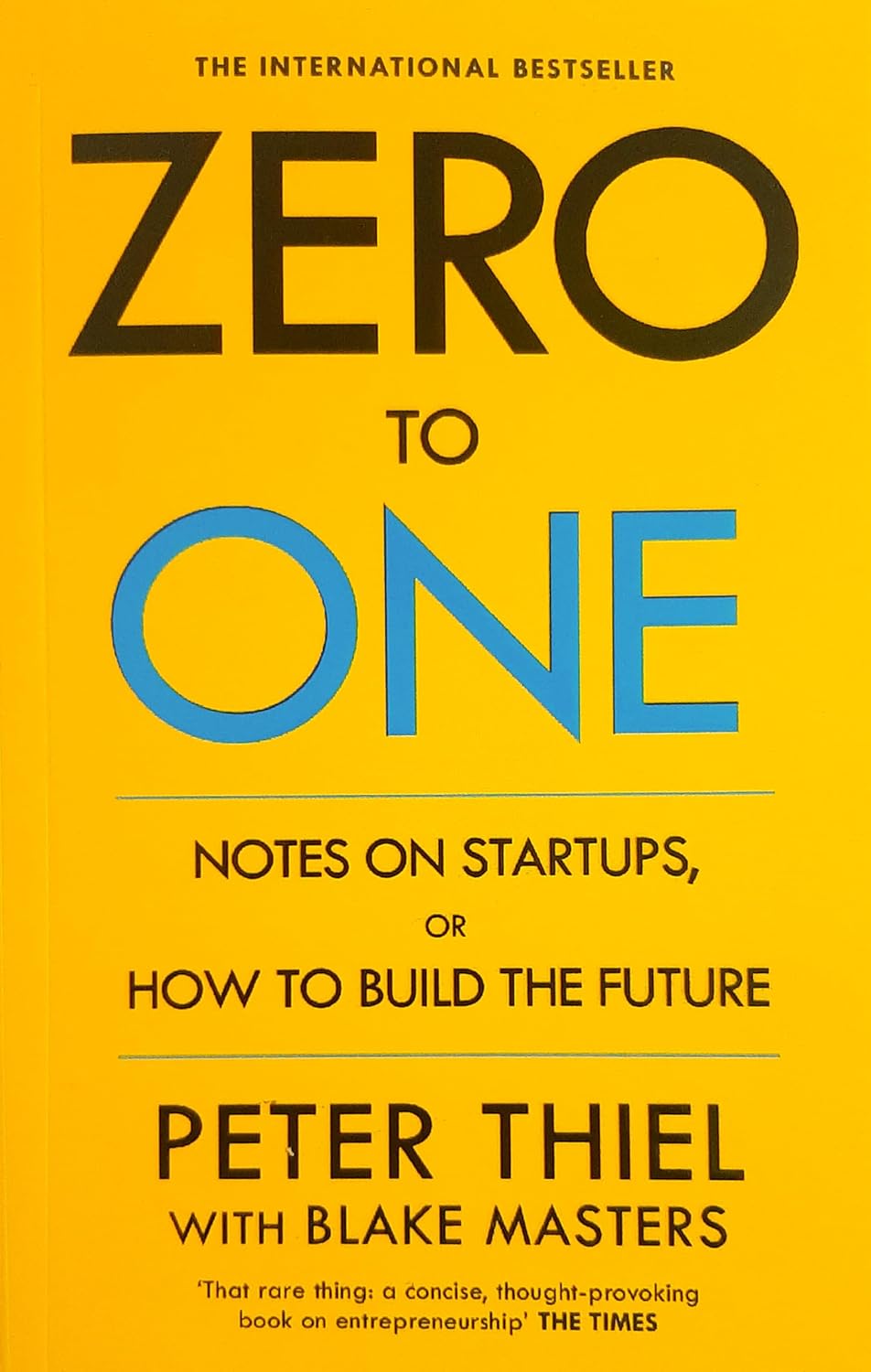
The Challenge of the Future
Summary:
Peter Thiel argues that the future is not inevitable and must be actively created; progress comes from technology that takes us from "zero to one" rather than incremental "one to n" improvements. He emphasizes that doing new things requires bold, contrarian thinking and deliberate planning to build lasting value.
Key points:
- The distinction between vertical progress (zero to one) and horizontal progress (one to n).
- Most people expect the future to be a continuation of the present, but definite planning and innovation produce breakthroughs.
- Stagnation is a risk when society relies on globalization and copying instead of technological novelty.
Themes & relevance:
This chapter frames entrepreneurship as a creative, forward-looking endeavor and challenges readers to prefer unique innovations over imitation. It sets the philosophical foundation for thinking about strategy, monopoly, and progress.
Takeaway / How to use:
Actively seek opportunities to create something genuinely new rather than merely iterating on existing solutions.
Key points
- The distinction between vertical progress (zero to one) and horizontal progress (one to n).
- Most people expect the future to be a continuation of the present, but definite planning and innovation produce breakthroughs.
- Stagnation is a risk when society relies on globalization and copying instead of technological novelty.
Party Like It's 1999
Summary:
Thiel recounts the dot-com boom and bust to show the dangers of ungrounded optimism and herd behavior: capital and talent were misallocated based on hype rather than durable business fundamentals. He uses the episode to extract lessons about valuation, planning, and the difference between building a company and riding a speculative wave.
Key points:
- The dot-com bubble resulted from believing the future was guaranteed without sound business models.
- Short-term growth and flashy metrics often mask lack of sustainable value.
- Risk and timing matter: being early is not the same as being right.
Themes & relevance:
The chapter warns entrepreneurs and investors to avoid hype-driven decision making and to prioritize durable advantages and clear plans. It is a corrective to market euphoria and a call for rigorous thinking.
Takeaway / How to use:
Evaluate opportunities by their long-term fundamentals, not by current craze or market sentiment.
Key points
- The dot-com bubble resulted from believing the future was guaranteed without sound business models.
- Short-term growth and flashy metrics often mask lack of sustainable value.
- Risk and timing matter: being early is not the same as being right.
All Happy Companies Are Different
Summary:
Thiel asserts that successful companies are unique because they avoid competition and secure monopoly-like positions, while failed firms often end up in cutthroat markets. He argues that the goal of a business should be to create and maintain lasting monopoly through proprietary technology, network effects, economies of scale, and branding.
Key points:
- Monopoly businesses can plan for the long term and capture substantial profits.
- Perfect competition drives profits to zero and is destructive for companies trying to build something durable.
- Sustainable advantages come from technology, network effects, economies of scale, and strong branding.
Themes & relevance:
This chapter reframes good business as the art of designing a unique company rather than competing in crowded spaces. It guides founders to seek defensible positions that enable long-term creation of value.
Takeaway / How to use:
Design your product and strategy to create a monopoly niche that competitors cannot easily replicate.
Key points
- Monopoly businesses can plan for the long term and capture substantial profits.
- Perfect competition drives profits to zero and is destructive for companies trying to build something durable.
- Sustainable advantages come from technology, network effects, economies of scale, and strong branding.
The Ideology of Competition
Summary:
Thiel critiques the cultural fetishization of competition, showing that relentless rivalry often reduces creativity and destroys value. He recommends that companies strive to be non-competitive by creating unique offerings and controlling niches where competition is irrelevant.
Key points:
- Excessive competition can lead to wasteful imitation and short-term thinking.
- Social ideologies that romanticize competition can blind people to the benefits of monopoly and strategic planning.
- Founders should focus on differentiating and building systems where they can win decisively rather than merely survive.
Themes & relevance:
The chapter highlights psychological and social barriers that push entrepreneurs toward crowded markets, arguing for contrarian positioning instead. It is relevant to strategic choices about product differentiation and long-term planning.
Takeaway / How to use:
Avoid competing on others' terms; create a unique market position where you can be the last mover standing.
Key points
- Excessive competition can lead to wasteful imitation and short-term thinking.
- Social ideologies that romanticize competition can blind people to the benefits of monopoly and strategic planning.
- Founders should focus on differentiating and building systems where they can win decisively rather than merely survive.
Last Mover Advantage
Summary:
Thiel explains how companies that become definitive market leaders can enjoy "last mover advantage" by establishing durable monopolies through scale, brand, and proprietary tech. He contrasts this with the false allure of being an early mover without the ability to secure defensible advantages.
Key points:
- Being the last mover means creating something so valuable and defensible that you dominate your market.
- Network effects, proprietary technology, and economies of scale compound over time to entrench leaders.
- Early entry alone is insufficient; execution, timing, and the ability to lock down advantages matter more.
Themes & relevance:
This chapter reframes timing in entrepreneurship: success is about building for permanence and cumulative advantage rather than mere speed. It informs decisions about product development, scaling, and protection of core assets.
Takeaway / How to use:
Build systems and advantages that increase returns over time so your business can become the enduring market leader.
Key points
- Being the last mover means creating something so valuable and defensible that you dominate your market.
- Network effects, proprietary technology, and economies of scale compound over time to entrench leaders.
- Early entry alone is insufficient; execution, timing, and the ability to lock down advantages matter more.
You Are Not a Lottery Ticket
Summary:
Thiel challenges fatalistic views of luck and argues that intentional planning, skill, and specific decisions drive success more than random chance. He encourages adopting a definite optimism—planning for a preferred future and taking concrete steps to make it happen.
Key points:
- Treat success as the result of deliberate choices, not random luck.
- Definite optimism (planning for a specific, better future) is superior to indefinite optimism or pessimism.
- Founders should make clear, bold plans rather than hoping outcomes will work out by chance.
Themes & relevance:
The chapter promotes agency and strategic thinking, pushing entrepreneurs to design concrete plans instead of relying on probabilistic hope. It connects mindset to practical business planning and execution.
Takeaway / How to use:
Adopt a definite plan and take specific actions to shape the future you want, rather than relying on luck.
Key points
- Treat success as the result of deliberate choices, not random luck.
- Definite optimism (planning for a specific, better future) is superior to indefinite optimism or pessimism.
- Founders should make clear, bold plans rather than hoping outcomes will work out by chance.
Follow the Money
Summary:
Thiel examines how to structure business and financing to capture value, explaining the importance of power law returns and thoughtful capitalization. He advises founders to focus on metrics that matter, maintain control where strategic, and raise capital on terms that support long-term goals.
Key points:
- Venture returns follow a power law where a few companies generate most of the value.
- Capitalization, ownership structure, and incentive design determine whether founders reap rewards from success.
- Focus on creating high-margin businesses with clear paths to profitability rather than vanity metrics.
Themes & relevance:
This chapter links strategy to financial architecture, stressing that how you raise and allocate capital shapes your ability to build a monopoly. It is practical guidance for fundraising, cap tables, and aligning incentives.
Takeaway / How to use:
Design your financing and ownership structure to preserve control and capture the majority of value your company creates.
Key points
- Venture returns follow a power law where a few companies generate most of the value.
- Capitalization, ownership structure, and incentive design determine whether founders reap rewards from success.
- Focus on creating high-margin businesses with clear paths to profitability rather than vanity metrics.
Secrets
Summary:
Thiel argues that the best businesses are built around secrets—important truths that are undiscovered or underappreciated by others—and that founders should search for these secrets to create unique value. He encourages contrarian inquiry and deep technical or market insight as the seed of lasting companies.
Key points:
- A secret is a truth about the world that others do not see or believe; finding one enables monopoly creation.
- Successful founders combine contrarian thinking with strong evidence and rigorous reasoning to validate secrets.
- Secrets can come from technology, markets, or business model design and require bold claims backed by execution.
Themes & relevance:
The chapter promotes intellectual curiosity and original thinking as the foundation of transformative startups, linking discovery to competitive advantage. It is a practical call to look for overlooked opportunities with real evidence.
Takeaway / How to use:
Search for and validate contrarian truths about your market or technology, then build your company around them.
Key points
- A secret is a truth about the world that others do not see or believe; finding one enables monopoly creation.
- Successful founders combine contrarian thinking with strong evidence and rigorous reasoning to validate secrets.
- Secrets can come from technology, markets, or business model design and require bold claims backed by execution.
Foundations
Summary:
Two or three critical decisions made when a company is founded determine its long-term prospects: team composition, ownership structure, and culture. Thiel argues that strong foundations — clear ownership, aligned incentives (including equity), and committed founders — reduce future friction and enable durable advantages.
Key points:
- Choose cofounders carefully: complementary skills, trust, and long-term commitment matter more than short-term convenience.
- Equity and control should be clearly allocated early, with mechanisms like vesting to align incentives.
- Legal structure, board composition, and formal roles established at the start shape future decision-making.
- Company culture is a foundation-level asset: small early teams set norms that scale with the company.
- Avoid fragile setups: ambiguous ownership, casual commitments, and ad-hoc governance create later crises.
Themes & relevance:
Foundations emphasize that entrepreneurial success is as much about human and legal architecture as about product ideas; getting these basics right multiplies technical and market efforts. This is relevant to founders planning hiring, equity, and governance today.
Takeaway / How to use:
Set clear ownership, vesting, and roles before scaling to lock in alignment and prevent future disputes.
Key points
- Choose cofounders carefully: complementary skills, trust, and long-term commitment matter more than short-term convenience.
- Equity and control should be clearly allocated early, with mechanisms like vesting to align incentives.
- Legal structure, board composition, and formal roles established at the start shape future decision-making.
- Company culture is a foundation-level asset: small early teams set norms that scale with the company.
- Avoid fragile setups: ambiguous ownership, casual commitments, and ad-hoc governance create later crises.
The Mechanics of Mafia
Summary:
Thiel describes the ‘‘mafia’’ as a tight-knit company culture where members are intensely loyal, work closely, and share a mission — exemplified by PayPal’s founding team and its enduring network. He contends that a proprietary, mission-driven culture assembled from exceptional people is a major competitive advantage.
Key points:
- Small, cohesive teams with strong personal bonds outperform large, fragmented ones in early stages.
- Hiring should focus on ‘A’ players who fit the mission; marginal hires dilute culture and momentum.
- Shared mission and intensive onboarding create trust, speed, and coordination.
- Equity and cofounder dynamics foster long-term loyalty and commitment.
- Avoid bureaucracy; preserve direct communication and high expectations as the team grows.
Themes & relevance:
This chapter highlights that culture and people mechanics are strategic assets, not HR afterthoughts; building an internal ‘‘mafia’’ matters for rapid execution and sustained value. Entrepreneurs should prioritize recruiting, bonding, and cultural maintenance.
Takeaway / How to use:
Hire slowly, insist on mission fit, and invest in a small, tightly connected founding team.
Key points
- Small, cohesive teams with strong personal bonds outperform large, fragmented ones in early stages.
- Hiring should focus on ‘A’ players who fit the mission; marginal hires dilute culture and momentum.
- Shared mission and intensive onboarding create trust, speed, and coordination.
- Equity and cofounder dynamics foster long-term loyalty and commitment.
- Avoid bureaucracy; preserve direct communication and high expectations as the team grows.
If You Build It, Will They Come?
Summary:
Thiel stresses that distribution is as important as product; even the best product fails without a plan to reach customers. He outlines scalable distribution mechanisms — sales, marketing, network effects, and viral loops — and argues founders must design go-to-market strategies from day one.
Key points:
- Product-market fit is necessary but not sufficient; explicit distribution strategies are required.
- Four main distribution paths: viral, sticky, paid, and sales; each demands different capabilities.
- Sales matters early for big-ticket or complex products; scaling requires repeatable, efficient processes.
- Network effects and monopolistic positioning create self-reinforcing demand if engineered properly.
- Avoid assuming customers will discover you organically; plan channels and economics upfront.
Themes & relevance:
Distribution turns technological advantage into real value; the chapter reframes marketing and sales as core engineering problems for startups. Founders should design customer acquisition with the same rigor as product development.
Takeaway / How to use:
Map your distribution channel(s) early and build repeatable, measurable sales or viral mechanics before scaling.
Key points
- Product-market fit is necessary but not sufficient; explicit distribution strategies are required.
- Four main distribution paths: viral, sticky, paid, and sales; each demands different capabilities.
- Sales matters early for big-ticket or complex products; scaling requires repeatable, efficient processes.
- Network effects and monopolistic positioning create self-reinforcing demand if engineered properly.
- Avoid assuming customers will discover you organically; plan channels and economics upfront.
Man and Machine
Summary:
Thiel rejects the idea that computers will simply replace humans, arguing instead that the best companies combine human judgment with computational power. He advocates designing companies where machines complement people, amplifying strengths rather than attempting wholesale substitution.
Key points:
- Complementarity: computers excel at computation and pattern recognition, humans at creativity and judgment; combine them deliberately.
- Avoid binary thinking about automation; hybrid human-machine workflows often outperform pure automation.
- Technological advantage should improve worker productivity and enable new kinds of work, not just cut costs.
- Successful companies leverage proprietary tech to augment unique human capabilities and create value that machines alone cannot.
Themes & relevance:
The chapter reframes technology strategy around augmentation, not replacement, which is relevant for product design, hiring, and long-term planning amid AI progress. Founders should design tasks with the right human-machine balance.
Takeaway / How to use:
Design systems that pair computational strengths with human judgment to create unique, hard-to-replicate capabilities.
Key points
- Complementarity: computers excel at computation and pattern recognition, humans at creativity and judgment; combine them deliberately.
- Avoid binary thinking about automation; hybrid human-machine workflows often outperform pure automation.
- Technological advantage should improve worker productivity and enable new kinds of work, not just cut costs.
- Successful companies leverage proprietary tech to augment unique human capabilities and create value that machines alone cannot.
Seeing Green
Summary:
Using the cleantech boom and bust as a case study, Thiel analyzes why many capital-intensive, commodity-like ventures failed despite noble goals: wrong timing, bad market signals, and underestimating the importance of monopoly economics. He warns entrepreneurs against building businesses with thin margins, high upfront costs, and reliance on uncertain subsidies.
Key points:
- Cleantech failures often stemmed from competing on price in commodity markets, not creating proprietary monopolies.
- High capital intensity and manufacturing scale favor incumbents; startups need unique technology or business models.
- Regulatory and political risks can corrupt market signals and create brittle business dependencies.
- Focus on technological differentiation, defensibility, and realistic unit economics rather than hype.
- Not all green tech is doomed, but success requires the same principles as other monopolies: proprietary tech, network effects, and distribution.
Themes & relevance:
This chapter cautions against ideological investing and encourages rigorous economic thinking; it’s relevant for founders and investors in energy, hardware, and other capital-intensive sectors. Practical viability beats good intentions.
Takeaway / How to use:
Avoid capital-intensive, commodity strategies; pursue proprietary technology and clear unit economics instead.
Key points
- Cleantech failures often stemmed from competing on price in commodity markets, not creating proprietary monopolies.
- High capital intensity and manufacturing scale favor incumbents; startups need unique technology or business models.
- Regulatory and political risks can corrupt market signals and create brittle business dependencies.
- Focus on technological differentiation, defensibility, and realistic unit economics rather than hype.
- Not all green tech is doomed, but success requires the same principles as other monopolies: proprietary tech, network effects, and distribution.
The Future
Summary:
Thiel closes with a meditation on optimism and agency: the most successful entrepreneurs are definite optimists who plan and build a specific future rather than passively hoping for progress. He urges readers to think for themselves, embrace long-term planning, and create singular ventures that move the world from zero to one.
Key points:
- Four attitudes toward the future: definite/optimistic, indefinite/optimistic, definite/pessimistic, and indefinite/pessimistic; definite optimism is the most productive.
- Planning, secrets, and boldness enable founders to create unique value rather than compete in incremental, zero-sum arenas.
- Progress comes from technological breakthroughs and coordinated effort, not from complacent expectation.
- Entrepreneurship is an assertion of the future — building something new requires conviction and concrete plans.
Themes & relevance:
The chapter synthesizes the book’s central argument: original progress requires definite plans and audacious execution; this mindset is critical for anyone aiming to found or scale transformative companies. It’s a call to deliberate creation over passive adaptation.
Takeaway / How to use:
Adopt definite optimism: identify a unique future you can build and make a concrete plan to get there.
Key points
- Four attitudes toward the future: definite/optimistic, indefinite/optimistic, definite/pessimistic, and indefinite/pessimistic; definite optimism is the most productive.
- Planning, secrets, and boldness enable founders to create unique value rather than compete in incremental, zero-sum arenas.
- Progress comes from technological breakthroughs and coordinated effort, not from complacent expectation.
- Entrepreneurship is an assertion of the future — building something new requires conviction and concrete plans.