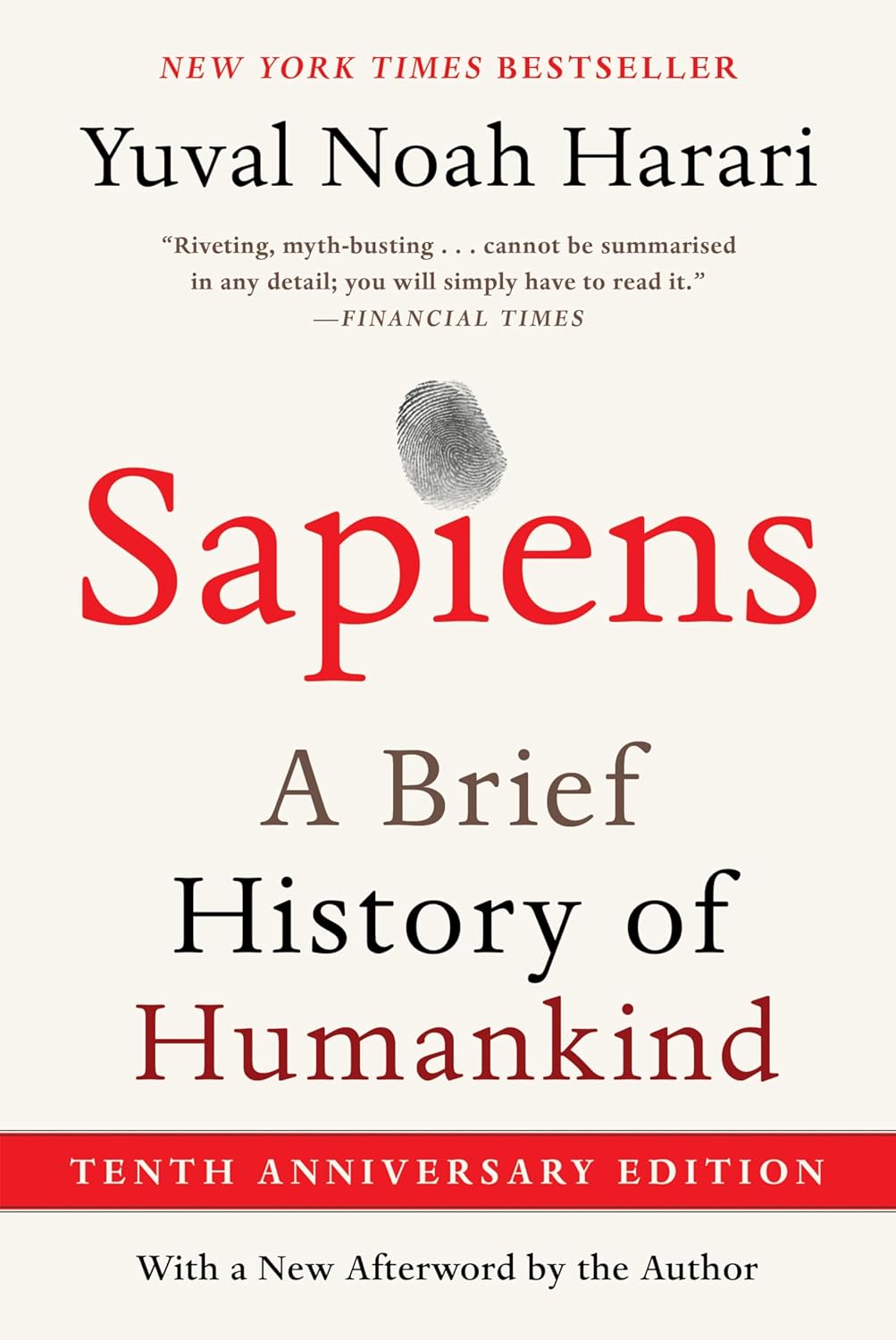
An Animal of No Significance
Summary:
About 70,000 years ago Homo sapiens underwent a Cognitive Revolution that enabled new modes of thought and communication. This shift from biological to cultural evolution allowed small bands of humans to cooperate flexibly and spread across the globe.
Key points:
- The Cognitive Revolution produced imagination, complex language, and the ability to share fictional stories.
- Biological differences between Homo sapiens and other humans were small; cultural changes produced large effects.
- Flexible cooperation among strangers became possible and crucial to Sapiens' expansion.
Themes & relevance:
Explains the origin of uniquely human capacities (fiction, large-scale cooperation) that underpin all later history. Understanding this helps explain how cultural systems can rapidly transform societies.
Takeaway / How to use:
Notice how shared stories and narratives enable cooperation and question what imagined orders you accept.
Key points
- The Cognitive Revolution produced imagination, complex language, and the ability to share fictional stories.
- Biological differences between Homo sapiens and other humans were small; cultural changes produced large effects.
- Flexible cooperation among strangers became possible and crucial to Sapiens' expansion.
The Tree of Knowledge
Summary:
Human language evolved not only for practical information but primarily to gossip and to communicate about things that do not exist. This ability to create and believe in shared fictions—religions, nations, laws—made large-scale human cooperation possible.
Key points:
- Language allowed transmission of information about social relations and reputations (gossip).
- Fictional realities (myths, gods, laws, corporations) enable millions to cooperate.
- Shared myths are not objectively true but are effective because many people believe them.
Themes & relevance:
Highlights the power of collective beliefs in shaping institutions and social order; relevant for understanding modern ideologies and institutions.
Takeaway / How to use:
Be conscious of which shared narratives shape your decisions and assess their real-world consequences.
Key points
- Language allowed transmission of information about social relations and reputations (gossip).
- Fictional realities (myths, gods, laws, corporations) enable millions to cooperate.
- Shared myths are not objectively true but are effective because many people believe them.
A Day in the Life of Adam and Eve
Summary:
Harari contrasts forager life with later agricultural life, describing typical daily activities, diet, social structures, and mobility of hunter-gatherer bands. He argues that many foragers enjoyed varied diets, social equality, and relatively ample leisure compared with early farmers.
Key points:
- Hunter
- gatherers had diverse diets and flexible subsistence strategies.
- Social life emphasized small
- group cooperation, sharing, and relative egalitarianism.
- Forager life was not harsh subsistence misery for most; agriculture later reshaped work and social hierarchy.
Themes & relevance:
Challenges romanticized vs. pessimistic views of forager life and reframes the Agricultural Revolution as a pivotal lifestyle change.
Takeaway / How to use:
Compare assumptions about progress against empirical evidence about well-being and workload.
Key points
- Hunter
- gatherers had diverse diets and flexible subsistence strategies.
- Social life emphasized small
- group cooperation, sharing, and relative egalitarianism.
- Forager life was not harsh subsistence misery for most; agriculture later reshaped work and social hierarchy.
The Flood
Summary:
This chapter examines the gradual processes that led humans to domesticate plants and animals and settle in fixed communities, initiating sweeping ecological and social changes. Domestication was a co-evolutionary process that reshaped species and human societies, often with unintended consequences.
Key points:
- Domestication was mutual adaptation: humans cultivated species and species adapted to humans.
- Settling and farming increased population density and disease transmission.
- The shift reorganized human diets, labor patterns, and relationships with other species.
Themes & relevance:
Shows how technological and economic shifts drive deep, often irreversible biological and social change.
Takeaway / How to use:
When adopting new technologies or practices, weigh long-term systemic impacts, not just immediate benefits.
Key points
- Domestication was mutual adaptation: humans cultivated species and species adapted to humans.
- Settling and farming increased population density and disease transmission.
- The shift reorganized human diets, labor patterns, and relationships with other species.
History's Biggest Fraud
Summary:
Harari argues the Agricultural Revolution was history's biggest fraud because it increased total food production and population but often reduced individual well-being. Farming demanded more labor, created health problems, and entrenched inequality while benefiting elites and expanding human numbers.
Key points:
- Agriculture boosted yields per land area but often worsened nutrition and health.
- Sedentary farming created property, inheritance, and class hierarchies.
- The apparent progress mainly benefited ruling classes and enabled empire
- building.
Themes & relevance:
Reframes 'progress' as complexity that can harm many while enriching a few; useful for critiquing simplistic assumptions about development.
Takeaway / How to use:
Question narratives of inevitable progress and analyze who actually benefits from major social changes.
Key points
- Agriculture boosted yields per land area but often worsened nutrition and health.
- Sedentary farming created property, inheritance, and class hierarchies.
- The apparent progress mainly benefited ruling classes and enabled empire
- building.
Building Pyramids
Summary:
Large-scale constructions, complex states, and monumental projects required new forms of organization and shared beliefs. Imagined orders—religions, laws, and ideologies—provided the glue for hierarchies and centralized power that could mobilize mass labor.
Key points:
- Monumental architecture symbolizes centralized authority and shared myths.
- Imagined orders legitimize hierarchies and coordinate large populations.
- Institutions like kingship, religion, and bureaucracy make mass cooperation feasible.
Themes & relevance:
Explores how ideological and institutional frameworks enable or constrain collective action and political power.
Takeaway / How to use:
Examine the narratives and institutions that legitimize authority in your society and how they shape collective priorities.
Key points
- Monumental architecture symbolizes centralized authority and shared myths.
- Imagined orders legitimize hierarchies and coordinate large populations.
- Institutions like kingship, religion, and bureaucracy make mass cooperation feasible.
Memory Overload
Summary:
As societies grew, oral communication and memory were insufficient; writing and record-keeping systems emerged to manage taxes, laws, and commerce. Information technologies transformed governance, economy, and historical consciousness.
Key points:
- Writing developed primarily for administration—keeping accounts, laws, and obligations.
- Record
- keeping enabled complex states, long-distance trade, and accumulated knowledge.
- New media changed power dynamics by enabling bureaucracy and historical narratives.
Themes & relevance:
Illustrates the social consequences of information technologies and the central role of data in state formation.
Takeaway / How to use:
Recognize how information systems shape incentives and institutional capacities and use better records to improve decisions.
Key points
- Writing developed primarily for administration—keeping accounts, laws, and obligations.
- Record
- keeping enabled complex states, long-distance trade, and accumulated knowledge.
- New media changed power dynamics by enabling bureaucracy and historical narratives.
There Is No Justice in History
Summary:
Harari examines how imagined orders produced persistent inequalities—class, gender, caste, and race—and how these hierarchies were justified by myths and institutions. He emphasizes that many social inequalities are not biologically ordained but constructed and sustained by shared beliefs.
Key points:
- Hierarchies became codified through legal, religious, and cultural norms.
- Justifications for inequality often rest on imagined categories rather than objective differences.
- Some progress has reduced injustices, but history shows persistent and shifting forms of domination.
Themes & relevance:
Encourages critical scrutiny of social hierarchies and the narratives that justify them, relevant to contemporary debates on equity.
Takeaway / How to use:
Challenge institutionalized inequalities by questioning the stories and structures that legitimize them.
Key points
- Hierarchies became codified through legal, religious, and cultural norms.
- Justifications for inequality often rest on imagined categories rather than objective differences.
- Some progress has reduced injustices, but history shows persistent and shifting forms of domination.
The Arrow of History
Summary:
Sapiens traces how human history has trended toward larger and more integrated units of political and economic organization — from bands and tribes to kingdoms, empires, and global systems. Harari argues that this unification has been driven less by inevitability than by shared imagined orders (money, law, religion) that enable cooperation on massive scales.
Key points:
- History’s “arrow” is toward increasing complexity and integration of human societies.
- Imagined orders (myths, legal codes, monetary systems) create scalable cooperation beyond kinship.
- Three major unifying forces are money, empires, and universal religions.
- Unification brings standardization and large
- scale peace but also cultural homogenization and domination.
Themes & relevance:
The chapter links long-term historical change to present
- day globalization, showing how human institutions evolved to knit disparate peoples together. It highlights that global unity is a process shaped by human inventions rather than a predetermined destiny.
Takeaway / How to use:
Recognize and evaluate the imagined orders that shape large-scale cooperation in your personal and civic life.
Key points
- History’s “arrow” is toward increasing complexity and integration of human societies.
- Imagined orders (myths, legal codes, monetary systems) create scalable cooperation beyond kinship.
- Three major unifying forces are money, empires, and universal religions.
- Unification brings standardization and large
- scale peace but also cultural homogenization and domination.
The Scent of Money
Summary:
Harari describes money as the most universal and efficient system of mutual trust ever invented: a flexible, impersonal medium that enables cooperation between strangers. He emphasizes that money’s power lies in a shared fiction — a collective belief that assigns value and enforces credit, exchange, and long-distance trade.
Key points:
- Money is an imagined universal fiction that converts trust into a practical mechanism for exchange.
- Its fungibility and neutrality allow large, anonymous markets to function.
- Credit systems and financial instruments expanded economic scale and complexity.
- Money underpins modern empires and cosmopolitan networks more reliably than kinship or religion.
Themes & relevance:
Understanding money as a shared belief system clarifies modern economic behavior and the fragility of financial trust. The chapter is relevant to contemporary debates about currency, credit, and the social basis of markets.
Takeaway / How to use:
Treat monetary systems as social constructs whose stability depends on collective trust and institutions.
Key points
- Money is an imagined universal fiction that converts trust into a practical mechanism for exchange.
- Its fungibility and neutrality allow large, anonymous markets to function.
- Credit systems and financial instruments expanded economic scale and complexity.
- Money underpins modern empires and cosmopolitan networks more reliably than kinship or religion.
Imperial Visions
Summary:
This chapter examines empires as the dominant political form that absorbed, structured, and standardized vast regions and peoples over millennia. Harari shows how empires spread languages, laws, infrastructures and often mixed coercion with pragmatic governance to create large, relatively stable orders.
Key points:
- Empires expand by offering a common framework of administration, law, and economic exchange.
- They are engines of cultural synthesis, technological diffusion, and bureaucratic organization.
- Empires can produce relative peace (pax) while also imposing violence, inequality, and cultural erasure.
- The notion of imperial rule evolved from conquest to legitimization through ideas and institutions.
Themes & relevance:
The chapter frames modern states and global institutions as heirs to imperial patterns of governance and integration. It underscores that many contemporary political structures are legacies of imperial administration and ideology.
Takeaway / How to use:
Study institutional legacies and power structures to better understand current geopolitical realities.
Key points
- Empires expand by offering a common framework of administration, law, and economic exchange.
- They are engines of cultural synthesis, technological diffusion, and bureaucratic organization.
- Empires can produce relative peace (pax) while also imposing violence, inequality, and cultural erasure.
- The notion of imperial rule evolved from conquest to legitimization through ideas and institutions.
The Law of Religion
Summary:
Harari explores how religions act as imagined orders that bind large groups by providing shared myths, moral codes, and rituals that legitimize social arrangements. He contrasts local cults with universal religions and shows how religion both unites and divides, often evolving to justify empires and laws.
Key points:
- Religions create moral and social cohesion through shared stories about order and purpose.
- Universal religions scale better than tribal cults because they transcend kinship and locality.
- Religious systems often adapt to, legitimize, or resist political and economic power.
- Syncretism and reinterpretation are common as religions spread and interact.
Themes & relevance:
Religion is portrayed as a potent cultural technology that shapes norms, law, and identity across large populations. The analysis remains relevant for understanding contemporary conflicts and ideological movements grounded in belief systems.
Takeaway / How to use:
Be aware of the moral narratives that underpin social institutions and how they influence behavior and policy.
Key points
- Religions create moral and social cohesion through shared stories about order and purpose.
- Universal religions scale better than tribal cults because they transcend kinship and locality.
- Religious systems often adapt to, legitimize, or resist political and economic power.
- Syncretism and reinterpretation are common as religions spread and interact.
The Secret of Success
Summary:
Harari argues that the surprising success of Homo sapiens rests on our unique capacity for flexible cooperation and the creation of shared myths that enable large-scale organization. He links biological capacities with cultural innovations to explain why some systems expand and dominate others.
Key points:
- Flexible, large
- scale cooperation distinguishes Sapiens from other species and enabled complex societies.
- Success often hinges on the creation and spread of compelling shared narratives (religion, law, money).
- Biological evolution and cultural invention interact to produce historical trajectories.
- Institutions that successfully coordinate large numbers of strangers gain demographic and military advantages.
Themes & relevance:
This chapter ties together cognitive and social explanations for human dominance, stressing the interplay of story-making and practical organization. It helps explain contemporary institutional effectiveness and cultural resilience.
Takeaway / How to use:
Leverage and critically examine the shared narratives that enable teamwork and coordination in organizations you participate in.
Key points
- Flexible, large
- scale cooperation distinguishes Sapiens from other species and enabled complex societies.
- Success often hinges on the creation and spread of compelling shared narratives (religion, law, money).
- Biological evolution and cultural invention interact to produce historical trajectories.
- Institutions that successfully coordinate large numbers of strangers gain demographic and military advantages.
The Discovery of Ignorance
Summary:
Harari describes the Scientific Revolution as a cultural shift that embraced ignorance as an opportunity: admitting we don’t know encouraged observation, experimentation, and the systematic pursuit of new knowledge. This new ethos fueled unprecedented technological and political change by prioritizing practical results over doctrinal certainty.
Key points:
- The Scientific Revolution began when scholars accepted ignorance and sought empirical answers.
- Science prioritized observation, mathematics, and the testing of hypotheses to produce reliable knowledge.
- This mindset enabled rapid technological progress and transformed economies and militaries.
- Science’s success depended on institutions that funded research and valued results (e.g., state and commercial interests).
Themes & relevance:
The chapter links the epistemic shift of modernity to the practical transformations that shape our world, from industry to medicine. It underscores that curiosity plus institutional support can produce transformative change.
Takeaway / How to use:
Cultivate a mindset that questions assumptions and tests ideas empirically in your work and decisions.
Key points
- The Scientific Revolution began when scholars accepted ignorance and sought empirical answers.
- Science prioritized observation, mathematics, and the testing of hypotheses to produce reliable knowledge.
- This mindset enabled rapid technological progress and transformed economies and militaries.
- Science’s success depended on institutions that funded research and valued results (e.g., state and commercial interests).
The Marriage of Science and Empire
Summary:
Harari shows how science and imperialism formed a feedback loop: empires financed exploration and technological innovation, while scientific advances expanded imperial reach and effectiveness. This partnership accelerated global conquest, extraction, and the spread of European power.
Key points:
- Empires provided resources, political backing, and practical problems that spurred scientific research.
- Scientific tools (navigation, medicine, weaponry) enabled imperial expansion and colonial administration.
- Knowledge production was often tied to economic and military objectives rather than pure curiosity.
- The entanglement produced both technological progress and exploitation of colonized peoples.
Themes & relevance:
The chapter highlights how power and knowledge are mutually reinforcing, shaping the modern world and inequalities that persist today. It calls attention to the ethical and historical costs of scientific and imperial projects.
Takeaway / How to use:
Critically assess how institutional incentives shape research priorities and the social consequences of technological advances.
Key points
- Empires provided resources, political backing, and practical problems that spurred scientific research.
- Scientific tools (navigation, medicine, weaponry) enabled imperial expansion and colonial administration.
- Knowledge production was often tied to economic and military objectives rather than pure curiosity.
- The entanglement produced both technological progress and exploitation of colonized peoples.
The Capitalist Creed
Summary:
Harari examines capitalism as a faith in future growth and credit, a system that transforms money, investment, and consumerism into engines of continual expansion. He traces how belief in perpetual economic growth reshaped institutions, values, and human desires.
Key points:
- Capitalism is built on trust in credit and the expectation of continuous economic growth.
- It channels savings into investments, fueling industrial expansion and consumer markets.
- Capitalism reshapes human priorities, promoting productivity, innovation, and consumerist lifestyles.
- The system’s success depends on faith in future returns and can produce instability and inequality.
Themes & relevance:
The chapter connects economic doctrines to cultural change, showing how capitalist incentives drive both progress and social disruption. It’s relevant for understanding contemporary debates about growth, sustainability, and social welfare.
Takeaway / How to use:
Think critically about short-term gains versus long
- term sustainability when making financial or organizational decisions.
Key points
- Capitalism is built on trust in credit and the expectation of continuous economic growth.
- It channels savings into investments, fueling industrial expansion and consumer markets.
- Capitalism reshapes human priorities, promoting productivity, innovation, and consumerist lifestyles.
- The system’s success depends on faith in future returns and can produce instability and inequality.
Chapter 17: The Discovery of Ignorance
Summary:
The chapter explains how the Scientific Revolution began when European intellectuals embraced the idea that admitting ignorance and seeking empirical evidence were productive attitudes. This shift from relying on tradition to systematic observation and experimentation set the stage for rapid technological and intellectual change.
Key points:
- Science began as an acknowledgment of ignorance and a commitment to finding out answers empirically.
- Practical problems (navigation, medicine, taxation, warfare) drove investment in scientific inquiry and instruments.
- New methods emphasized observation, experimentation, and mathematics over deference to received authorities.
- Institutions (universities, academies, and state
- sponsored research) helped transform isolated discoveries into cumulative knowledge.
Themes & relevance:
This chapter highlights intellectual humility and methodological change as catalysts for modern progress, showing how admitting what we don't know enables discovery. Its relevance lies in understanding why evidence-based thinking underpins contemporary technology and policy.
Takeaway / How to use:
Adopt a curiosity-driven, evidence
- first approach: ask what you don’t know and test assumptions with observation or experiment.
Key points
- Science began as an acknowledgment of ignorance and a commitment to finding out answers empirically.
- Practical problems (navigation, medicine, taxation, warfare) drove investment in scientific inquiry and instruments.
- New methods emphasized observation, experimentation, and mathematics over deference to received authorities.
- Institutions (universities, academies, and state
- sponsored research) helped transform isolated discoveries into cumulative knowledge.
Chapter 18: The Marriage of Science and Empire
Summary:
Harari describes how science and imperial expansion became mutually reinforcing: empires funded and benefited from scientific research, while scientific tools (maps, classification systems, weaponry) enabled imperial control and resource extraction. Knowledge collection—about plants, peoples, and geography—became an instrument of power and profit.
Key points:
- Imperial states and commercial enterprises provided funding, data, and practical problems that accelerated scientific advances.
- Scientific practices (surveying, taxonomy, cartography) were put to work to exploit resources and govern colonies.
- The flow of information and specimens from colonies into European institutions created global systems of knowledge and commerce.
- Military and navigational technologies illustrate how scientific progress translated directly into geopolitical power.
Themes & relevance:
This chapter examines the political and economic incentives that shaped scientific agendas, reminding us that knowledge production is rarely neutral. It’s relevant for evaluating how current research priorities reflect powerful interests.
Takeaway / How to use:
Be aware of who funds and benefits from research and consider how incentives shape what knowledge gets produced.
Key points
- Imperial states and commercial enterprises provided funding, data, and practical problems that accelerated scientific advances.
- Scientific practices (surveying, taxonomy, cartography) were put to work to exploit resources and govern colonies.
- The flow of information and specimens from colonies into European institutions created global systems of knowledge and commerce.
- Military and navigational technologies illustrate how scientific progress translated directly into geopolitical power.
Chapter 19: The Capitalist Creed
Summary:
The chapter traces how capitalism emerged as a dominant economic ideology centered on credit, growth, and faith in the future, enabling large-scale investment and the creation of modern corporations. Harari emphasizes that capitalism is sustained by shared beliefs—trust in contracts, markets, and the expectation of continuous growth.
Key points:
- The invention and spread of credit and financial instruments made large
- scale investment possible.
- Joint
- stock companies and limited liability allowed pooling of capital and diffusion of risk.
- Capitalism depends on collective faith in future profitability and institutions that enforce contracts.
- Profit
- seeking motivated technological innovation and expanded markets, but also introduced new risks and inequalities.
Themes & relevance:
This chapter frames capitalism as a system built on intersubjective trust and future-oriented expectations, illuminating why financial crises and debates about regulation persist. It helps explain modern economic behavior and the social power of market institutions.
Takeaway / How to use:
Evaluate economic decisions by considering long-term incentives and the institutional structures that enable trust and investment.
Key points
- The invention and spread of credit and financial instruments made large
- scale investment possible.
- Joint
- stock companies and limited liability allowed pooling of capital and diffusion of risk.
- Capitalism depends on collective faith in future profitability and institutions that enforce contracts.
- Profit
- seeking motivated technological innovation and expanded markets, but also introduced new risks and inequalities.
Chapter 20: The Wheels of Industry
Summary:
Harari discusses the Industrial Revolution’s transformation of production through mechanization, fossil-fuel energy, and factory systems, which dramatically increased material output and reshaped societies. He links mass production to the rise of consumer culture, urbanization, and profound environmental consequences.
Key points:
- Harnessing coal and later oil multiplied available energy and enabled continuous industrial
- scale production.
- Factories centralized labor, accelerating urban growth and changing social relations and family life.
- Mass production lowered costs and fueled new markets and consumer habits, supported by advertising and credit.
- Industrialization raised living standards for many but created environmental degradation and new forms of social inequality.
Themes & relevance:
This chapter connects technological and economic change to social transformation and ecological limits, underscoring trade-offs between prosperity and sustainability. It’s relevant for debates on climate, consumption, and equitable development.
Takeaway / How to use:
Prioritize sustainable energy and consumption choices to balance material well-being with long
- term environmental health.
Key points
- Harnessing coal and later oil multiplied available energy and enabled continuous industrial
- scale production.
- Factories centralized labor, accelerating urban growth and changing social relations and family life.
- Mass production lowered costs and fueled new markets and consumer habits, supported by advertising and credit.
- Industrialization raised living standards for many but created environmental degradation and new forms of social inequality.