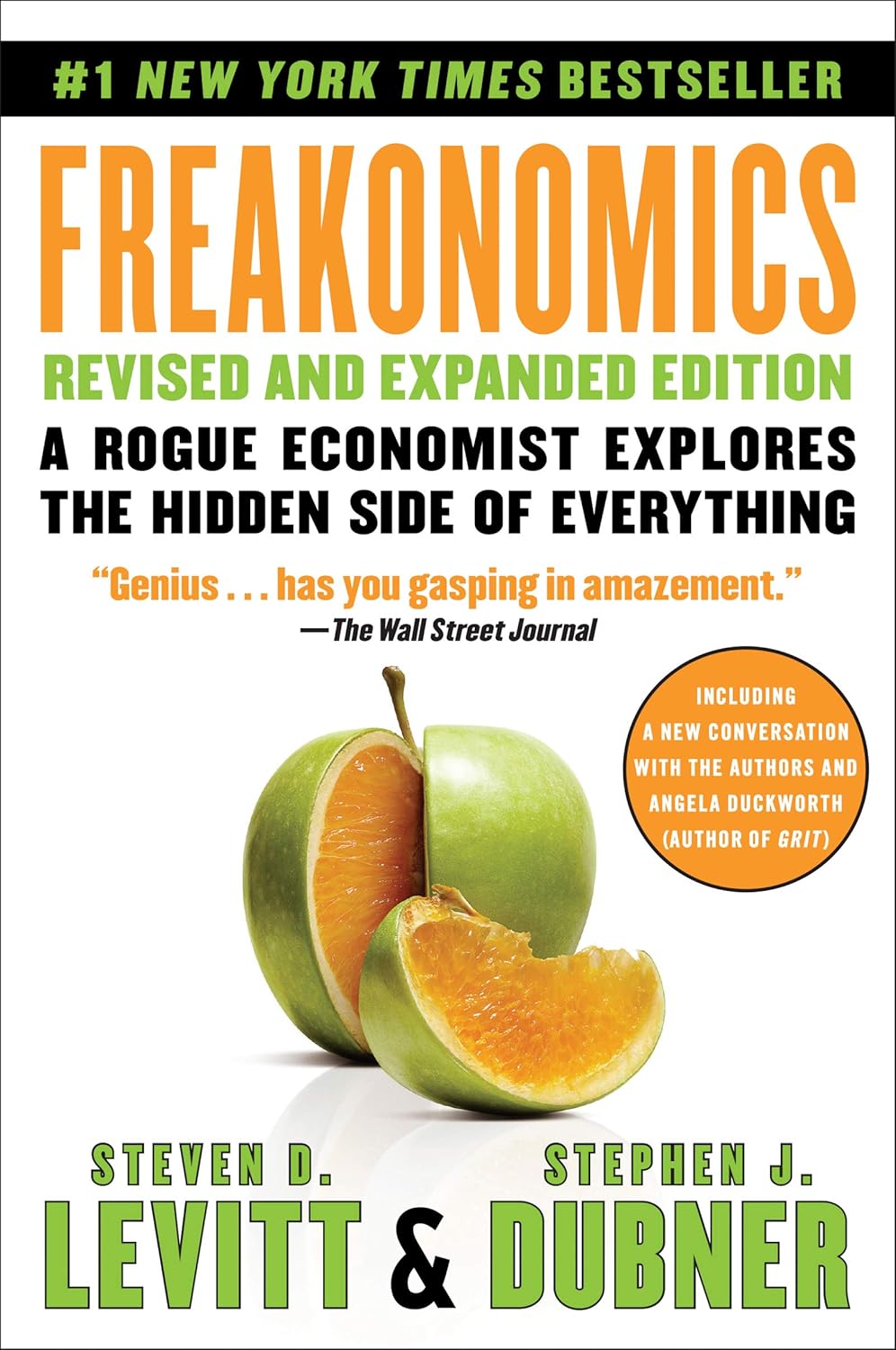
Freakonomics: A Rogue Economist Explores the Hidden Side of Everything: ReadSprint summary highlights
ReadSprint paraphrases for review. These highlights are not verbatim quotations from the book or its author. Check the original edition for exact wording and context.
Freakonomics: A Rogue Economist Explores the Hidden Side of Everything
by Steven D. Levitt & Stephen J. Dubner
Levitt and Dubner open by showing how incentives shape behavior, using detectives-in the-data to uncover cheating among Chicago public school teachers and match fixing among sumo wrestlers.
ReadSprint paraphrase · Not a quotation from the author.
Levitt and Dubner open by showing how incentives shape behavior, using detectives-in the-data to uncover cheating among Chicago public school teachers and match fixing among sumo wrestlers.
Incentives (financial, reputational, career) strongly influence individual behavior.
Share with the ReadSprint source so others can read the context.
Freakonomics: A Rogue Economist Explores the Hidden Side of Everything
by Steven D. Levitt & Stephen J. Dubner
They demonstrate that subtle statistical patterns can reveal powerful incentives and perverse behaviors.
ReadSprint paraphrase · Not a quotation from the author.
They demonstrate that subtle statistical patterns can reveal powerful incentives and perverse behaviors.
Unusual statistical patterns (e.g., improbable test
Share with the ReadSprint source so others can read the context.
Freakonomics: A Rogue Economist Explores the Hidden Side of Everything
by Steven D. Levitt & Stephen J. Dubner
This chapter explores how information asymmetry and incentives shape organizations, comparing the secretive, membership-driven KKK (and how secrecy and disclosure affect power) with the ways real estate agents can act on private informatio…
ReadSprint paraphrase · Not a quotation from the author.
This chapter explores how information asymmetry and incentives shape organizations, comparing the secretive, membership-driven KKK (and how secrecy and disclosure affect power) with the ways real estate agents can act on private information to benefit themselves.
score gains or win-loss streaks) can reveal cheating or manipulation.
Share with the ReadSprint source so others can read the context.
Freakonomics: A Rogue Economist Explores the Hidden Side of Everything
by Steven D. Levitt & Stephen J. Dubner
Levitt uses data and records to show how access to information and the incentives of intermediaries change outcomes for principals.
ReadSprint paraphrase · Not a quotation from the author.
Levitt uses data and records to show how access to information and the incentives of intermediaries change outcomes for principals.
Careful data analysis can detect behavior that direct observation or anecdotes miss.
Share with the ReadSprint source so others can read the context.
Freakonomics: A Rogue Economist Explores the Hidden Side of Everything
by Steven D. Levitt & Stephen J. Dubner
Levitt examines the economics of drug-dealing organizations, showing they resemble corporations with steep hierarchies where most street level dealers earn very little while a few at the top reap large rewards.
ReadSprint paraphrase · Not a quotation from the author.
Levitt examines the economics of drug-dealing organizations, showing they resemble corporations with steep hierarchies where most street level dealers earn very little while a few at the top reap large rewards.
Correlation can suggest hypotheses but must be tested for alternative explanations.
Share with the ReadSprint source so others can read the context.
Freakonomics: A Rogue Economist Explores the Hidden Side of Everything
by Steven D. Levitt & Stephen J. Dubner
Ethnographic and quantitative evidence explain why low-level dealers tolerate high risks and how organizational structure sustains the trade.
ReadSprint paraphrase · Not a quotation from the author.
Ethnographic and quantitative evidence explain why low-level dealers tolerate high risks and how organizational structure sustains the trade.
Look for incentive structures and statistical anomalies when evaluating performance claims.
Share with the ReadSprint source so others can read the context.
Freakonomics: A Rogue Economist Explores the Hidden Side of Everything
by Steven D. Levitt & Stephen J. Dubner
Levitt tackles the large crime decline of the 1990s and uses empirical methods to evaluate possible causes, controversially arguing that legalized abortion (following Roe v.
ReadSprint paraphrase · Not a quotation from the author.
Levitt tackles the large crime decline of the 1990s and uses empirical methods to evaluate possible causes, controversially arguing that legalized abortion (following Roe v.
The chapter highlights that human behavior often follows predictable incentive structures and that economists can use data to expose hidden actions; this is relevant across education, sports, business, and policy.
Share with the ReadSprint source so others can read the context.
Freakonomics: A Rogue Economist Explores the Hidden Side of Everything
by Steven D. Levitt & Stephen J. Dubner
Wade) significantly reduced the pool of high-risk births and thus later crime.
ReadSprint paraphrase · Not a quotation from the author.
Wade) significantly reduced the pool of high-risk births and thus later crime.
Levitt and Dubner open by showing how incentives shape behavior, using detectives-in the-data to uncover cheating among Chicago public school teachers and match fixing among sumo wrestlers. They demonstrate that subtle statistical patterns can reveal powerful incentives and perverse behaviors.
Share with the ReadSprint source so others can read the context.
Freakonomics: A Rogue Economist Explores the Hidden Side of Everything
by Steven D. Levitt & Stephen J. Dubner
He weighs other factors—policing, incarceration, economy, lead reduction—but emphasizes the value of testing competing explanations with data.
ReadSprint paraphrase · Not a quotation from the author.
He weighs other factors—policing, incarceration, economy, lead reduction—but emphasizes the value of testing competing explanations with data.
Information asymmetry gives intermediaries (whether clandestine groups or brokers) power over principals.
Share with the ReadSprint source so others can read the context.
Freakonomics: A Rogue Economist Explores the Hidden Side of Everything
by Steven D. Levitt & Stephen J. Dubner
Using large datasets, Levitt and Dubner investigate which parenting choices correlate with better outcomes (test scores, behavior), finding that many commonly touted practices have small or no measurable effects compared with background fa…
ReadSprint paraphrase · Not a quotation from the author.
Using large datasets, Levitt and Dubner investigate which parenting choices correlate with better outcomes (test scores, behavior), finding that many commonly touted practices have small or no measurable effects compared with background factors like parental education and socioeconomic status.
Transparency and disclosure can undercut organizations built on secrecy or manipulation.
Share with the ReadSprint source so others can read the context.