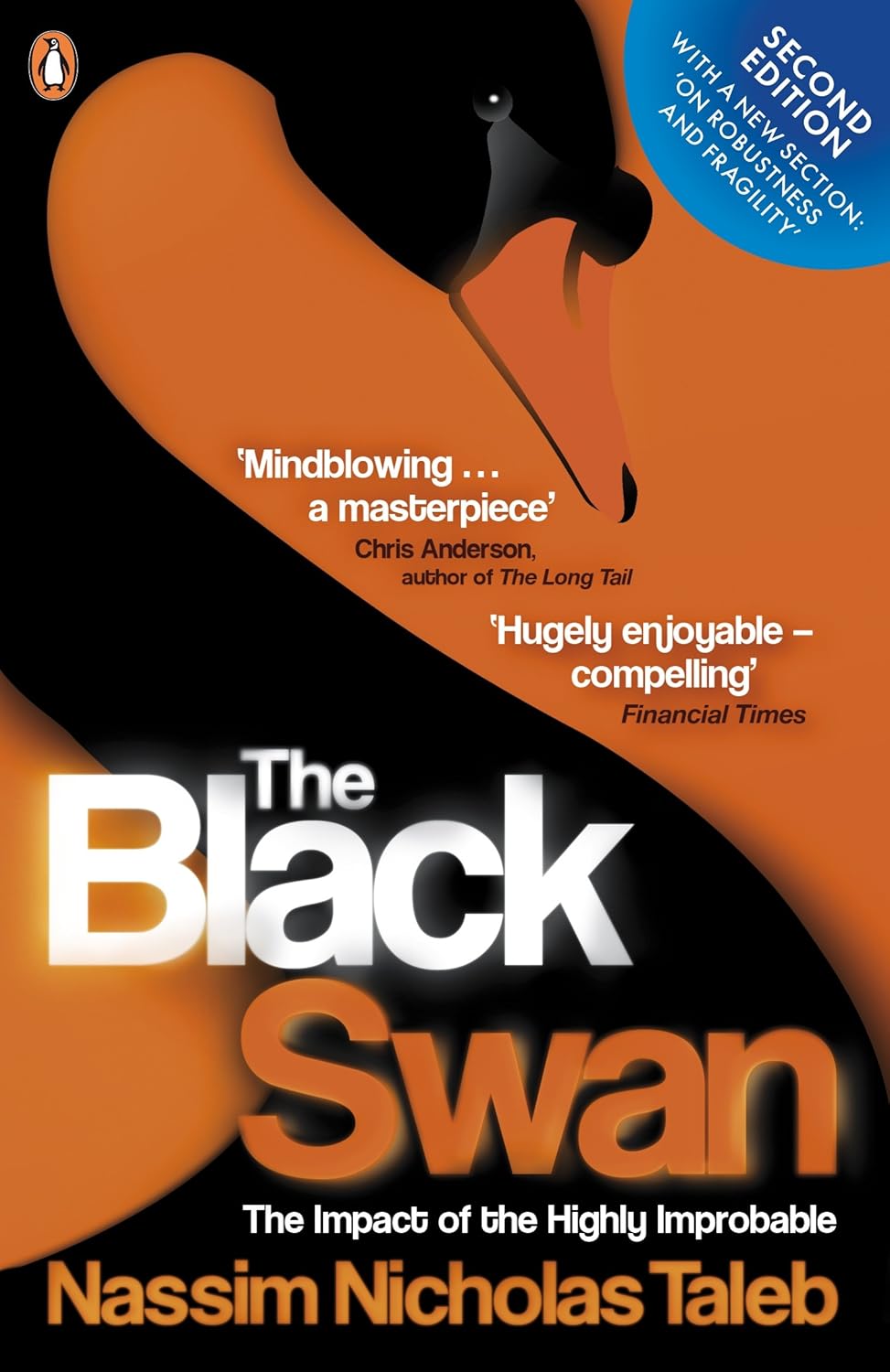
The Black Swan: The Impact of the Highly Improbable: ReadSprint summary highlights
ReadSprint paraphrases for review. These highlights are not verbatim quotations from the book or its author. Check the original edition for exact wording and context.
The Black Swan: The Impact of the Highly Improbable
by Nassim Nicholas Taleb
Taleb introduces the concept of the Black Swan: a highly improbable, unpredictable event with massive impact, which people attempt to explain after the fact.
ReadSprint paraphrase · Not a quotation from the author.
Taleb introduces the concept of the Black Swan: a highly improbable, unpredictable event with massive impact, which people attempt to explain after the fact.
A Black Swan is defined by rarity, extreme impact, and retrospective (but not prospective) predictability.
Share with the ReadSprint source so others can read the context.
The Black Swan: The Impact of the Highly Improbable
by Nassim Nicholas Taleb
He explains why such events shape history and why traditional knowledge and forecasting underestimate their importance.
ReadSprint paraphrase · Not a quotation from the author.
He explains why such events shape history and why traditional knowledge and forecasting underestimate their importance.
Human psychology tends to narrate and simplify, making rare events seem explainable after they occur.
Share with the ReadSprint source so others can read the context.
The Black Swan: The Impact of the Highly Improbable
by Nassim Nicholas Taleb
Taleb recounts his background—intellectual formation across disciplines and experiences in trading—that shaped his skepticism of experts and models.
ReadSprint paraphrase · Not a quotation from the author.
Taleb recounts his background—intellectual formation across disciplines and experiences in trading—that shaped his skepticism of experts and models.
Classical probabilistic and forecasting methods ignore or minimize the role of rare, high
Share with the ReadSprint source so others can read the context.
The Black Swan: The Impact of the Highly Improbable
by Nassim Nicholas Taleb
He contrasts theoretical knowledge with real-world exposure to randomness and rare events.
ReadSprint paraphrase · Not a quotation from the author.
He contrasts theoretical knowledge with real-world exposure to randomness and rare events.
impact events.
Share with the ReadSprint source so others can read the context.
The Black Swan: The Impact of the Highly Improbable
by Nassim Nicholas Taleb
Taleb argues that many domains are fundamentally unpredictable because they are dominated by rare, high-impact events and nonlinearities.
ReadSprint paraphrase · Not a quotation from the author.
Taleb argues that many domains are fundamentally unpredictable because they are dominated by rare, high-impact events and nonlinearities.
Pay attention to rare, high-impact possibilities and avoid overreliance on standard predictive models.
Share with the ReadSprint source so others can read the context.
The Black Swan: The Impact of the Highly Improbable
by Nassim Nicholas Taleb
He critiques the illusion of predictability fostered by past success and small sample observations.
ReadSprint paraphrase · Not a quotation from the author.
He critiques the illusion of predictability fostered by past success and small sample observations.
Taleb sets the stage for rethinking risk, uncertainty, and how we interpret history and science; this framing is relevant to finance, policy, and personal decisions.
Share with the ReadSprint source so others can read the context.
The Black Swan: The Impact of the Highly Improbable
by Nassim Nicholas Taleb
Taleb describes the narrative fallacy: humans construct simple, coherent stories to explain complex events, which creates an illusion of understanding.
ReadSprint paraphrase · Not a quotation from the author.
Taleb describes the narrative fallacy: humans construct simple, coherent stories to explain complex events, which creates an illusion of understanding.
Taleb introduces the concept of the Black Swan: a highly improbable, unpredictable event with massive impact, which people attempt to explain after the fact. He explains why such events shape history and why traditional knowledge and forecasting underestimate their importance.
Share with the ReadSprint source so others can read the context.
The Black Swan: The Impact of the Highly Improbable
by Nassim Nicholas Taleb
This tendency leads to overconfidence and misinterpretation of randomness.
ReadSprint paraphrase · Not a quotation from the author.
This tendency leads to overconfidence and misinterpretation of randomness.
Personal anecdotes illustrate how theory can fail when confronted with real randomness.
Share with the ReadSprint source so others can read the context.
The Black Swan: The Impact of the Highly Improbable
by Nassim Nicholas Taleb
Taleb introduces the ludic fallacy: the inappropriate application of simplistic, game-like models to complex real world problems.
ReadSprint paraphrase · Not a quotation from the author.
Taleb introduces the ludic fallacy: the inappropriate application of simplistic, game-like models to complex real world problems.
Practical experience in markets revealed the outsized impact of rare events on outcomes.
Share with the ReadSprint source so others can read the context.
The Black Swan: The Impact of the Highly Improbable
by Nassim Nicholas Taleb
He shows that structured, closed-form models fail to capture open ended uncertainty and rare events.
ReadSprint paraphrase · Not a quotation from the author.
He shows that structured, closed-form models fail to capture open ended uncertainty and rare events.
Intellectual humility and cross
Share with the ReadSprint source so others can read the context.